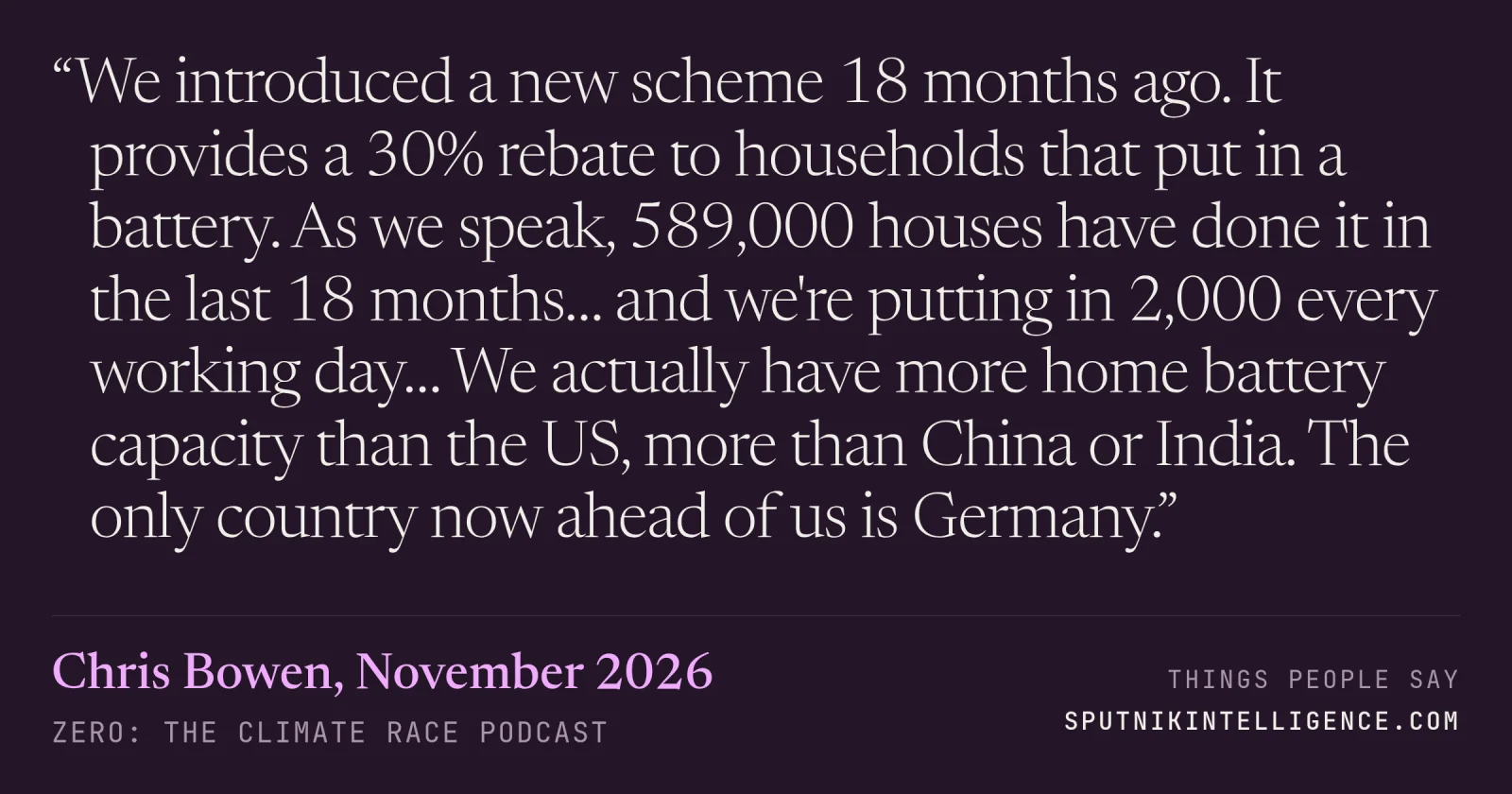
Asked how Australia can bring credibility to COP31, Bowen gives the figures for its home battery rebate. He says he hopes Australia will overtake Germany soon.
…take investment at scale. That's why Iberdrola has committed two-thirds of its capex toward building smarter, more resilient networks. Because generating more electricity is only part of the challenge. As demand grows, the future needs a grid capable of delivering it. Find out more at eBadrola.com.
…comes to the total amount of batteries installed in the country. If you rank it, it's China, US, and then Australia, which is not a populous country compared to the other two. What is the recipe of success that you think you can take to COP31 to share with other countries that they can replicate?
…and it's from a standing start. So we introduced a new scheme 18 months ago. It came into force on the 1st of July 2025, which in effect, it's a little bit more complicated than this, but for the sake of this conversation, provides a 30% rebate to households that put in a battery. Now, as we speak, 589,000 houses have done it in the last 18 months. By the time this goes to air, it'll be 600,000. And we're putting in 2,000 every working day, every weekday. That's Australians getting on with it. And one small difference to what you said is what you said about Australia in battery rankings is correct on utility scale. So we're doing it big scales as well. So it's China, US and us on utility scale batteries. But on home batteries, it's slightly different. We actually have more home battery capacity than the US. despite our much…
But what is the formula for success here? There's the policy support, there's subsidies to, you know, installing a battery at home or providing some feed-in tariff on solar. Lots of countries do that. What is it that Australia has done differently that allows you to unlock more?
I think it's a combination of things. It is the, so we have what we call the small-scale renewable energy scheme, which does provide rebates for both solar and batteries. It's lasted a lot longer for solar, came in in 2000 for solar, only in 2025 for batteries. That's important. And you can see…
It is a challenge in communication where the hero narrative is something that, you know, people are easy to grasp where, oh, one man did something or one woman did something and thus something happened or one policy came out and as a result, bang, we have all this. But really, the implementation…