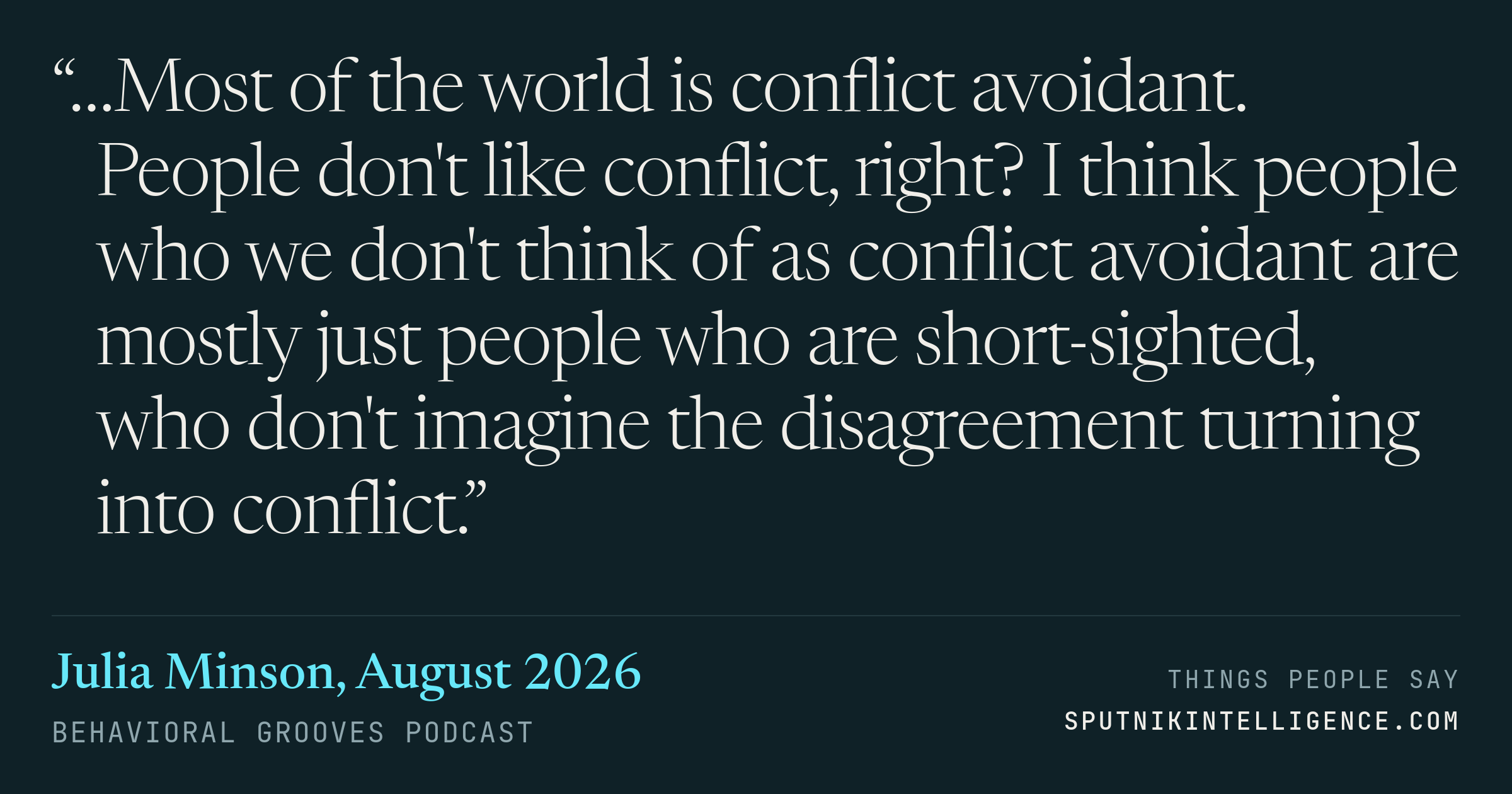
Minson is responding to the hosts describing themselves as conflict-avoidant Midwesterners, and notes that nearly everyone she meets has a story about why they personally avoid conflict: being a woman, a Canadian, a Midwesterner. She flags the claim as conjecture she has not measured globally, then inverts the usual framing. On her account the people who look comfortable with conflict are not braver, just not seeing where the disagreement leads.
You know, so I have a framework that I offer in the book that's based on my work with Charlie Dorris, where we basically say, look, for disagreement to become conflict, there are three factors that make disagreement more likely to become conflict. One is that the topic, the decision, the set of beliefs has to be important. It has to be consequential, right? And if you think about it, if you're a sports fan, which team is better than which other team doesn't actually have tangible consequences to your life. And even more so, what the other person believes doesn't have consequences, right? Like you might be sort of heartbroken, if the Celtics don't do well. But what some other guy believes about the Celtics is not actually going to impact how well they do. So kind of like the consequences of the disagreement matter. And so that would be very different than if you are a team owner or a team manager or a team coach, because now we're still talking about sports, but there are consequences because this is your work. You know, the other piece, so that's sort of consequentiality is one factor, importance. And then the other factor is how interdependent you are with the other person. So does their beliefs actually change your outcomes? Right. And so I often sort of use the example of, you know, COVID vaccines. Right. So if some stranger somewhere doesn't want to get vaccinated for COVID, I might disagree with them and it is consequential and it is sort of societally important, but it's not going to change my life. Right. If it's a person in my family who doesn't want to get vaccinated for COVID, well, that's now very, very different. Right. And then the third factor sort of is how much do the people involved believe that they have evidence on their side. Right. And so again, with, you know, we talk, you know, we talk about how there's no accounting for taste, right? You're not supposed to argue about matters of taste because people appreciate the fact that there is no evidence. But if I feel like science is on my side or morality is on my side or the word of God is on my side, then it's very, very hard to put up with the fact that, you know, a different person, you know, won't cede their point. And so if you have those three things all happening at once, the topic is important, our behavior is interdependent, and I think that the ultimate evidence is on my side, then we are very likely to have a difficult conversation.
Yeah. So context matters in these situations. It's situationally specific.
Yes. Yes. Context matters hugely, you know, and I think this is like the thing that people talk about. You know, you have brought up being Midwesterners that are conflict avoidant. I have a lot of conversations with a lot of people who say they're conflict avoidant. And they always have like a story about why they're conflict avoidant. Like, well, I'm a woman, so I'm conflict avoidant. You know, I'm a Midwesterner, so I'm conflict avoidant. I'm a Canadian, right? So I'm conflict avoidant, right? We all have like these stereotypes, but my theory, and you know, haven't measured this like globally, so this is conjecture. Most of the world is conflict avoidant. People don't like conflict, right? I think people who we don't think of as conflict avoidant are mostly just people who are short-sighted, who don't imagine the disagreement turning into conflict.
Right.
In other words, like they just don't see around the corner. No,
wow.