 Julia Minson
Studies why people disagree badly and what changes when they don't, focusing on the gap between how conflict-avoidant people believe they are and what actually...
Julia Minson
Studies why people disagree badly and what changes when they don't, focusing on the gap between how conflict-avoidant people believe they are and what actually...
“…Most of the world is conflict avoidant. People don't like conflict, right? I think people who we don't think of as conflict avoidant are mostly just people who are short-sighted, who don't imagine the disagreement turning into conflict.”
Behavioral Grooves Podcast · August 2026
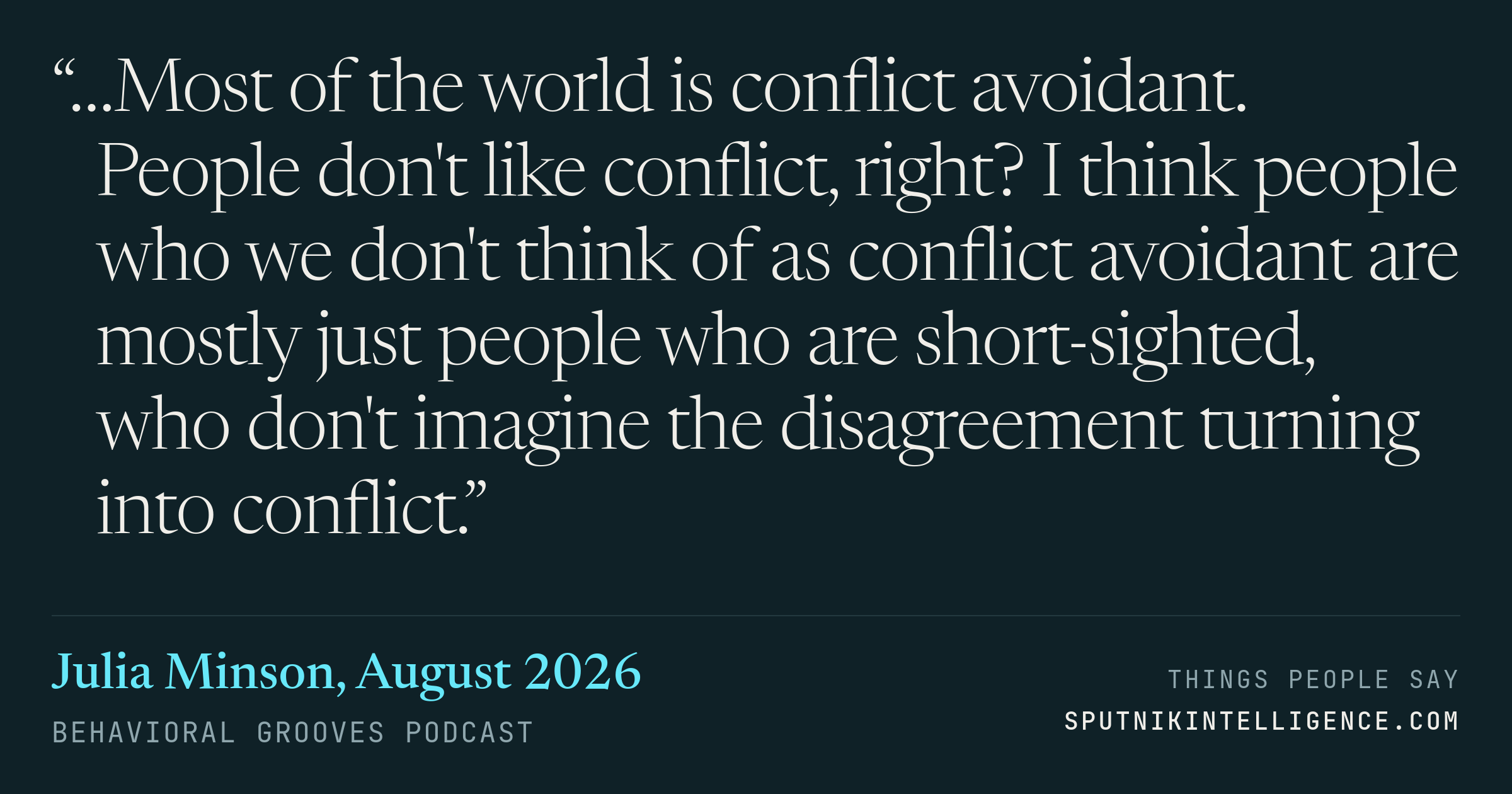
Minson is responding to the hosts describing themselves as conflict-avoidant Midwesterners, and notes that nearly everyone she meets has a story about why they personally avoid conflict: being a woman, a Canadian, a Midwesterner. She flags the claim as conjecture she has not measured globally, then inverts the usual framing. On her account the people who look comfortable with conflict are not braver, just not seeing where the disagreement leads.
Transcript
…that, you know, a different person, you know, won't cede their point. And so if you have those three things all happening at once, the topic is important, our behavior is interdependent, and I think that the ultimate evidence is on my side, then we are very likely to have a difficult conversation.
Yeah. So context matters in these situations. It's situationally specific.
Yes. Yes. Context matters hugely, you know, and I think this is like the thing that people talk about. You know, you have brought up being Midwesterners that are conflict avoidant. I have a lot of conversations with a lot of people who say they're conflict avoidant. And they always have like a story about why they're conflict avoidant. Like, well, I'm a woman, so I'm conflict avoidant. You know, I'm a Midwesterner, so I'm conflict avoidant. I'm a Canadian, right? So I'm conflict avoidant, right? We all have like these stereotypes, but my theory, and you know, haven't measured this like globally, so this is conjecture. Most of the world is conflict avoidant. People don't like conflict, right? I think people who we don't think of as conflict avoidant are mostly just people who are short-sighted, who don't imagine the disagreement turning into conflict.
Right.
In other words, like they just don't see around the corner. No,
wow.
More from Behavioral Grooves Podcast