 Charles Duhigg
Author of The Power of Habit and Supercommunicators, and journalist at The New Yorker Magazine (and previously at the New York Times.) Also, for one terrifying...
Charles Duhigg
Author of The Power of Habit and Supercommunicators, and journalist at The New Yorker Magazine (and previously at the New York Times.) Also, for one terrifying...
“There's no one on this planet who goes for a run in the morning and they're like, oh, I'm going to keep my Amex in my pocket today, right? Like the cause effect there doesn't make any sense. But it seems to be a consistent pattern that when you start creating new exercise habits ... it makes other habits more malleable and easier to change.”
Behavioral Grooves Podcast · October 2026
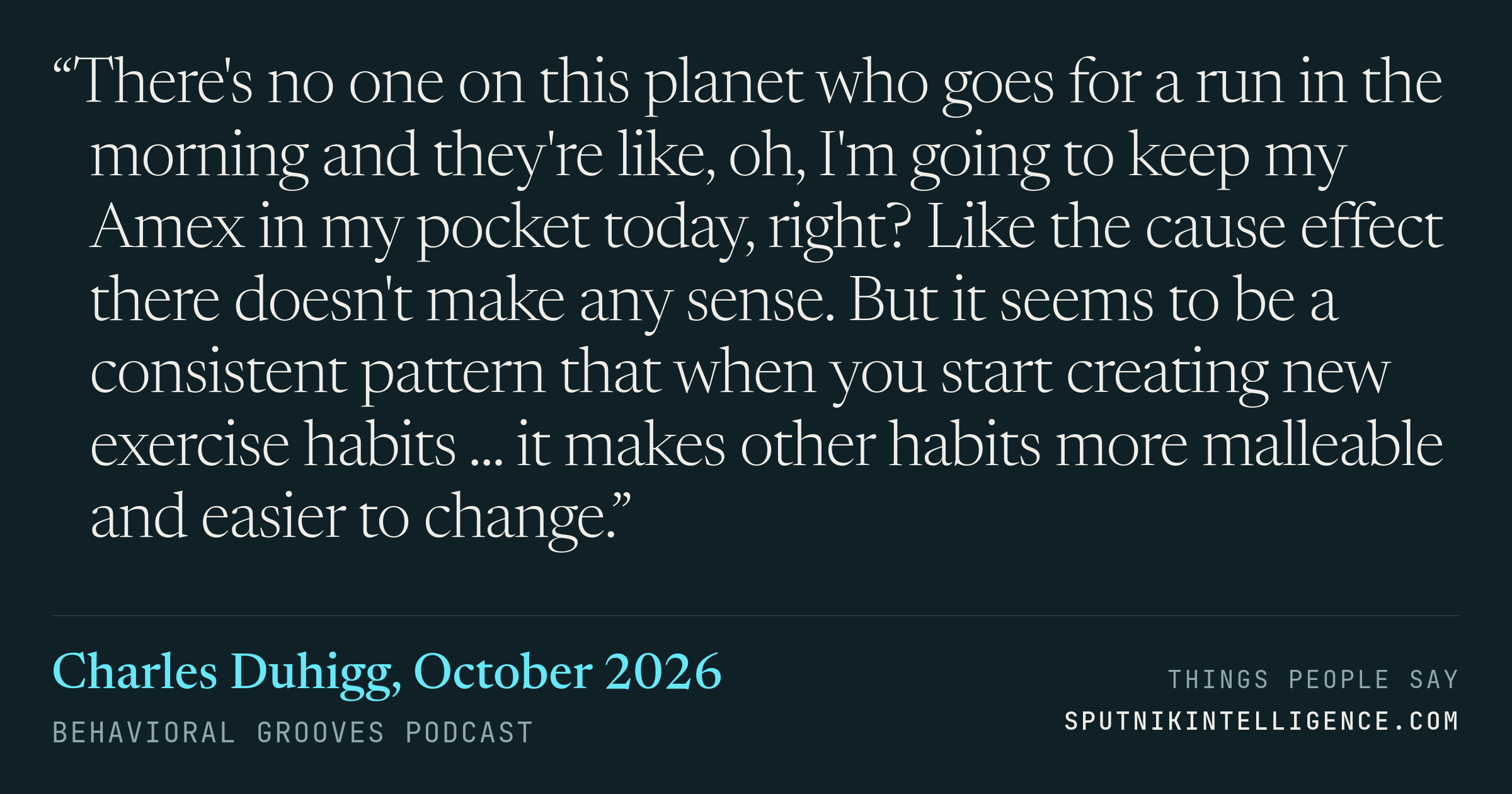
Duhigg is explaining keystone habits. He has just cited research finding that on days people exercise they use their credit cards less and procrastinate less at work. His own explanation is that exercising changes how you see yourself.
Transcript
It's a great resource. And so, a lot of what a lot of this kind of idea of the habit window comes from that research. And what they found looking at users of GLP-1s is that when you start using the GLP-1, you get this moment when the food noise kind of quiets and it doesn't happen right away, right? Like people who take GLP-1s, you don't lose weight at first. It takes a little while to kind of reprogram your behavior. But at some point, at some point, the window opens and your habits become much more malleable because you're aware of the cues and the rewards in your environment. Because you have the freedom. Some of the cues have been quieted and some of the rewards are less rewarding. You have the freedom to build new habits deliberately. You have this opportunity to sort of reprogram your behavior. Now, what's interesting is that the window does close at some point, right? What we found is that there is this, and it can be, you know, up to a couple years, but there is this period where forming new habits is really important because for two reasons. First of all, at some point, even if you're on the GLP-1, it seems to get harder to form new habits. And you can do things. You can change dosage to influence that, et cetera. But for most people, the goal of a GLP-1 is not to be on a GLP-1 your entire life. Now, we know that for the average population taking GLP-1s, their weight gain begins almost immediately after discontinuing the medication, right? They usually have regained all of the weight within 18 months. But for people who undergo a structured habit change system like Noom or habit reversal therapy or something like that, what we found in that sample population is that up to 80% of them keep the weight off for at least a year and a half. And so I think what that's telling us is phase one of GLP-1 use was the GLP-1, you take the medication, you lose weight, and you stay on the medication. Phase two is, no, no, no, you use the medication as a tool to create this window. You build new habits in that window, and then you can discontinue the medication, but the behavior change persists.
Talk to us about this idea of habit chaining, because that's another part of this, this whole component. And actually, I'll go back because you talked about Keystone habits and I think power of habit. I think that was one, you know, and again, love that concept. And how did those work with this habit chaining and the various different pieces of that? So,
and this gets a lot into the identity stuff that we were talking about before. So, the idea of the Keystone Habit is that what we see in the research is that there are some habits that when they start to change, they seem to set off this chain reaction that make other changes possible in people's lives. A great example of this is exercise, right? I did not exercise when I was younger. I was not an athlete in high school. When I started exercising, what I found was that on the days that I would exercise, I would, it was way easier to eat healthily at lunch that day. There's some researchers in Australia, Otin and Chang, who have found that on the days that people exercise, they tend to use their credit cards less often and spend less money. They procrastinate less at work. Now, there's no one on this planet who goes for a run in the morning and they're like, oh, I'm going to keep my Amex in my pocket today, right? Like the cause effect there doesn't make any sense. But it seems to be a consistent pattern that when you start creating new exercise habits, when you change those habits, it makes other habits more malleable and easier to change. So what do we think is going on there? Well, I think what's happening is that, as I mentioned before, this idea of stated preferences versus revealed preferences, there is a part of your brain that is paying attention to not what you say, but how you behave. So the prefrontal cortex, the goal setting parts of my brain, I can set goals. I can say, look, I want to lose 20 pounds. And I can convince myself that I genuinely do. But there's some other part of our brain, our less conscious part of our brain that's paying attention to me. And it's saying, that guy says he wants to lose 20 pounds, but every time he goes into the cafeteria, he orders a hamburger. Like, I don't actually think he wants to lose 20 pounds, right? And so my self-image of my stated preferences is in conflict with the self-image of my revealed preferences. And I think what happens is when you start exercising, that part of your brain that doesn't listen to your BS, that part of your brain says, oh, this guy's actually gone running three times in the last nine days. Like that actually, that actually, that's what an athlete does. Like this guy is more of an athlete than I thought he was. And an athlete doesn't eat a hamburger for lunch. An athlete eats a salad. And so I think there's this identity change. And the reason why I believe this is true is because what Research shows is that if you were a high school athlete, if you were someone who thinks of themselves as an athlete, and then you take a couple of years off because you have a baby or your new job, and then you go back to running, it tends not to be a keystone habit for you. It tends not to set off that chain reaction. There's other healthy benefits from it, but it doesn't change how you eat or how you. And I think that's because the people for whom changing exercise, starting to exercise is powerful, the people for whom it's a keystone habit are the people who are kind of irrationally scary of exercise, right? Like when I started running, I was like, I'm going to look like an idiot. I look so goofy when I run and I don't know what to wear and I'm not sure what route to take. Those are like clearly the dumbest concerns on the face of the planet, but they were real for me. And I think that suggests that part of my self-identity was wrapped up in this decision to start running. And so when I started running, it really had an influence on my
life. Hey, this is Kurt, and we want to say thanks for listening to Behavioral Groups. And we hope that you're enjoying this episode. But it feels a little bit one-sided. You're hearing from us, but we're not hearing from you.
This is Tim, and we have two suggestions to remedy that. The first is join our Facebook page and engage with us. We
want to talk with you. We want to hear your perspectives. And hopefully our Facebook page might be the place to have some of that interaction. So please, please come and join us.
More from Behavioral Grooves Podcast