 Gary Slutkin, MD
Author, "The End of Violence" | Founder, Cure Violence Global | Formerly World Health Organization | Director, Epidemic Interventions WHO/GPA//HQ www.GarySlukin...
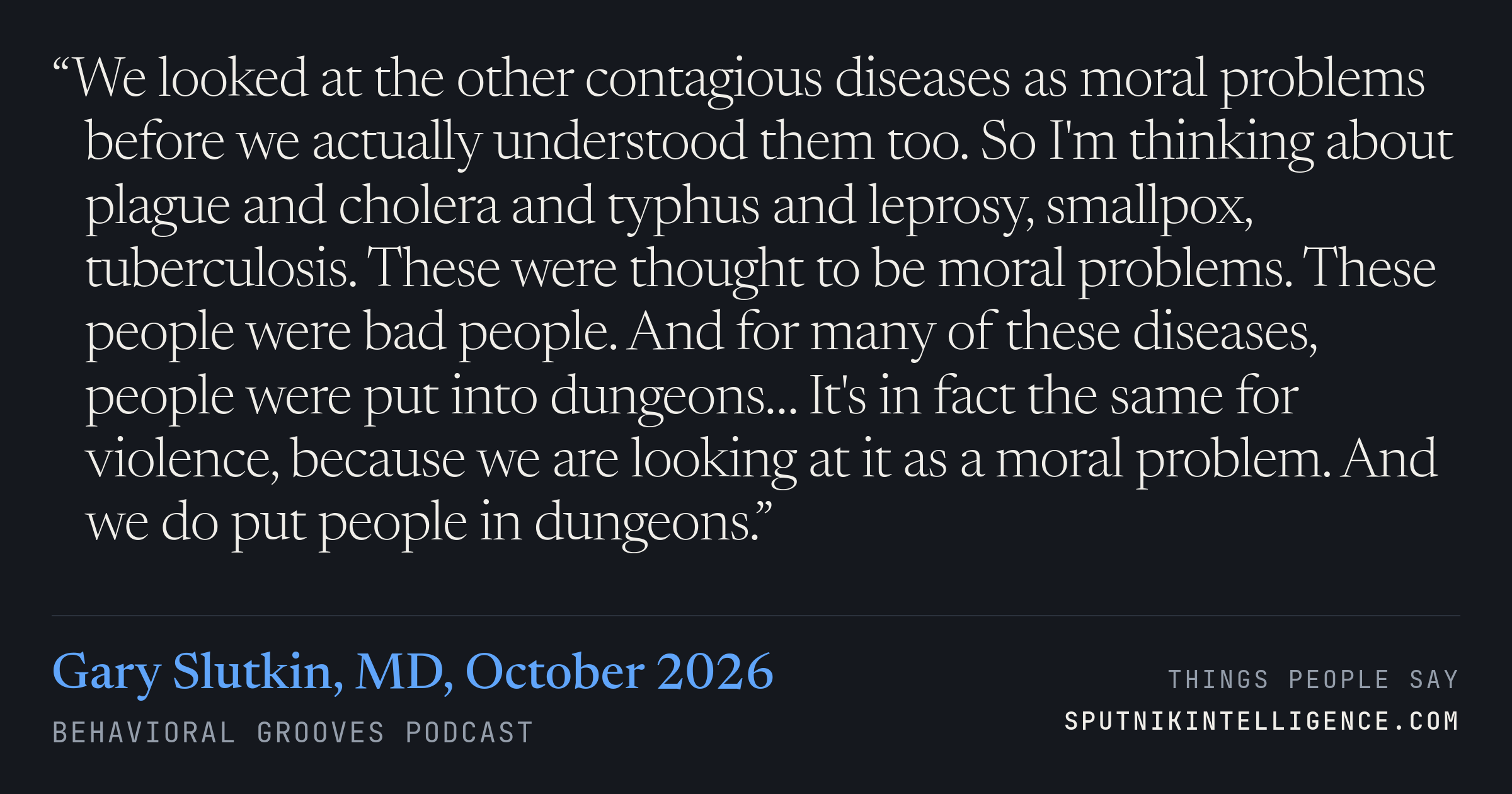
“We looked at the other contagious diseases as moral problems before we actually understood them too. So I'm thinking about plague and cholera and typhus and leprosy, smallpox, tuberculosis. These were thought to be moral problems. These people were bad people. And for many of these diseases, people were put into dungeons… It's in fact the same for violence, because we are looking at it as a moral problem. And we do put people in dungeons.”
Behavioral Grooves Podcast · October 2026
Slutkin, an epidemiologist, argues that violence meets the definition of a contagious disease because it causes more of itself. Asked why the public hasn't connected the dots, he says violence is being misdiagnosed the way infections once were.
Transcript
…of the dots and in some cases, some research to really figure out how it's working. And the book, the book really spends a lot of time on that because I wanted to understand it as much as I could and even see if there was even a flaw in this. And I really couldn't even looking at things like this.
…it checks all of the boxes around this? And you did mention that the World Health Organization and the CDC have components around violence, but the general public doesn't necessarily see violence as a contagious disease. What is it about it that we just haven't? Why haven't we connected the dots?
Yeah, this is really one of the best questions. And it's important to think about this. Let me say two ways of looking at this. First, we looked at the others, the other contagious diseases, as moral problems before we actually understood them too. So I'm thinking about plague and cholera and typhus and you name it, leprosy, smallpox. These were thought, tuberculosis, these were thought to be moral problems. These people were bad people. And many, for many of these diseases, people were put into dungeons. They thought to be moral failures. So what was missing was understanding the invisible. And that and that it's very similar. It's in fact the same for violence because we are looking at. It is a moral problem. And we do put people in dungeons. And what's actually going on is in the invisible space that I spent a few chapters discussing what's actually going on in that space. There's another problem within that problem, which is that we look at the way our stomach functions and the way our lungs function as a little bit separate from the way our brain functions. So we identify with our brain, oh no, that's us, that's who I am. And we don't realize how it's affected in ways that are almost, well, in fact, are automatic. So…
Yeah, that is the medical community looks at, and epidemiologists look at it as something that, how can we cure this, right? The question oftentimes turns to, well, if we understand, if we properly diagnose something, then maybe there's a cure. Why have we missed out on curable tools when it seems…
Yeah, well, we were stuck. And the problem was stuck. And this, you know, you can think about being on a medical ward and there's a patient coming in and you keep trying to do the same thing over and over and he's not here. She's not getting better. And commonly, and, you know, I saw this, guess…
Yeah, actually, I think that that's a great analogy to bring up with the current war in Iran and what we're living through. It is expanding. In a contagious way. And you frame violence as being something that is contagious. And I have to admit that that's something that I hadn't thought about.…
More from Behavioral Grooves Podcast