AE

Alberto Estefan

Things Alberto Says on Podcasts

Where to Find Them

Alberto Estefan has been a guest on Cleaning Up: Leadership in an Age of Climate Change .

Recently: “Mexico Is On The Brink Of A Solar Boom | Ep281: Alberto Estefan” on Cleaning Up: Leadership in an Age of Climate Change (November 2026).

What They Said

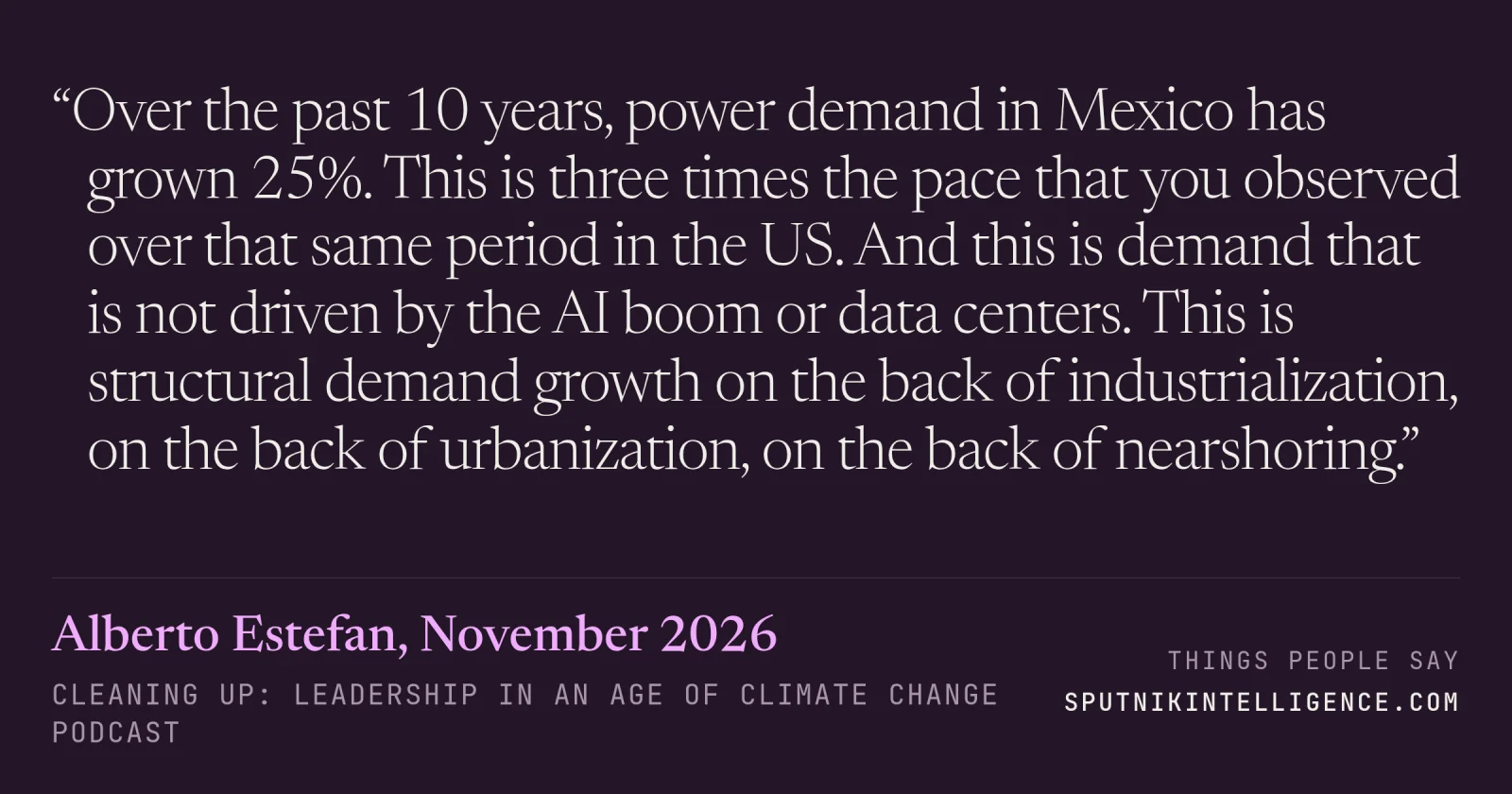
“Over the past 10 years, power demand in Mexico has grown 25%. This is three times the pace that you observed over that same period in the US. And this is demand that is not driven by the AI boom or data centers. This is structural demand growth on the back of industrialization, on the back of urbanization, on the back of nearshoring.” — Alberto Estefan, Cleaning Up: Leadership in an Age of Climate Change

Asked how he sells investors on a region seen as politically volatile, the guest rests his case on demand growth and long-term contracts.

Cleaning Up: Leadership in an Age of Climate Change · 2026-11-04 Permalink → Listen →
Cleaning Up: Leadership in an Age of Climate Change Around 06:53 into the episode
Alberto Estefan

…ways. And so it's from an investment perspective, which is, I guess, a key focus at Actis, it provides both the opportunity to invest behind the growth of the sector, but then also a large stock of assets that we can operate and execute our operational improvement investment thesis behind those.

Bryony Worthington

…a lot of political volatility in the region. But there are countries, as you say, like Chile, who remain pretty stable and have quite a westernized investable. Environment with strong policies. How would you, if someone's being a bit skeptical about the region, how do you sell it to investors?

Alberto Estefan

I guess the conviction that we have behind some of these markets has to do on the one hand with the supply demand fundamentals. And so take a place like Mexico. Over the past 10 years, power demand has grown 25%. This is three times the pace that you observed over that same period of time in the US. And this is in a context where this is demand that is not driven by the AI boom or data centers. This is structural demand growth on the back of industrialization, on the back of urbanization, on the back of near shoring. These are long-term secular trends that fuel demand over large cycles. And ultimately, these fundamentals prove very kind of resilient from the perspective of the value proposition that a credible investor can bring to some of these geographies from the perspective of being long-term owners, serious investors that will operate responsibly these assets. And so I think that's kind of the most defensive element in terms of how we, the value that we believe that we bring to these countries in a context then where the way that we invest is through long-term cash flow visibility. And so I think different to…

Bryony Worthington

Yeah, I can see how those de-risking policies are super important. And perhaps that's the thing you need to watch, right, is the policy environment that supports those commercial contracts, which are enforceable, that gives you that security. But just thinking about Mexico in a little bit more…

Alberto Estefan

It is true that Mexico is extremely tied to the US and the economic cycle in the US. It has become the US largest trading partner over the past 10 years over Canada and China. But interestingly, the China plus one narrative that we saw sort of in the first Trump administration.

Bryony Worthington

Just pause that, what does China plus one mean?
Speaker names come from our own diarization. The position is estimated from where the line sits in the episode.
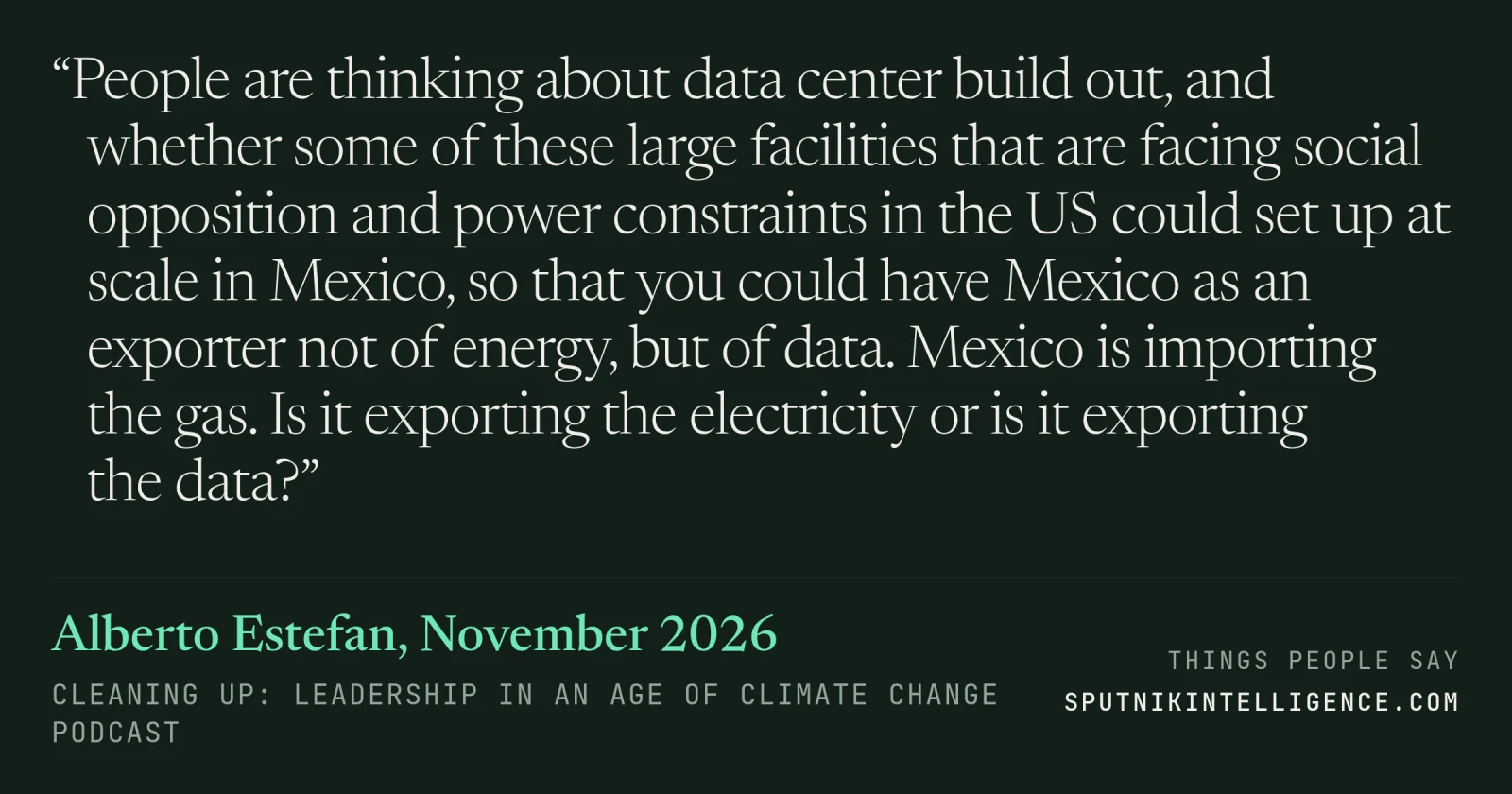
“People are thinking about data center build out, and whether some of these large facilities that are facing social opposition and power constraints in the US could set up at scale in Mexico, so that you could have Mexico as an exporter not of energy, but of data. Mexico is importing the gas. Is it exporting the electricity or is it exporting the data?” — Alberto Estefan, Cleaning Up: Leadership in an Age of Climate Change

Asked how much power moves across the US-Mexico border, the guest says cross-border transmission is limited today, then raises the idea of US data centers relocating to Mexico.

Cleaning Up: Leadership in an Age of Climate Change · 2026-11-04 Permalink → Listen →
Cleaning Up: Leadership in an Age of Climate Change Around 41:17 into the episode
Alberto Estefan

…has trade-offs, because at the same time, it probably makes it for a less dynamic market and a less dynamic build out of the necessary infrastructure, but done in a way where you'll probably have less of the issues of curtailment and transmission constraints that you're seeing in other markets.

Bryony Worthington

…the future, given Mexico's geography, you ought to be sending a lot of clean, cheap power northwards. And I guess to perhaps neighboring countries too. Obviously, the geography is very different when you turn to the south. But how much is there a transmission conversation happening at the moment?

Alberto Estefan

So I would say it's not top of the agenda. It's relatively limited. So it does happen. So, for example, we actually used to own a few projects both on the windside and in the gas to power side that sold power into Kaiso in California from Baja California in Mexico. So it does happen to a limited extent. And there are certain other interconnections across the border. At one point, there was actually a plant in South Texas that was selling power down into Mexico. And so these exchanges do happen. But I think it could happen to a larger scale. And it'll be interesting to see how that develops over time. People are thinking, for example, about data center build out as well, and whether some of these large facilities that are facing social opposition and power constraints in the US could set up at scale in Mexico, and so that you could have Mexico as an exporter not of energy, but of data. And if you start thinking then about the flows, it's interesting to think that, well, Mexico is importing the gas. Is it exporting the electricity or is it exporting the data? And kind of these flows in what is ultimately a very interrelated dynamic…

Bryony Worthington

Yeah, maybe just to plug my own organization of EMBA, who recently put out their new deck around the integration of those commodities, right? The sort of electrode tech plus information revolution means that, yeah, the success of a country now is about electrons. And as you say, it could be flowing…

Alberto Estefan

Yes, yes, absolutely. And yeah, we did build a wind farm, for example, that was selling under a long-term offtake contract with a utility in California. And so those type of cross-border projects, I think, will be part of the conversation going forward.

Bryony Worthington

So I suppose just kind of as we start wrapping up, that at the moment, well, with a sort of slightly unpredictable neighbor to the north, but this domestically set up to hopefully attract a lot of inward investment. Is it happening at the pace that it needs to, or is it still underselling the…

Speaker names come from our own diarization. The position is estimated from where the line sits in the episode.

Collections They Appear In