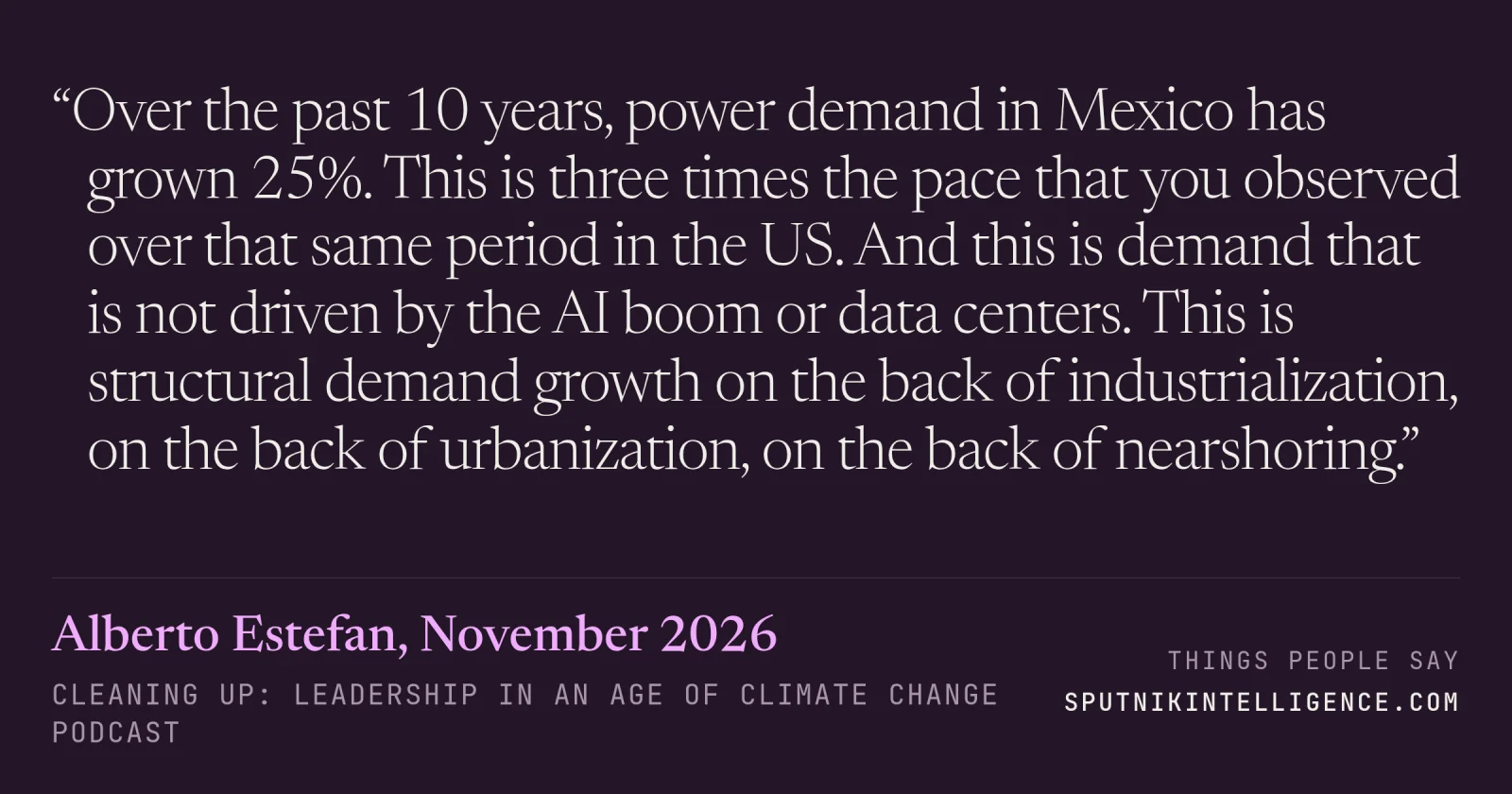
“Over the past 10 years, power demand in Mexico has grown 25%. This is three times the pace that you observed over that same period in the US. And this is demand that is not driven by the AI boom or data centers. This is structural demand growth on the back of industrialization, on the back of urbanization, on the back of nearshoring.”
Cleaning Up: Leadership in an Age of Climate Change · Climate & Energy · November 2026
Context
Asked how he sells investors on a region seen as politically volatile, the guest rests his case on demand growth and long-term contracts.
Transcript
…ways. And so it's from an investment perspective, which is, I guess, a key focus at Actis, it provides both the opportunity to invest behind the growth of the sector, but then also a large stock of assets that we can operate and execute our operational improvement investment thesis behind those.
…a lot of political volatility in the region. But there are countries, as you say, like Chile, who remain pretty stable and have quite a westernized investable. Environment with strong policies. How would you, if someone's being a bit skeptical about the region, how do you sell it to investors?
I guess the conviction that we have behind some of these markets has to do on the one hand with the supply demand fundamentals. And so take a place like Mexico. Over the past 10 years, power demand has grown 25%. This is three times the pace that you observed over that same period of time in the US. And this is in a context where this is demand that is not driven by the AI boom or data centers. This is structural demand growth on the back of industrialization, on the back of urbanization, on the back of near shoring. These are long-term secular trends that fuel demand over large cycles. And ultimately, these fundamentals prove very kind of resilient from the perspective of the value proposition that a credible investor can bring to some of these geographies from the perspective of being long-term owners, serious investors that will operate responsibly these assets. And so I think that's kind of the most defensive element in terms of how we, the value that we believe that we bring to these countries in a context then where the way that we invest is through long-term cash flow visibility. And so I think different to…
Yeah, I can see how those de-risking policies are super important. And perhaps that's the thing you need to watch, right, is the policy environment that supports those commercial contracts, which are enforceable, that gives you that security. But just thinking about Mexico in a little bit more…
It is true that Mexico is extremely tied to the US and the economic cycle in the US. It has become the US largest trading partner over the past 10 years over Canada and China. But interestingly, the China plus one narrative that we saw sort of in the first Trump administration.
Just pause that, what does China plus one mean?
More from Cleaning Up: Leadership in an Age of Climate Change