AP

Adam Posen

Things Adam Says on Podcasts

Where to Find Them

Adam Posen hosts Odd Lots . They have also been a guest on Bloomberg Surveillance (49 times) , Trumponomics (4 times) , Foreign Policy Live (3 times) , Marketplace (APM) (2 times) , Unhedged (2 times) , Marketplace All-in-One (2 times) , Top Traders Unplugged , FT News Briefing , Markus' Academy , The Spillover , PIIE Insider LIVE , Bloomberg Intelligence , Marketplace , Exchanges , Paul Krugman , VoxTalks Economics , The David Frum Show and The Foreign Affairs Interview .

Recently: “Central Banks in a Bind + Could AI Replace the FOMC?” on The Spillover (October 2026); “Adam Posen Thinks Things Could Get Very 'Messy' for the Fed” on Odd Lots (September 2026); “What's driving up the 30-year Treasury yield?” on Marketplace (July 2026); “What's driving up the 30-year Treasury yield?” on Marketplace (APM) (July 2026); “What's driving up the 30-year Treasury yield?” on Marketplace All-in-One (July 2026); “International Economic Challenges for the President-Elect | Markus' Academy | Ep. 45” on Markus' Academy (July 2026).

What They Said

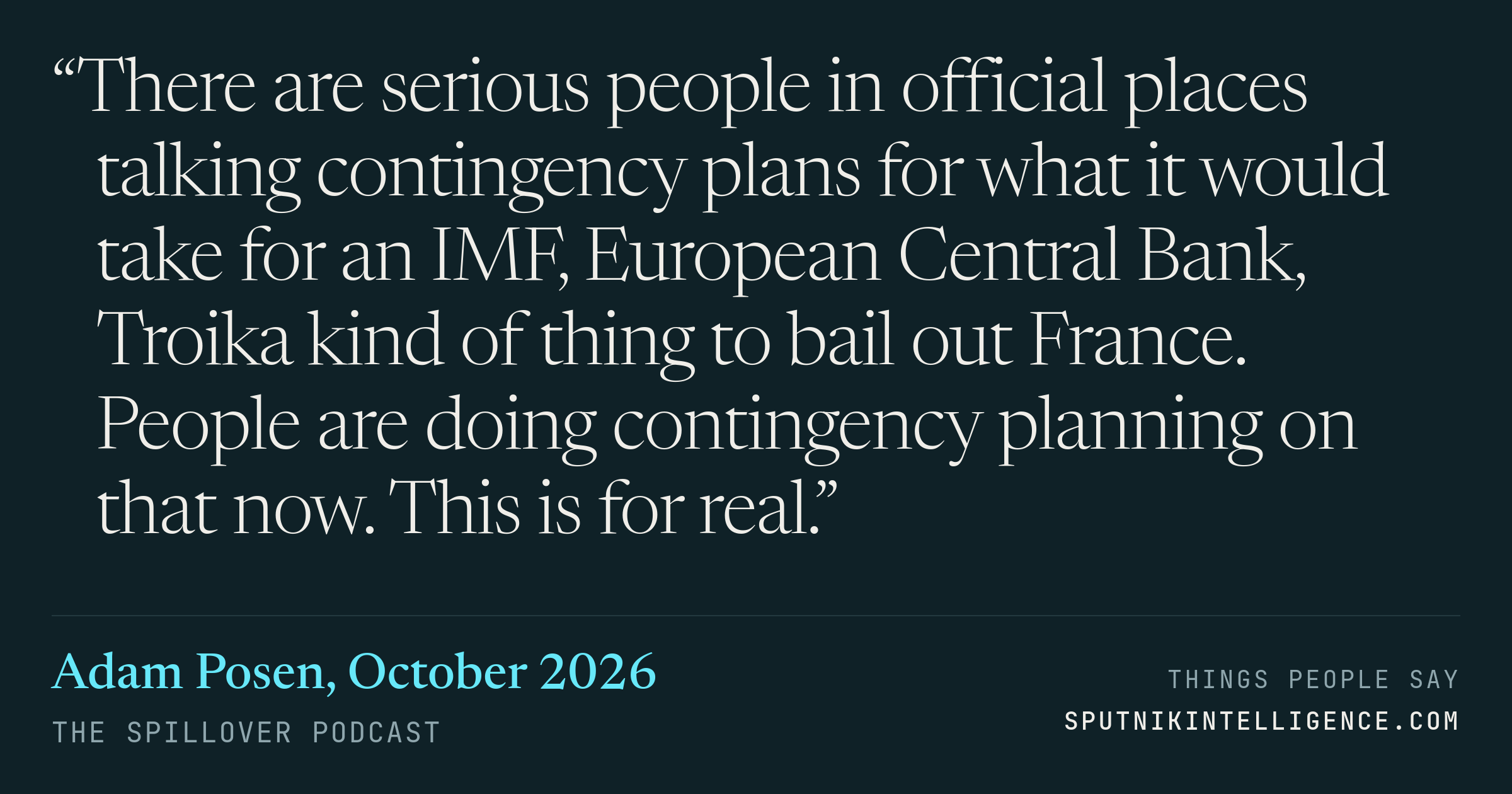
“There are serious people in official places talking contingency plans for what it would take for an IMF, European Central Bank, Troika kind of thing to bail out France. People are doing contingency planning on that now. This is for real.” — Adam Posen, The Spillover

Near the end of the episode, Posen responds to a co-host's worry that the global rise in long-term bond yields ends with a major economy needing a bailout. He adds that he would not want to gamble on a French crisis scaring other governments into better behaviour.

The Spillover · 2026-10-01 Permalink → Listen →
The Spillover Around 44:02 into the episode
Adam Posen

Exactly. And so I think what I worry about is this actually makes things worse that it drags it out because you got no place to put your money because you're not going to put it wholesale into China. And so there is no other place to absorb this stuff. And so these all these economies, including the U.S., get a longer leash than they otherwise would have if they were deviating from the others. And then you could say, oh, Europe's messing up. I'll move into Japan or vice versa.

Rebecca Patterson

Right.

Adam Posen

So finally, your point, scary about a bailout. 50 years, I hadn't thought of that, but you're right. I mean, there are serious people in official places talking contingency plans for what it would take for an IMF or IMF, European Central Bank, Troika kind of thing to bail out France. I mean, people are doing contingency planning on that now. This is for real. And again, if you want to be sort of bloodless about this, and I am not confident enough as AI to make this call from induction, but you could make a case. Well, in a sense, it's good if France blows up because they're big enough to scare everybody and it might keep the nut jobs from getting out of government. But it could happen before the other ones blow up and that might induce a better outcome. I don't want to gamble on that.

Sebastian Mallaby

That is a sobering note on which to wrap. I think we should wrap. Adam, Kaleidoscopic in your range. Thank you so much for being here. Thank

Adam Posen

you for having me.

Sebastian Mallaby

That was a tour to force.

Speaker names from our own diarization · position estimated from where the line sits in the episode
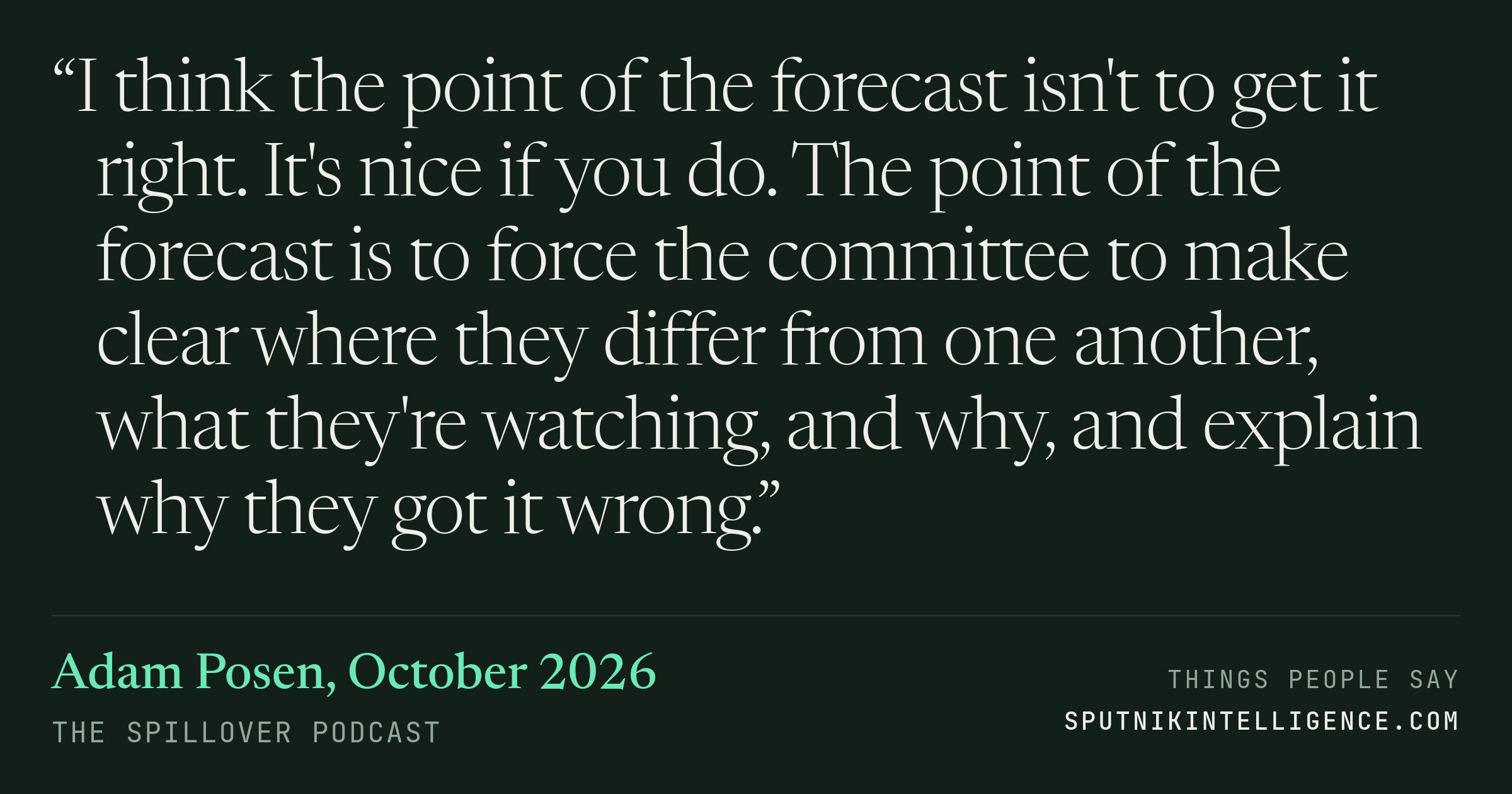
“I think the point of the forecast isn't to get it right. It's nice if you do. The point of the forecast is to force the committee to make clear where they differ from one another, what they're watching, and why, and explain why they got it wrong.” — Adam Posen, The Spillover

Posen is answering the criticism that the Fed is a poor forecaster, and whether AI could do the job better. He says the economy is too complex for any model to simply get the prediction right, and that the forecast's real job is accountability.

The Spillover · 2026-10-01 Permalink → Listen →
The Spillover Around 22:15 into the episode
Adam Posen

Is that some sense that you could be embarrassed or held to account if you did something that contradicted your previous statements? Whereas I think Chair Warsh would be perfectly comfortable saying, ha ha, you thought something I said at a Hoover Institute conference in 2025 binds me. It doesn't. You lose. I mean, you wouldn't quite say it the right way. When the

Rebecca Patterson

facts change, I change my mind. Change my mind. That would be the nice

Adam Posen

way he'd say it. So I do think that if you take the moral hazard view seriously, and in my view, excessively seriously, you might deliberately try to indulge in that, make markets not be too assured that their little models actually predict. Again, goes with what Sebastian was saying earlier. I think in the end, that is still small potatoes, to use a technical term, versus the two big issues in what you said, which is: could the Fed get things right more often? And could the Fed be vulnerable to AI-led disruption? So, on the first, I guess there, as much as I believe AI is going to transform everything, certainly the think tank business we're all in. I do think the national economy is so complex and so large, and it goes to the hayeking, Hayek's critique of you can't know everything that the sort of ambition of the central planner or the Enlightenment project. That if I had all the equations for everything in the world, I could press a button and I'd know where everything was going, that it's really not ever going to turn out that way. And I would go further, and this again is my point of view and probably not widely shared. I think one of the things Chair Warsh and others has attacked is they say, well, the Fed's a lousy forecaster, or they're not even as good a forecaster as the markets. I don't think that's the point of the forecast. I think the point of the forecast isn't to get it right. It's nice if you do. The point of the forecast is to force the committee to make clear where they differ from one another, what they're watching, and why, and explain why they got it wrong. What's the new information or the new insight? That's to me is the point of the forecast. And so, again, AI may help with that, but I don't think it's not like, oh, it gets the prediction right and this all goes away. Right.

Sebastian Mallaby

You know, my friends in AI Replace would seize on one thing you just said and flip it. And the thing that they would seize on is the notion that when you have a very complex system, you can't have equations. It's precisely where there is huge complexity, enormous amounts of data, a massive combinatorial space, something like protein folding or the game of go earlier on, or modeling all of text. This is actually where AI has the advantage. And it leads to a thought experiment, which I'm actually genuinely agnostic about at the moment. I'm thinking about it. Could you replace the FOMC with an AI?

Rebecca Patterson

Would you rather have a group of humans around a table or a model?

Sebastian Mallaby

Allowing that both are flawed.

Speaker names from our own diarization · position estimated from where the line sits in the episode

Collections They Appear In