JG

James Gleick

Things James Says on Podcasts

Where to Find Them

James Gleick has been a guest on a16z crypto show , Masters in Business , On the Media , a16z Podcast and Radiolab .

Recently: “From the Telephone to Modern Computing | James Gleick” on a16z Podcast (November 2026); “The first network effect was a phone call (ft. James Gleick)” on a16z crypto show (November 2026); “The Cataclysm Sentence” on Radiolab (June 2023); “Hurry Up!” on On the Media (December 2016); “Interview With James Gleick: Masters in Business (Audio)” on Masters in Business (November 2016).

What They Said

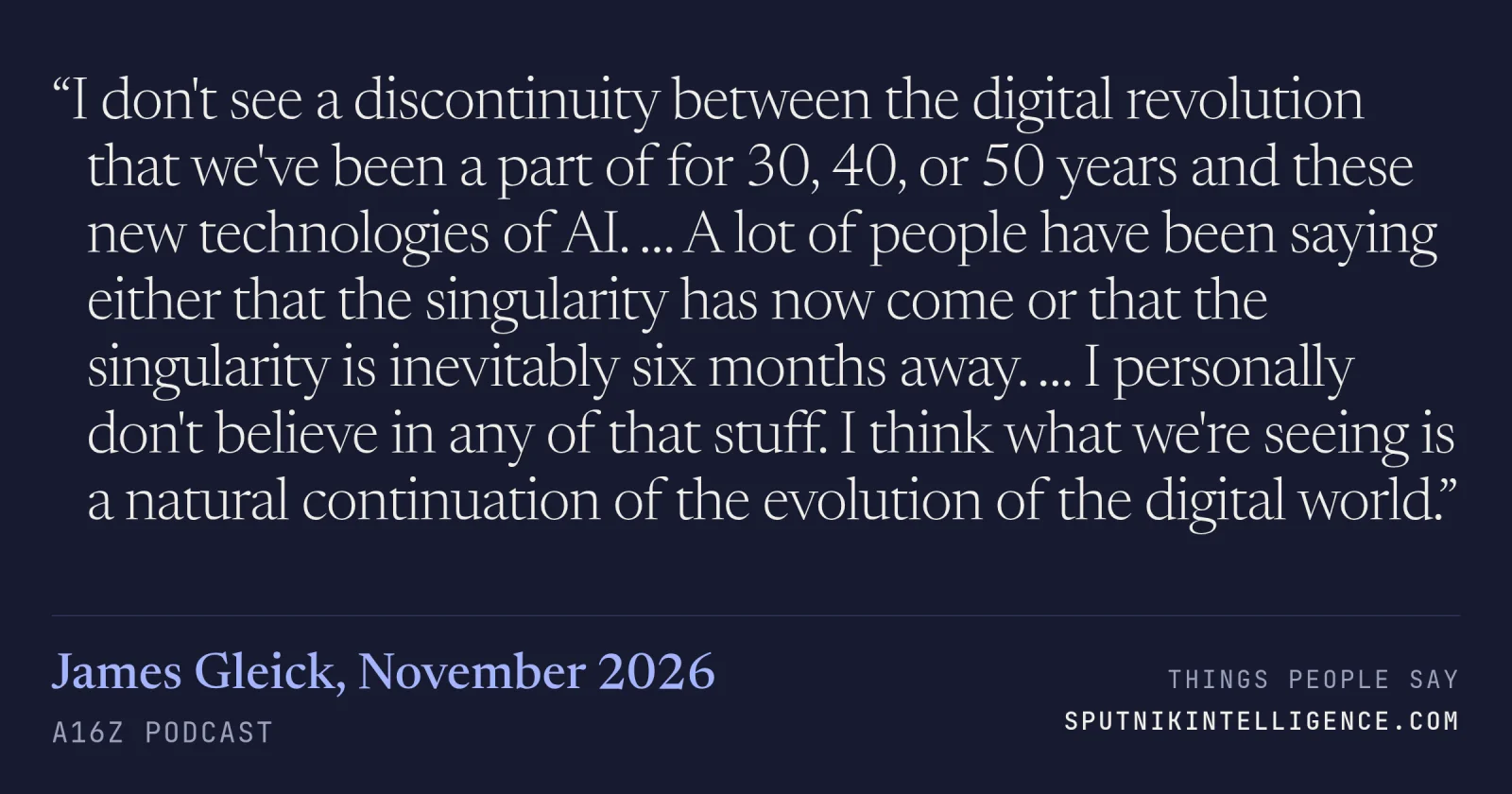
“I don't see a discontinuity between the digital revolution that we've been a part of for 30, 40, or 50 years and these new technologies of AI. … A lot of people have been saying either that the singularity has now come or that the singularity is inevitably six months away. … I personally don't believe in any of that stuff. I think what we're seeing is a natural continuation of the evolution of the digital world.” — James Gleick, a16z Podcast

Asked whether AI is a fourth industrial revolution, James Gleick pushes back: computers have always been solving harder problems, and he sees AI as more of the same curve rather than a break.

a16z Podcast · 2026-11-14 Permalink → Listen →
a16z Podcast Around 40:05 into the episode
James Gleick

Oh, actually, I don't. Ooh, interesting.

Sonal Chokshi

Yeah.

James Gleick

…being a breaking point, a discontinuity in history. And a lot of people have been saying either that the singularity has now come or that the singularity is inevitably six months away. If you define the singularity as the moment when our machines are finally going to become conscious and smarter than us and leave us in the dust, and if we're unlucky, you know, exterminate us along the way. I personally don't believe in any of that stuff. I think what we're seeing is a natural continuation of the evolution of the digital world. And our computers are getting more powerful. They're communicating better. There are negatives to it, as there are to every new technology. They're getting better at impersonating people and they're being misused to trick people into thinking that they are entities that it's useful to converse with. But I think it's, you know, the technologies of AI are going to be very useful, are becoming…

Sonal Chokshi

don't know, Robert, where do you net out on this one?

Robert Hackett

There was a book written about this called The Control Revolution that I really love, sort of a niche academic book, but it describes sort of the long arc of what is happening, the digital transformation as extending back to the first revolution that you were talking about with machines. And…

Sonal Chokshi

it's funny. I feel like you guys could convince me of that. But I think the one thing I might argue here, it becomes a difference not of degree, but kind. And you have so much of this continuity, like so reinforcing that it almost breaks off into its own thing. Like I might argue that something…

Speaker names come from our own diarization. The position is estimated from where the line sits in the episode.
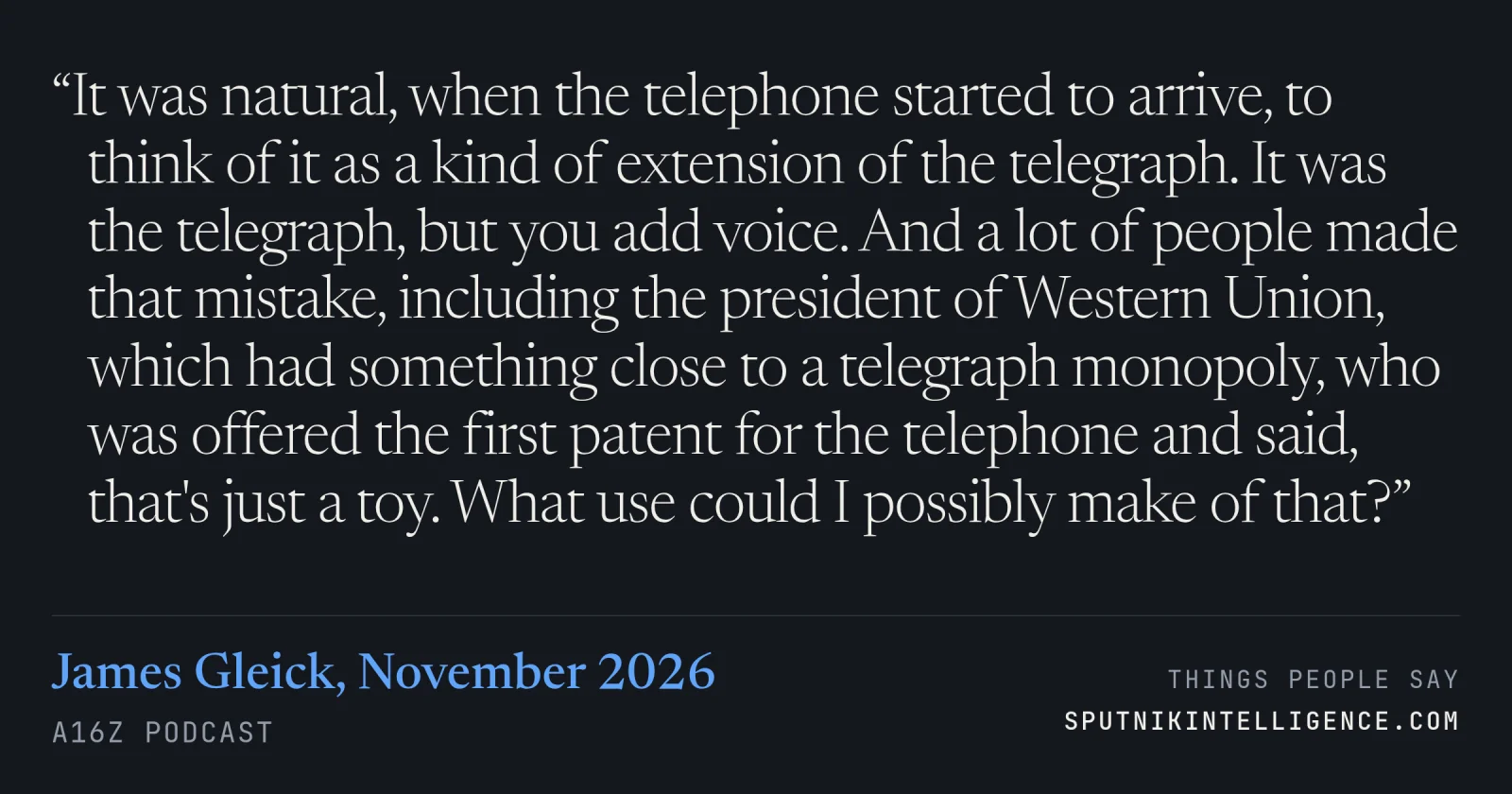
“It was natural, when the telephone started to arrive, to think of it as a kind of extension of the telegraph. It was the telegraph, but you add voice. And a lot of people made that mistake, including the president of Western Union, which had something close to a telegraph monopoly, who was offered the first patent for the telephone and said, that's just a toy. What use could I possibly make of that?” — James Gleick, a16z Podcast

James Gleick describes how incumbents saw the telephone through the lens of the telegraph and missed what was new about it. It's a familiar pattern for anyone watching how established companies size up AI.

a16z Podcast · 2026-11-14 Permalink → Listen →
a16z Podcast Around 02:56 into the episode
Sonal Chokshi

…of course, there's the science that Bell Labs created around the telephone. So, this is a very rich book. And I think we'll just jump right into it by talking about the telephone as a device, kind of a network, and then more broadly, the innovation process and backstory. So, James, ahoy. Ahoy.

Robert Hackett

…what happened. It's more interesting, more complex than that. There was prior precedent. There were competing claims to the invention. So I thought maybe you could just kind of describe some of what you found when you looked into this in doing this archaeology, this excavation of telephony.

James Gleick

It's true. And we know a world where sending your voice long distances is completely unremarkable. I mean, we're using a telephone right now. We're very far apart geographically. We are speaking and creating sound waves in the room, and the sound waves are being converted into electricity. And almost instantaneously, you are hearing what I'm saying because the electricity is reconverted into sound waves at your end. And that is the telephone idea. And it didn't exist. I mean, people always dreamed of being able to communicate across long distances, but there was no practical way to do that until the telegraph arrived. And then the telegraph, in the time of which we speak, was rapidly transforming the world. Everybody understood how important it was. It was making a lot of money. Wires were crisscrossing the United States, and people were sending messages electrically. So that was fantastic. And so it was natural. When the telephone started to arrive, to think of it as a kind of extension of the telegraph, something new. It was the telegraph, but you add voice. And a lot of people made that mistake, including the president of Western Union, which had something close to a telegraph…

Robert Hackett

It's funny because this is exactly what Thomas Edison thought the first uses of the phonograph were going to be. He was like, oh, people are going to love to hear the sermons. They're going to love to hear concerts and stuff. But yeah, it ended up being rock music and jazz that kind of caught on…

James Gleick

so that was what Edison's musical taste would have been like if he were alive today. That's true. And of course, the phonograph came along right after the telephone. I mean, it was hard on its heels. And that's not an accident because everybody was figuring out how to make connections between…

Robert Hackett

I've got to say, the German man in Frankfurt using sausage casings to make this device is just like, you couldn't make this stuff up. It's just too rich.

Speaker names come from our own diarization. The position is estimated from where the line sits in the episode.
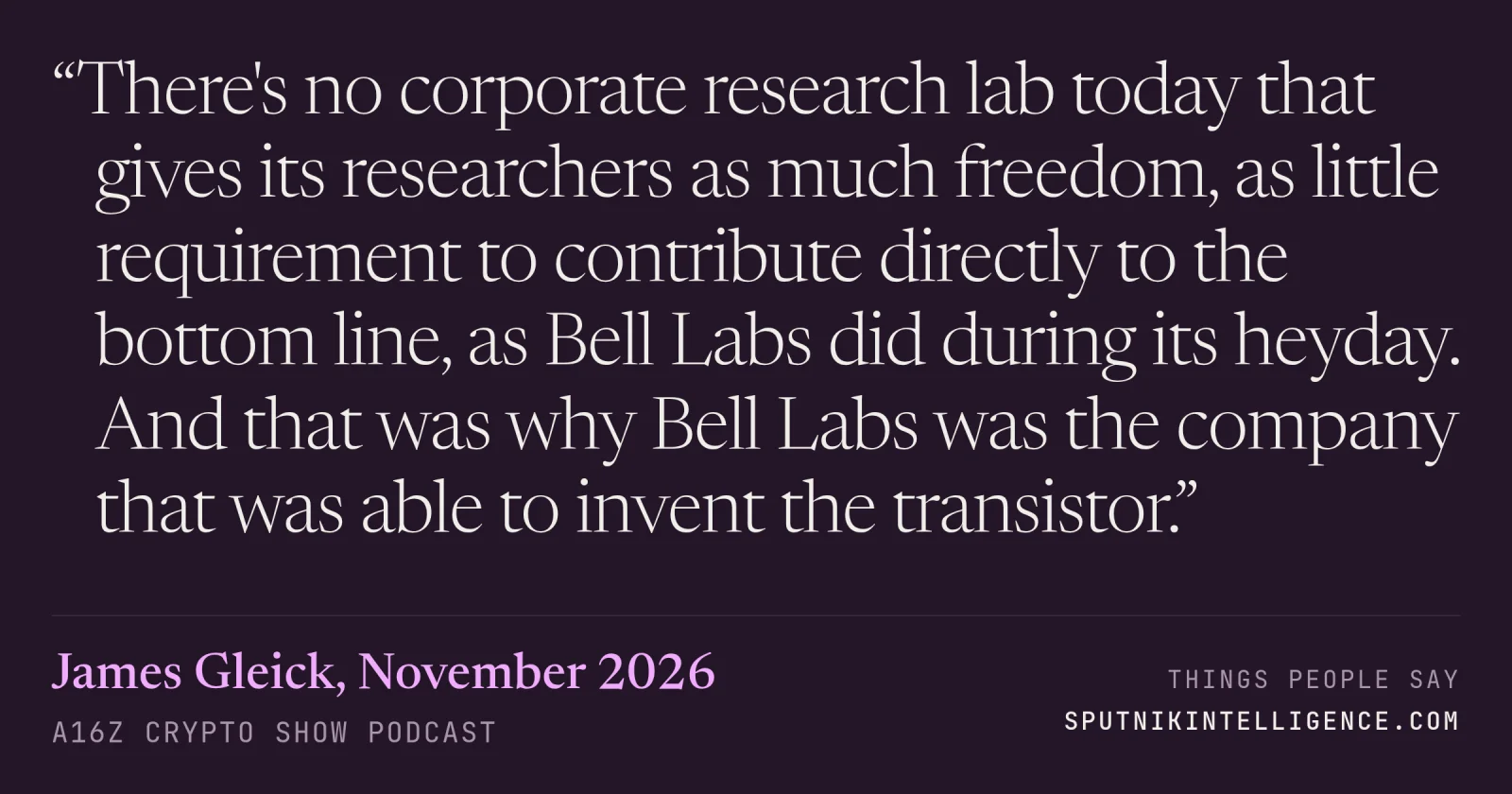
“There's no corporate research lab today that gives its researchers as much freedom, as little requirement to contribute directly to the bottom line, as Bell Labs did during its heyday. And that was why Bell Labs was the company that was able to invent the transistor.” — James Gleick, a16z crypto show

Gleick says Bell Labs' freedom was an accidental benefit of the Bell monopoly, which cared little about profit, and explains why that produced so many breakthroughs.

a16z crypto show · 2026-11-13 Permalink → Listen →
a16z crypto show Around 29:14 into the episode
James Gleick

…was necessary for the world to transform into the thing it is today was for there to be a convergence between the new digital electronic domain that involved computing machinery primarily and all kinds of other digital electronic stuff and this analog world that ruled the telephone lines. Yeah.

Sonal Chokshi

…integrated circuits, and all of these things are precisely because, tell me if I'm wrong, but this is what I took away from the book, because of that convergence you're describing, that they had to figure out how to make these things connect, clean up, do more. I don't know. Is that the right link?

James Gleick

It's certainly right to say that that's where the science came from. But, you know, it wasn't purposeful in the sense that they set out to drive the world in that direction. What was unique about Bell Labs, what was so wonderful about it, was, first of all, it became very quickly the largest, most expensive, best-staffed corporate research lab in the world. It rivaled universities. But beyond that, as a kind of accidental benign effect of the Bell system having a monopoly, it didn't care that much about profit. Of course, its primary mission was to create technologies that would be useful in improving the company's networks and transmission lines and devices. And there was tons of science that did that. But the company was also filled with people who were given free reign because it was felt by their managers that if they let these smart scientists tinker and follow their noses, good things would happen. And in fact, good things did happen. And Bell Laboratories were responsible for an astonishing number of Nobel Prizes. And I think it's fair to say…

Sonal Chokshi

Yeah. I would add to this, I'm a student, Robert knows this, I'm a student of this because I worked at Xerox PARC. And similarly, it's a lot of people always ask me, like, you know, because that's also a place that invented a lot of iconic technologies, Ethernet, blue lasers. The list is endless.…

Robert Hackett

By the way, Xerox loved The Office of the Future until they actually saw it and then they were like, bury this thing. Yeah. Nobody's going to need to print anything anymore.

James Gleick

In a way, the iconic example of a mathematician who was just allowed to follow his nose was Claude Shannon.

Speaker names come from our own diarization. The position is estimated from where the line sits in the episode.
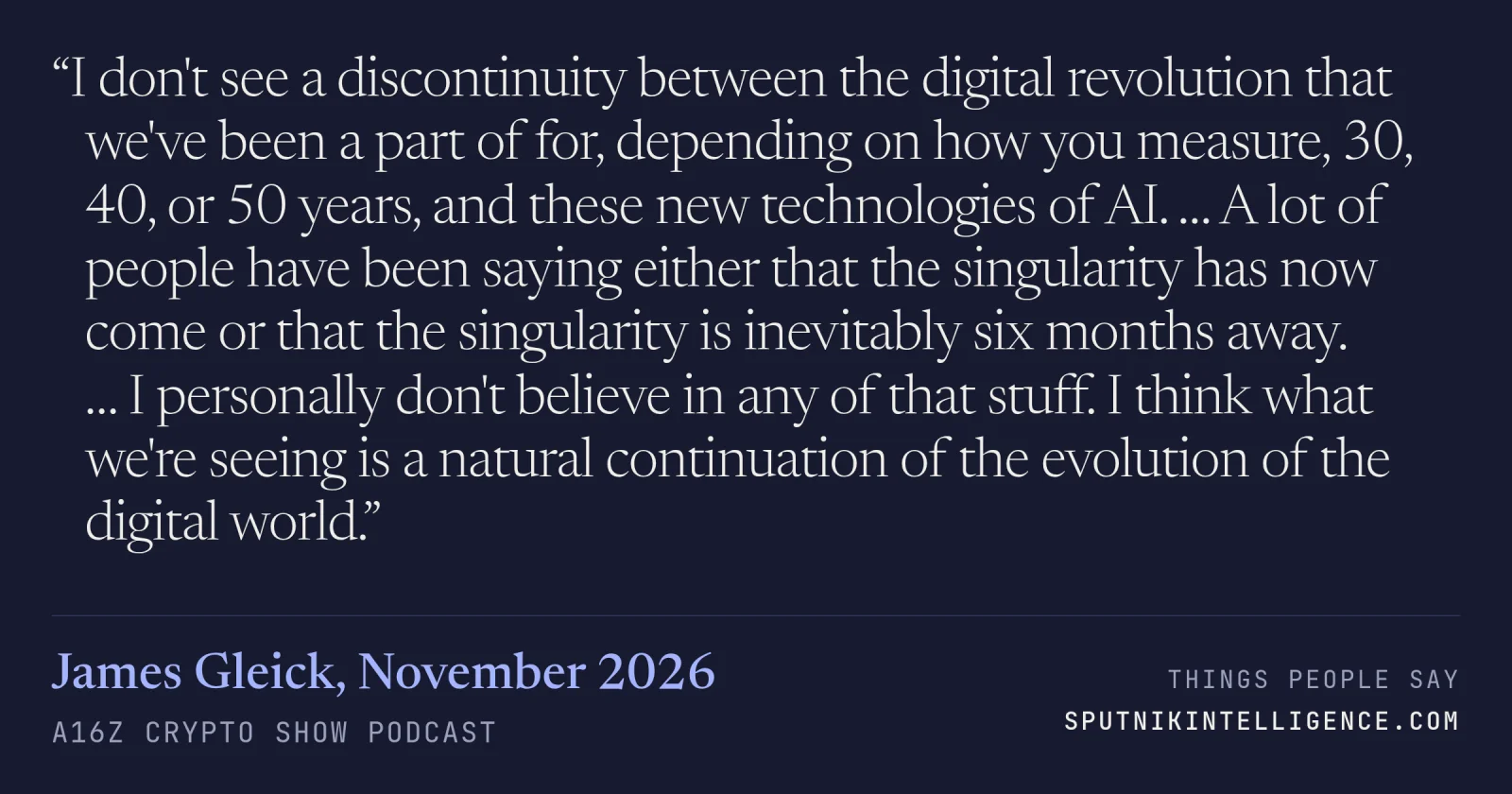
“I don't see a discontinuity between the digital revolution that we've been a part of for, depending on how you measure, 30, 40, or 50 years, and these new technologies of AI. … A lot of people have been saying either that the singularity has now come or that the singularity is inevitably six months away. … I personally don't believe in any of that stuff. I think what we're seeing is a natural continuation of the evolution of the digital world.” — James Gleick, a16z crypto show

Asked whether AI is a fourth industrial revolution, James Gleick says no, comparing it with computers steadily solving harder problems over decades.

a16z crypto show · 2026-11-13 Permalink → Listen →
a16z crypto show Around 37:12 into the episode
James Gleick

Well, when you say a fourth revolution, are you talking about AI?

Sonal Chokshi

Yeah. Yeah.

James Gleick

…being a breaking point, a discontinuity in history. And a lot of people have been saying either that the singularity has now come or that the singularity is inevitably six months away. If you define the singularity as the moment when our machines are finally going to become conscious and smarter than us and leave us in the dust, and if we're unlucky, You know, exterminate us along the way. I personally don't believe in any of that stuff. I think what we're seeing is a natural continuation of the evolution of the digital world. And our computers are getting more powerful. They're communicating better. There are negatives to it, as there are to every new technology. They're getting better at impersonating people and they're being misused to trick people into thinking that they are entities that it's useful to converse with. But I think it's, you know, the technologies of AI are going to be very useful, are becoming…

Sonal Chokshi

I don't know, Robert, where do you net out on this one?

Robert Hackett

There was a book written about this called The Control Revolution that I really love, sort of a niche academic book, but it describes sort of the long arc of what is happening, the digital transformation as extending back to the first revolution that you were talking about with machines. And…

Sonal Chokshi

it's funny. I feel like you guys could convince me of that. But I think the one thing I might argue here, it becomes a difference not of degree, but kind. And you have so much of this continuity, like so reinforcing that it almost breaks off into its own thing. Like I might argue that something…

Speaker names come from our own diarization. The position is estimated from where the line sits in the episode.

Collections They Appear In