Asked about the key unresolved junctures in how life and complexity develop, Szostak argues that physical limits constrain evolution. He goes on to give the example of roughly two billion years of a 'slime planet' before oxygen could accumulate.
So are we still talking about the origin of life?
…self-transcending process. Some elements of that are still super mysterious in terms of what carries the living state and what doesn't. What are those missing junctures? So you could use this. You could start from the bottom up and do this. Maybe you could start from wherever you'd like. But yeah.
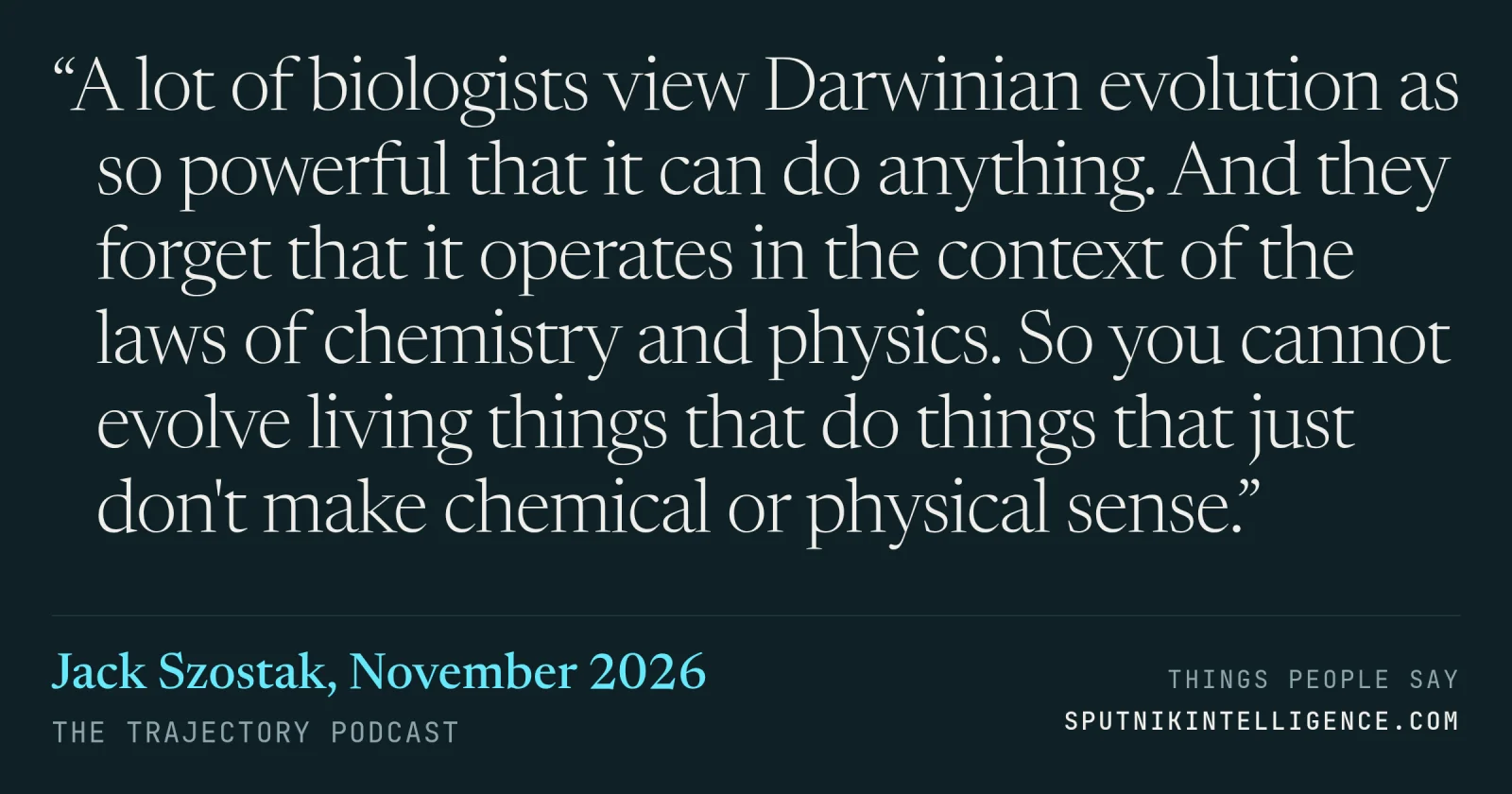
Maybe something that's relevant to this is that I think a lot of biologists view Darwinian evolution as so powerful that it can do anything. And they forget that it operates in the context of the laws of chemistry and physics. So you cannot evolve living things that do things that just don't make chemical or physical sense. And those chemical and physical limitations can be extremely strong. We know that in the history of our planet, there was a period of maybe roughly two billion years where we had bacteria, right? We were basically a slime planet. Nothing very interesting happened for a heck of a long time until it became possible to accumulate higher and higher levels of oxygen. So before that, the oxygen was…
What are your thoughts about the meta-transitions and evolution sort of idea at a high level?
What exactly do you mean?
As sort of a delineator of some of those important thresholds, you know, we could talk about the great oxygenation event. We could talk about multicellularity. We could talk about big enough brains to start doing language and the emergence of this economy and technosphere, et cetera. Are you kind…