NC

Nick Chaset

Things Nick Says on Podcasts

Where to Find Them

Nick Chaset has been a guest on Interchange Recharged (3 times) , CleanTech Talk — Solar, Batteries, EVs, AI (2 times) , Volts (2 times) , Catalyst with Shayle Kann , SunCast , Energy Empire , Energy Evolution and AI, Energy and Climate Podcast .

Recently: “Re-release: Flexibility as a service: Can Octopus's acquisition of Uplight finally make US residential VPPs work?” on Interchange Recharged (November 2026); “Can distributed energy work around American utilities?” on Volts (October 2026); “What If Data Centers Paid You?” on Energy Empire (May 2026); “Flexibility as a service: Can Octopus's acquisition of Uplight finally make US residential VPPs work?” on Interchange Recharged (April 2026); “892: Is Octopus Energy a Utility or a Tech Company? Nick Chaset Has the Answer” on SunCast (January 2026); “Octopus extends its tentacles into America” on Volts (November 2025).

What They Said

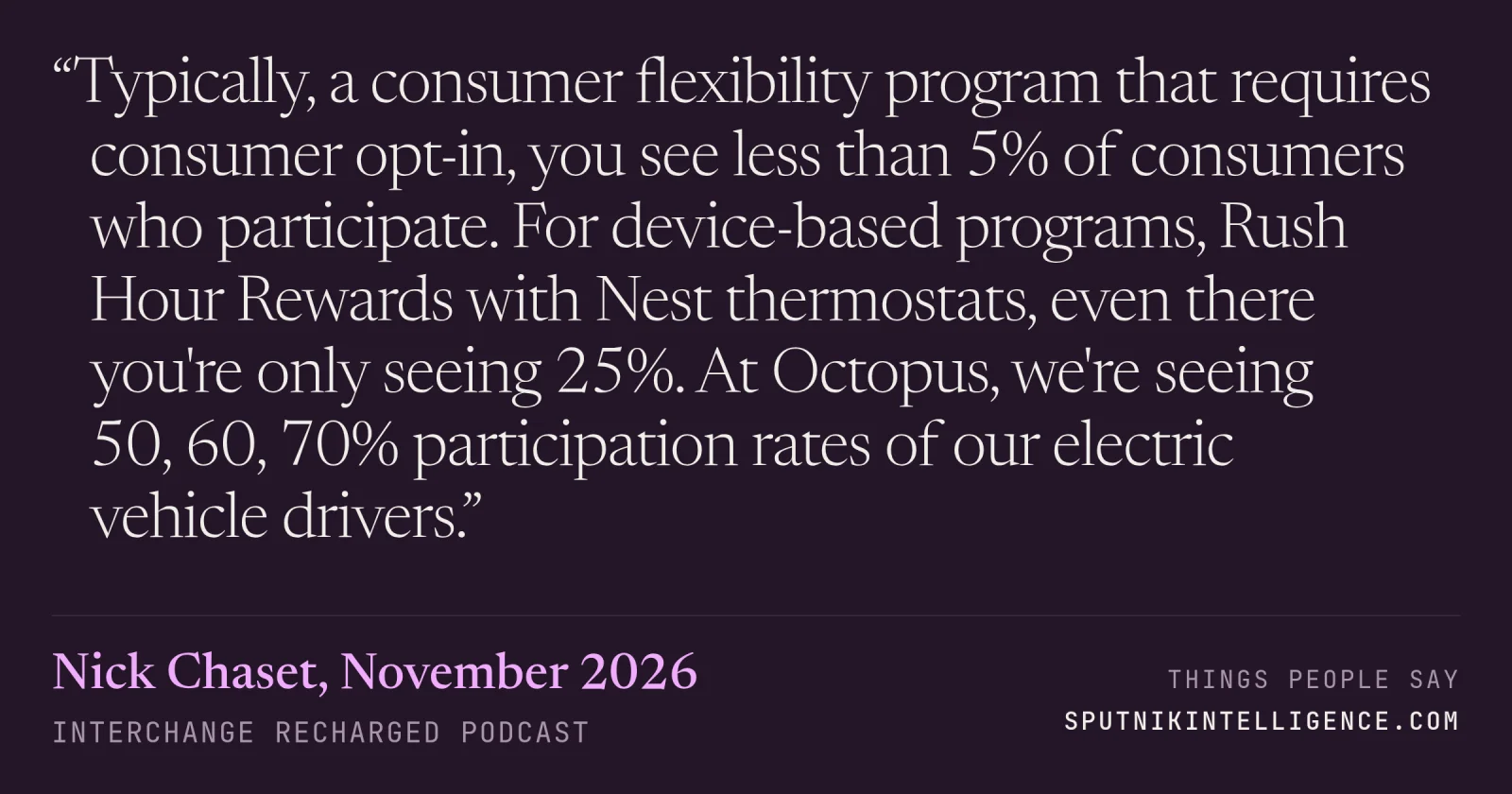
“Typically, a consumer flexibility program that requires consumer opt-in, you see less than 5% of consumers who participate. For device-based programs, Rush Hour Rewards with Nest thermostats, even there you're only seeing 25%. At Octopus, we're seeing 50, 60, 70% participation rates of our electric vehicle drivers.” — Nick Chaset, Interchange Recharged

Asked why Octopus gets much higher participation in demand flexibility than US programs, the guest gives these figures and blames siloed, device-by-device US program rules. The numbers are his own claims.

Interchange Recharged · 2026-11-03 Permalink → Listen →
Interchange Recharged Around 19:40 into the episode
Nick Chaset

…and you need to be able to rely on lots and lots of devices to respond in that moment. You want people to be bought into doing it. And we feel strongly part of that buy-in is to expand the value of flexibility beyond just payments for events to continuous optimization and continuous savings.

Bridget Van Dorsten

…not somebody who's participated in this kind of program before. Can Octopus's walk me through what it is about the customer experience that Octopus offers that's so different from what currently exists in the market today and how you're able to achieve participation rates that are so much higher?

Nick Chaset

I think there's two core bits. One is ease of use. It's just really simple to participate in an Octopus tariff. You have the app already. It's a 30-second journey from deciding you want to sign up to being able to execute the signup. The other bit that's really significant is how we think about characterizing the benefits. All of our flexibility initiatives are tied to direct consumer savings. So, you sign up for Agile, which is one of our flexibility rates, and what you're getting is 75% off the cost of charging your electric vehicle if you're allowing Octopus to have some control over when and how that vehicle charges between when you plug it in and in the morning when you want to get up and go to work or take your kids to school or what have you. And so, because we link the benefits of flexibility to the units of measurement that people care about, how much money am I paying on my bill, and we make it really easy and we create a single location, a single experience to connect every device, we reduce massively the friction associated with participation. Contrast that with the typical experience…

Bridget Van Dorsten

Yeah, it sounds like you're making it easy for customers to save money. Through this uplight partnership, then I would imagine that all of the utilities that uplight is currently serving would be pretty excited to get on board with an octopus app if you're able to, I mean, deliver such excellent…

Nick Chaset

a great question. I mean, you know, some of that has to be market tested. We have a theory that I have articulated here. Once we get into it with utilities and with uplight, what exactly the nature of that engagement is going to be, I think we will find out. But our theory is that in a world where…

Bridget Van Dorsten

I think you pointed out something that is quite interesting in terms of what I would maybe chalk up to a cultural difference, also like a systemic difference with the way that utilities function in the U.S. being a monopoly. They care about their customers, but the customer usually doesn't have a…

Speaker names come from our own diarization. The position is estimated from where the line sits in the episode.
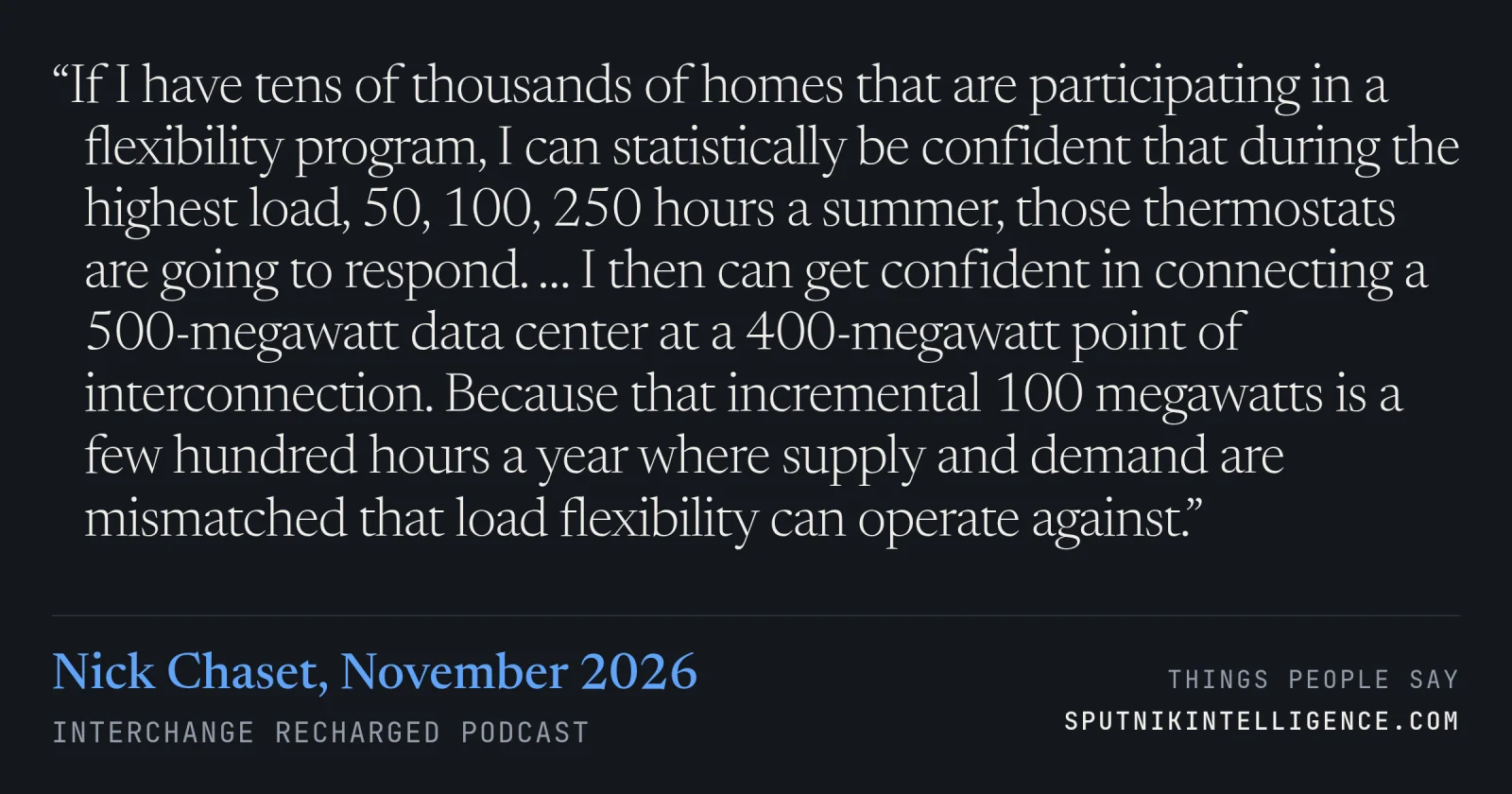
“If I have tens of thousands of homes that are participating in a flexibility program, I can statistically be confident that during the highest load, 50, 100, 250 hours a summer, those thermostats are going to respond. … I then can get confident in connecting a 500-megawatt data center at a 400-megawatt point of interconnection. Because that incremental 100 megawatts is a few hundred hours a year where supply and demand are mismatched that load flexibility can operate against.” — Nick Chaset, Interchange Recharged

Asked how residential flexibility helps utilities with data center interconnection and load growth, the guest argues utilities could plan around the load reductions that enrolled homes reliably deliver.

Interchange Recharged · 2026-11-03 Permalink → Listen →
Interchange Recharged Around 29:30 into the episode
Nick Chaset

…not doing as good of a job as we need to in leveraging the demand stack, engaging with consumers, connecting those devices, operating those devices to make flexibility a core strategy for a utility as opposed to sort of sitting out there in the sort of the more the niche area of customer programs.

Bridget Van Dorsten

…specifically mentions helping utilities manage AI-driven data center demand. Can Octopus's walk me through that connection? How is it that residential flexibility can help with the challenges that utilities are facing, will continue to face around data center interconnection and load growth?

Nick Chaset

We think there's a lot of opportunity there. It's an opportunity set that has been not fully explored, but let me give you a couple examples. So Virginia, right now, there's a lot of community pushback, particularly in Loudoun County, against data centers. And a lot of it's being characterized as data centers are causing rates to go up. Deploying flexibility, as I've said earlier, is one of the most effective strategies we have available to us in the short run, at least, to help lower customer bills. Being able to really lean into customer flexibility, be it connecting the devices customers already have, or actually deploying new things like batteries into homes in somewhere like Loudoun County, and being able to characterize this as, yes, these large loads are coming. And as part of these large loads coming and part of the investment they're making, they're making investments in empowering you, consumer, to take control over your energy bill and lower your rates. So there's that opportunity, which is more of a cause and effect than a direct relationship. So that's one. The second is we're seeing with bring your own capacity, which is an emergent tool that large loads are starting to consider, whereby flexibility providers will create net new capacity in…

Bridget Van Dorsten

I would have to agree. I guess my only question off of the back of that would be, when do you think that that would be feasible? Because that's a lot of spinning plates to control all at the same time.

Nick Chaset

All of this stuff is, all this stuff is moving very fast, right? Let's take a really interesting example of a model akin to this. And it's what's happening in Minnesota with Excel Energy. Excel Energy is deploying larger scale batteries at commercial industrial sites to mitigate the demands from…

Bridget Van Dorsten

I think you've shared that this is moving very fast with this partnership. You really have to start getting into the weeds first before you can draw any conclusions. But if you had to say, looking out 18 months, 24 months, what do you think success looks like through this partnership? What should…

Speaker names come from our own diarization. The position is estimated from where the line sits in the episode.
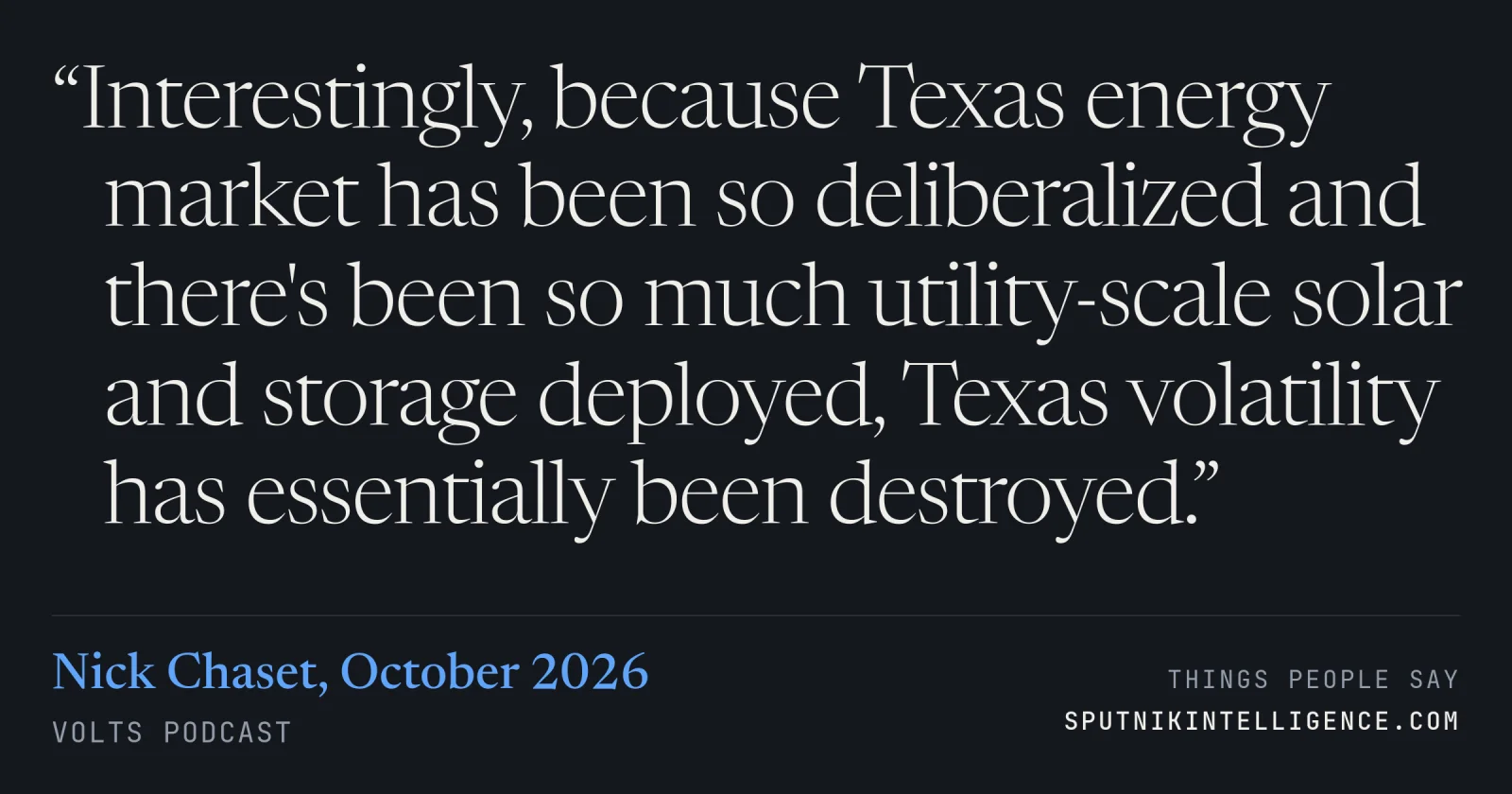
“Interestingly, because Texas energy market has been so deliberalized and there's been so much utility-scale solar and storage deployed, Texas volatility has essentially been destroyed.” — Nick Chaset, Volts

David Roberts asked how Octopus Energy's Texas business is doing. Chaset said it's going well, but customers there show less interest in flexibility programs than in other markets, because grid-scale batteries have flattened the price swings that made shifting demand worth money.

Volts · 2026-10-21 Permalink → Listen →
Volts Around 11:48 into the episode
Nick Chaset

Forced choice in Texas.

David Roberts

They do. Okay. All right.

Nick Chaset

Yep, exactly right. So, the business underlying business is going well. We're not seeing as much active participation in flexibility programs as we have in other markets. Interestingly, because Texas energy market has been so deliberalized and there's been so much utility-scale solar and storage deployed, Texas volatility has essentially been destroyed.

David Roberts

Yes, this is such a fascinating story. This is such a really over

Nick Chaset

the last 12 to 18 months. And so, flexibility, especially in an energy-only market and one like in Texas, where transmission and distribution rates for residential customers are essentially charged on a flat volumetric rate. The whole value prop of flexibility is interday price arbitrage, right?…

David Roberts

going to get to that too.

Speaker names come from our own diarization. The position is estimated from where the line sits in the episode.

Collections They Appear In