JM

Jason Ma

Things Jason Says on Podcasts

Where to Find Them

Jason Ma has been a guest on CRYPTO 101 , Latent Space and RoboPapers .

Recently: “Dyna-2: General Purpose Physical Agents with Hour-Long Autonomy — Jason Ma, Dyna Robotics” on Latent Space (October 2026); “Ep#99: DYNA-2: A 1 Million Hour Scaling Law for World-Action Models” on RoboPapers (August 2026); “Ep. 576 The Future of Communication on the Blockchain with Axelar” on CRYPTO 101 (December 2023).

What They Said

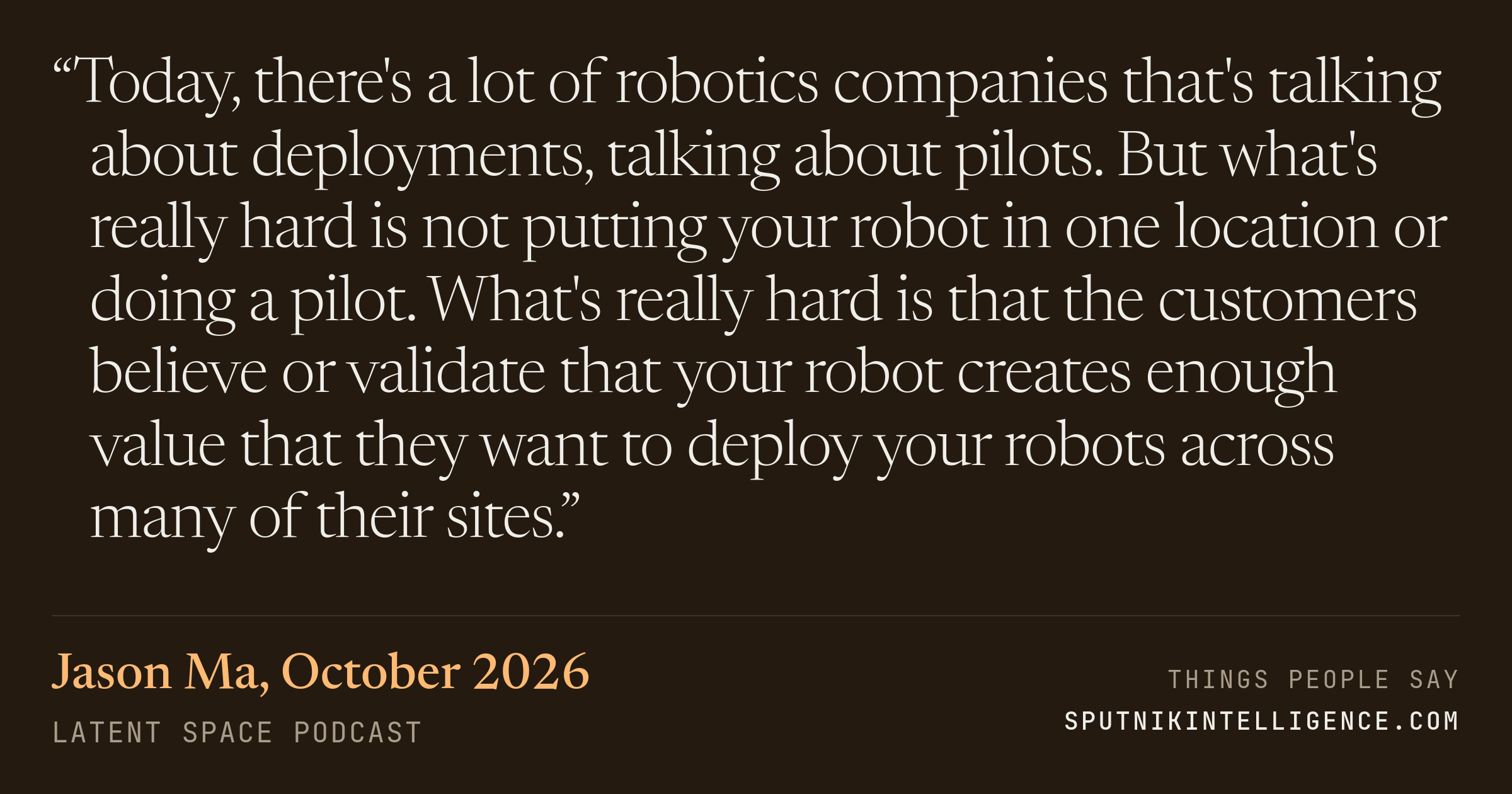
“Today, there's a lot of robotics companies that's talking about deployments, talking about pilots. But what's really hard is not putting your robot in one location or doing a pilot. What's really hard is that the customers believe or validate that your robot creates enough value that they want to deploy your robots across many of their sites.” — Jason Ma, Latent Space

Ma describing Dyna's biggest scaled customer, a restaurant chain where its robots fold thousands of napkins a day across many US locations. He draws a line between a pilot and a customer that chooses to roll the robots out across its sites.

Latent Space · 2026-10-13 Permalink → Listen →
Latent Space
Jason Ma

You know, the best. Very thin wrappers. Yeah. We should have filmed there. Yeah, we should have just filmed there.

Speaker 2

Obi-roll will be.

Jason Ma

Yeah, but in Dentai Phone, like if you go to Denta Phone or other, you know, somewhat upscale restaurant, there's napkins on your table, right? So our robots today fold thousands of napkins for many, many different locations, many different Dentai Phone locations in the United States. So that's actually our biggest scaled customer, right? So I want to make a distinction here. Today, there's a lot of robotics companies that's talking about deployments, talking about pilots. But what's really hard is not putting your robot in one location or doing a pilot. What's really hard is that the customers believe or validate that your robot creates enough value that they want to deploy your robots across many of their sites. So that's what's happened for us with Dentai Phone, which to the best of my knowledge hasn't really happened for other companies doing similar general purpose robots. So at Dentai Phone, our robots fold thousands of napkins per day. The quality standard is extremely high, you know, because they want like, okay, the second folder seam of the napkin is only like a couple centimeters below the, I…

Speaker 2

At some level, that's why robotics are good for. Robots are good for too, right? Humans are not the most consistent. Yes. Especially in small details, whereas a robot can somewhat do it perfectly. It's interesting, that's the example you bring for general purpose robotics versus at some level, I…

Jason Ma

Yeah, I'm sure maybe you can, right? But the hard thing about manipulating deformable object, right? Like napkin, towels, everything is deformable. There's just infinitely many possible configurations. So that's really hard for a specialized robot. And what we find is that by developing a general…

Speaker 1

Is that actually the second use case?

Speaker names from our own diarization · position estimated from where the line sits in the episode
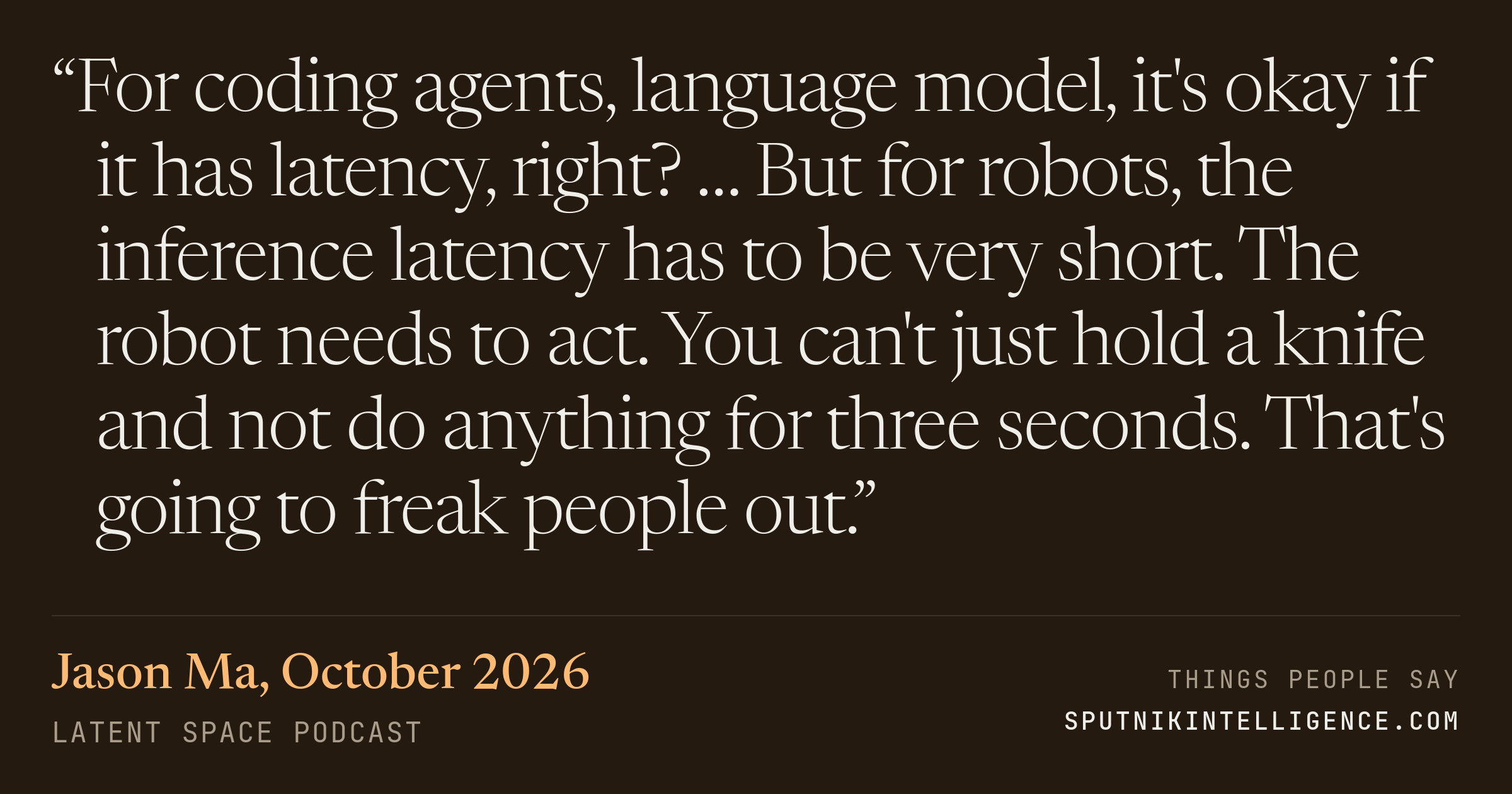
“For coding agents, language model, it's okay if it has latency, right? … But for robots, the inference latency has to be very short. The robot needs to act. You can't just hold a knife and not do anything for three seconds. That's going to freak people out.” — Jason Ma, Latent Space

Ma, of Dyna Robotics, answering whether robot models run on the device, in the cloud or both. He explains why physical agents can't tolerate the few-second pauses people accept from chatbots.

Latent Space · 2026-10-13 Permalink → Listen →
Latent Space
Jason Ma

…I'm just really excited about this reaction because I think even though we have scaled to a million hours of data, we are deploying a bunch of robots. The robots actually already starting to do very cool things. We're just at the beginning, just the tip of iceberg for what is there to come.

Speaker 2

…20B is very fit for your average MacBook. Then there's a larger one that's fit for a single GPU. Do you work in the constraints of robot model on device in cloud, a hybrid? And then how does that affect your scaling law of data? A million hours is great, but do we just scale up parameters, data?

Jason Ma

Yeah, no, that's a great question. So I think what's really different about robots versus language model and other applications is that for coding agents, language model, it's okay if it has latency, right? But like, you know, today, whenever I ask ChatGPT, it takes like a couple of seconds before it spits out anything. But for robots, like the inference latency has to be very short. The robot needs to act. You can't just hold a knife and not do anything for three seconds. That's going to freak people out.

Speaker 2

We saw someone put their real hand under our

Jason Ma

models pretty smart, so that's okay. But in general, if you think about very dynamic tasks, for example, you want your robot to hold a, I don't know, a tennis racket and juggle the ball. It's very dynamic, very reactive. You can't just like, the physics gravity doesn't wait for you. So for that…

Speaker 4

you have

Speaker names from our own diarization · position estimated from where the line sits in the episode

Collections They Appear In