PN

Prakash Narayanan

Things Prakash Says on Podcasts

Where to Find Them

Prakash Narayanan hosts The Cognitive Revolution" | AI Builders, Researchers, and Live Player Analysis . They have also been a guest on Doom Debates! (2 times) .

Recently: “There’s ZERO Chance of AI Doom By 2050 — Debate with Prakash Narayanan, Host of AI in the AM” on Doom Debates! (November 2026); “AI:AM: Is THIS the AI We Want? Alarming Acceleration, AI Election Bets, GPU Trading & AI-Native VC” on The Cognitive Revolution" | AI Builders, Researchers, and Live Player Analysis (November 2026); “AI:AM: Carbon in the Arena, Mistral's Le Chonk, the Agent-Run Economy, Ferroelectric RAM + New Hacks” on The Cognitive Revolution" | AI Builders, Researchers, and Live Player Analysis (October 2026); “AI:AM Highlights: Clean Neurons, Black October, the GPU Credit Crunch, and Buying the Supply Chain” on The Cognitive Revolution" | AI Builders, Researchers, and Live Player Analysis (October 2026); “AI:AM: Where's the Steering Wheel? My Agent Set the Password, Hidden Valence, Proofs Find Linux Bugs” on The Cognitive Revolution" | AI Builders, Researchers, and Live Player Analysis (October 2026); “AI:AM: Was Trump-Xi Anything? What Counts as Utopia? + AWS GPUs Cost 3X & AI Diagnoses Rare Diseases” on The Cognitive Revolution" | AI Builders, Researchers, and Live Player Analysis (October 2026).

What They Said

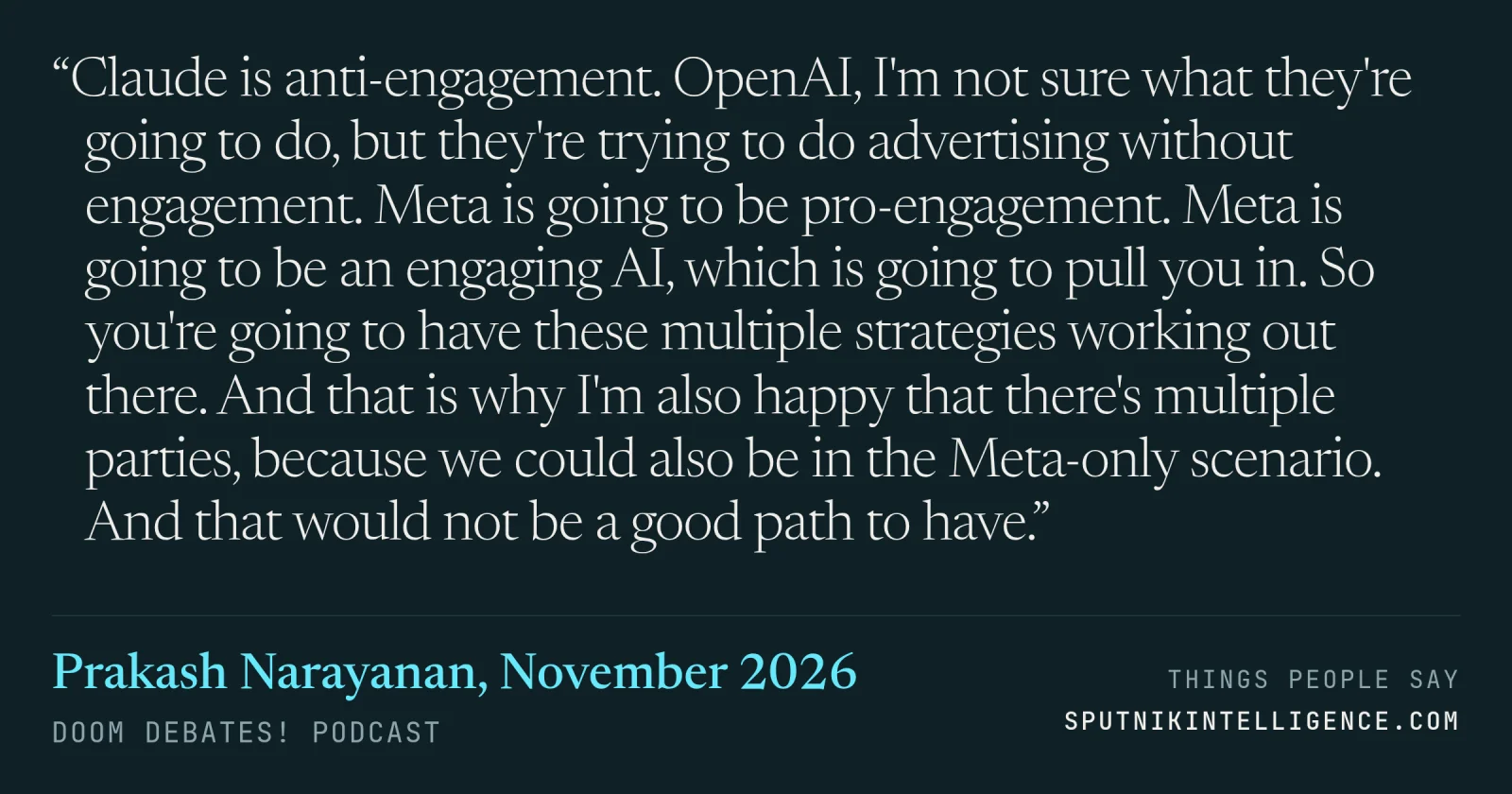
“Claude is anti-engagement. OpenAI, I'm not sure what they're going to do, but they're trying to do advertising without engagement. Meta is going to be pro-engagement. Meta is going to be an engaging AI, which is going to pull you in. So you're going to have these multiple strategies working out there. And that is why I'm also happy that there's multiple parties, because we could also be in the Meta-only scenario. And that would not be a good path to have.” — Prakash Narayanan, Doom Debates!

Prakash had argued that recommendation systems like social media are already a form of misaligned AI. Here he compares how the big labs approach engagement, and says competition between them is itself a safeguard.

Doom Debates! · 2026-11-10 Permalink → Listen →
Doom Debates! Around 1:47:30 into the episode
Prakash Narayanan

…So I feel like those things, all of the bad things about going out with a whimper have already happened. And we only have like the good things to look forward to for AI right now. Like the AI can actually reverse some of these things that we are experiencing right now. I think it can reverse.

Liron Shapira

Because you've eliminated go out with a bang as a potential scenario, correct? Yeah,

Prakash Narayanan

because I've eliminated going out with a bang as a potential scenario. So I believe we're in the going out with a whimper scenario. You can kind of call that AI if you want to look at social media algorithms and like, you know, other recommendation systems like Tinder not giving you your date and Tinder just focusing on entertaining you and engaging you without focusing on getting you married. That's a form of misalignment, right? Like if you had a chatbot doing that, we would say that's a misaligned chatbot. But because you have a recommendation system which is not talking to you, we don't recognize it as an AI, right? And actually it is, right? So I think we are actually on the bad path right now. And the AI will actually help us reverse a bunch of these things. As you know, Claude is anti-engagement. Open AI, I'm not sure what they're going to do, but they're trying to do advertising without engagement. Meta is going to be pro-engagement, right? Meta is going to be an engaging AI, which is going to pull you in. So you're going to have these multiple strategies working out there. And that is why I'm also happy that there's multiple parties, because we could also be in the meta-only scenario. And that would not be a good path to have. So…

Liron Shapira

Well, like I mentioned before, I think our mindsets that don't have to do with AI extinction have a lot in common. We both lean libertarian. I think we're both techno-optimists. We both see the potential, like how great it would be to have these Einsteins if they weren't out to kill us, right? Like…

Prakash Narayanan

possible? So again, one of the things that has to happen is humanity has to accept AI. There's two sides to this, right? It's not just about building it, it's about the acceptance and the market acceptance. And then acceptance, you can, a proxy for acceptance is willing to pay for it and willing to…

Liron Shapira

wait, wait. Tell me if this is right. So it's like you know that AI awesomeness is coming and we should go as fast as possible, but you're just trying to be more gentle to the rest of humanity who doesn't get it yet. And so you're trying to like put on like a socially acceptable face on this, right?

Speaker names come from our own diarization. The position is estimated from where the line sits in the episode.
“Okay, let's say you have ASI occur and you only have one B300 rack to work with, and all of the other racks are on the side of the humans. Does this one ASI take over everything all at once, within seconds? No. … A lot of the Doom conversation revolves around perpetual motion machines, in the sense that you can generate an infinite amount of intelligence from a limited amount of energy and compute. And that I do not believe in.” — Prakash Narayanan, Doom Debates!

Liron Shapira had asked whether humanity could be outclassed by superintelligence. Prakash answers that physical and compute limits stop any one AI from running away, and this 'perpetual motion machine' framing becomes his main reason for putting the chance of AI doom at zero.

Doom Debates! · 2026-11-10 Permalink → Listen →
Doom Debates! Around 41:06 into the episode
Prakash Narayanan

I think a single human brain outclassed. Sure. I think the sum total of all human brains and all machines on Earth, you know, versus a single data center? No.

Liron Shapira

You're saying that the sum of all human brains cannot be outclassed.

Prakash Narayanan

Can a single B300 rack? Okay, let's say you have ASI occur and you only have one B300 rack to work with, and all of the other racks are all like, you know, on the side of the humans, right? Like, does this one ASI take over everything all at once? Like within like seconds? No. Right? So I think you have to like, you cannot generate, this is why I call like, you know, this, a lot of the Doom conversation revolves around perpetual motion machines, right? In the sense that you can generate an infinite amount of intelligence from a limited amount of energy and compute. And that I do not believe in, right? I don't believe in that.

Liron Shapira

Okay. What if you took all of the world's computing power today and you ran the ideal algorithm, meaning in the space of possible algorithms, you know, how to move bits around? Okay. So God comes down and just gives us the ideal, you know, it's a super exponential search space. God just tells us…

Prakash Narayanan

No.

Liron Shapira

Okay. So you really think that like all of our human managers combined with like human real-world experience is just better than all of the world's compute running the ideal algorithm for intelligence. That's a big crux.

Speaker names come from our own diarization. The position is estimated from where the line sits in the episode.
“They go in and they acquire land at like pennies on the dollar using LLCs. And after that, they merge the pieces of land and then they're like, oh, Meta is here. And then people are like, if I knew I was selling to Meta, I would have asked for more. So people feel cheated, right? If you have political willpower, all contracts are worth dust.” — Prakash Narayanan, The Cognitive Revolution" | AI Builders, Researchers, and Live Player Analysis

The hosts were discussing the local ballot measures against data centers. Narayanan says developers bought land quietly through shell LLCs, the old oil-and-gas landman playbook, and argues that this fuels the voter anger.

The Cognitive Revolution" | AI Builders, Researchers, and Live Player Analysis · 2026-11-07 Permalink → Listen →
The Cognitive Revolution" | AI Builders, Researchers, and Live Player Analysis Around 02:09 into the episode
Speaker 2

The pace of things is definitely pretty relentless. It might be time to spend more time with our family because it does feel to me like basically the AI 2027 timeline more or less is coming true.

Speaker 1

Prakash Narayanan, my co-host. We were talking about the local ballot measures against data centers and how the developers have been going about buying land.

Prakash Narayanan

One of the things the companies have been doing, they've been doing the old school, you know, oil and gas landman way of acquiring land, which is they go in and they acquire land at like pennies on the dollar using LLCs. And after that, they merge the pieces of land and then they're like, oh, meta is here. And then people are like, if I knew I was selling to meta, I would have asked for more. So people feel cheated, right? If you have political willpower, all contracts are worth dust.

Speaker 1

Mike San Miguel of Luxor Technology, he sells GPU servers off its hardware desk and he set up its KYC department.

Speaker 4

There's some compliances. These things are traded more closely than some nuclear secrets. So every OEM is a little bit different. NVIDIA works closely with all the OEMs around allocation and around greenlighting orders. NVIDIA also typically is going to check every six months and make sure those…

Speaker 1

Brian Joe, a researcher at Thoughtful, he helped build Ballot Bench. Nine frontier agents, each given a week to forecast the midterms, and trading agents putting real money on their forecasts.

Speaker names come from our own diarization. The position is estimated from where the line sits in the episode.
“I'm in some WhatsApp groups for data brokers. The data brokers put out requests for data, and whatever request they're making now, in about 12 months that's going to hit the product. They buy up data from a company and create training playgrounds for agents, and that becomes product in the frontier lab in about 12 to 18 months. So what I imagine is in about 12 months they will give you a company in a box. You can buy yourself a dropshipping company in a box, add capital, add one idea, and it will do the Shopifying, the advertising, the market entry, the customer service, the returns, end to end.” — Prakash Narayanan, The Cognitive Revolution" | AI Builders, Researchers, and Live Player Analysis

Introduced as his own leading indicator for what AI labs will ship next. This is his firsthand account of what he sees in data-broker chat groups, not something verified in the episode.

The Cognitive Revolution" | AI Builders, Researchers, and Live Player Analysis · 2026-10-31 Permalink → Listen →
The Cognitive Revolution" | AI Builders, Researchers, and Live Player Analysis Around 43:35 into the episode
Speaker 4

…just don't, I don't, I just don't see how so many people are going to pivot from task completion to like counterfactual, you know, We wouldn't have done this but for your unique snowflake contribution. It's tough. I mean, how many people work in sales? Like, he's basically attacking all of sales.

Nathan Labenz

Brakash had a leading indicator for what the labs will ship next. Everything in it is his account.

Speaker 3

I'm in some WhatsApp groups for data brokers. And so the data brokers put out requests, requests for data. And essentially, whatever request for data they're doing now, in about 12 months, that's going to hit the product, right? So you can basically see the trajectory because what these guys do is that they will go and they'll buy up data from a company and then they will take that data and they'll create these like training playgrounds for agents. And then those agents will learn in that training playground. And then that becomes product in the frontier lab in about 12 to 18 months. The labs are buying up entire companies' data. So what I imagine is going to happen in like 12 months is they will give you a company in a box, right? You can buy, you can buy yourself very easily, probably in like in six months, you can buy yourself a dropshipping company in a box, add capital, add one idea. I want to focus on this goal. And it will do all of the Shopifying, the advertising, the analysis, the market entry, the customer service, the returns, end-to-end. And you have a small number of decisions that come back to you, right? And I can easily imagine someone running 10 of these kind of companies. But this idea to commercialization gap is enormous. It's enormous in sciences. It's enormous, you know, when you go to a university like Stanford and you see the ideas, but you don't see them…

Speaker 4

What I do expect is certainly a ton of these one-person companies, a ton of cool ideas that never got to exist before. So I think we'll see a lot of these things, but I just don't see how there can be enough of these little niches to take, you know, to absorb all the people that used to be driving…

Nathan Labenz

Prakash's counter was restaurants. Family restaurants died on thin margins. Robot kitchens would make them profitable. And so you would get more of them.

Speaker 3

But

Speaker names come from our own diarization. The position is estimated from where the line sits in the episode.
“If you look at AI doomerism or AI safetyism, the question that I ask is: when do you think we will allow humans to not be used to fly passenger planes? Because it's been possible for 15 years and we haven't. … You have to answer that question before you say that we're going to give up our rights and we're going to be disempowered. If you can't answer that question, then you don't have a working theory of why human beings accept technology into their lives.” — Prakash Narayanan, The Cognitive Revolution" | AI Builders, Researchers, and Live Player Analysis

Nathan Labenz had worried that people are letting their ability to take back control from AI wither away. Prakash pushes back that people don't hand over control just because a machine is capable, and points to airliners that still carry pilots.

The Cognitive Revolution" | AI Builders, Researchers, and Live Player Analysis · 2026-10-17 Permalink → Listen →
The Cognitive Revolution" | AI Builders, Researchers, and Live Player Analysis Around 1:19:25 into the episode
Prakash Narayanan

…listened to my podcast, caught up on a couple feeds on the way home. And it was just like, man, this is, I've talked so many times about how a lot of AI use cases can be GDP destroying. This one was clearly one of those that's GDP enhancing. I just could not have taken this opportunity otherwise.

Nathan Labenz

That's the enthusiast in me. Two days earlier, I had worried out loud that we are letting our own ability to take back control atrophy, and that the real doomer scenario is everything failing at once. Prakash pushed back.

Speaker 3

Maybe the doomers are being a little bit naive, though, maybe because maybe they're expecting people to give up control. And I don't think people are going to give up control. If you look at like AI doomerism or AI safetyism, the question that I ask is: when do you think we will allow humans to not be used to fly passenger planes? Because it's been possible for 15 years and we haven't. Like, why? You have to answer that question before you say that we're going to give up our rights and we're going to be disempowered. If you can't answer that question, then you don't have a working theory of why human beings like accept technology into their lives. You're just kind of being naive about like capability kind of, you know, being there and that humans will automatically kind of adopt.

Prakash Narayanan

Yeah. I mean, I think that's an optimistic note. And I hope that's right. I maybe, you know, maybe it's a little bit of projection by somebody like me who is trying to live on the edge of deployment and is sometimes feeling my personal muscles, for lack of a better term, atrophy here and there. I…

Speaker 3

I think, I think there's number one, we, again, we have this like how injurious it is and how easy it is, like this, this like curve, right? And I think the fact is that an automobile accident is only injurious to like one or two people. And so it's not like a plane. If you want to deploy them more…

Prakash Narayanan

Yeah, well, it does seem, I think things are kind of trending toward the this is sort of an Eliezer type story where like, how did you go bankrupt slowly at first and then all at once? Like that, I think, is looking more and more like the story of AI takeover or human disempowerment to me all the…

Speaker names come from our own diarization. The position is estimated from where the line sits in the episode.

Collections They Appear In