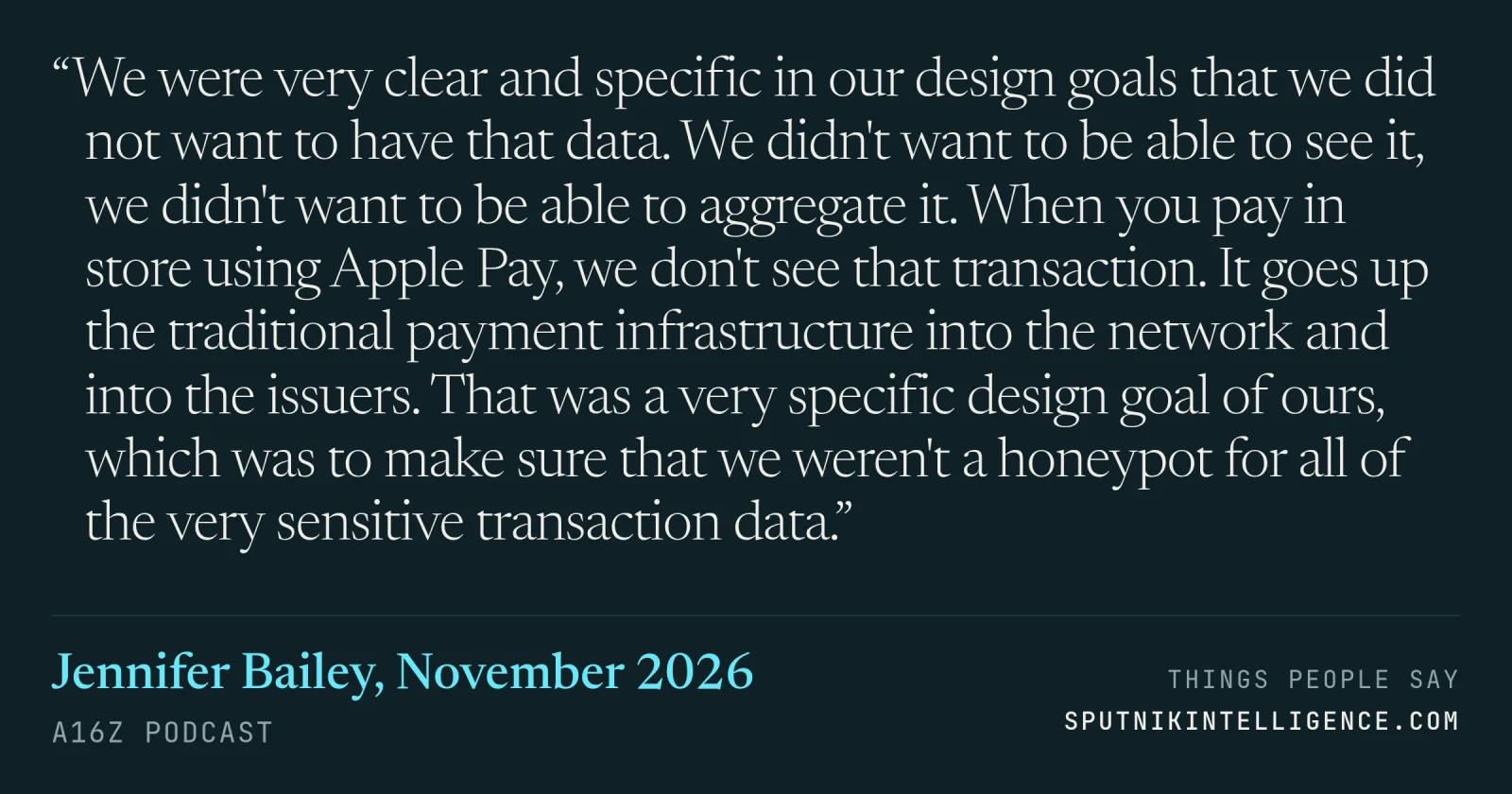
Alex asked how Apple handled privacy and security when building payments on top of old card infrastructure. Jennifer describes the design meetings with the card networks and explains that Apple deliberately chose not to hold transaction data.
…but are now really taking off from a contactless perspective. Those were big markets for iPhones, though. So, we went pretty early and then just started to do the business development work and market development work to get the acceptance that we needed and the footprint that we needed.
…when I pay online, if I'm entering my CBV and all of these account details, I don't know what happens to them when the merchant receives them and they might just store them. And again, if I'm paying with Apple Pay, I don't have to worry about that. Apple is very privacy and security concerned.
Yeah.
How did you try to reinvent things? And I'm sure there was some back and forth with kind of old-fashioned infrastructure along the way.
Yeah, definitely. In the early days in the early design of Apple Pay, we were collaborating with obviously internally on the engineering side, but also with the networks. You know, the tokenization schemes that we use are network-based. So, Visa, MasterCard, Amex, and then now we work with these…
So, maybe we could leap from Apple Pay to Apple Wallet. I'm a big fan of this because last night I took my 15-year-old to a San Francisco Symphony Orchestra concert. My parking pass was in my Apple Wallet. Our tickets were in my Apple Wallet. And now that we've already seen that show, they've…