
JH
Jeff Hancock

Jeff Hancock

Things Jeff Says on Podcasts

Where to Find Them

Jeff Hancock writes The Future of Everything . They have also been a guest on Think Fast Talk Smart: Communication Techniques (3 times) , Super Data Science: ML & AI Podcast with Jon Krohn (2 times) and HBR IdeaCast .

Recently: “1044: In Case You Missed It in October 2026” on Super Data Science: ML & AI Podcast with Jon Krohn (November 2026); “1033: Workslop: The Hidden Cost of AI-Generated Work, with Prof. Jeff Hancock and Dr. Kate Niederhoffer” on Super Data Science: ML & AI Podcast with Jon Krohn (October 2026); “The Hidden Causes of AI Workslop—and How to Fix Them” on HBR IdeaCast (March 2026); “173. Rethinks: Surviving the Holidays” on Think Fast Talk Smart: Communication Techniques (December 2024); “Best of: What happens when computers can write like humans” on The Future of Everything (May 2024); “Best of: What happens when computers can write like humans” on The Future of Everything (May 2024).

What They Said

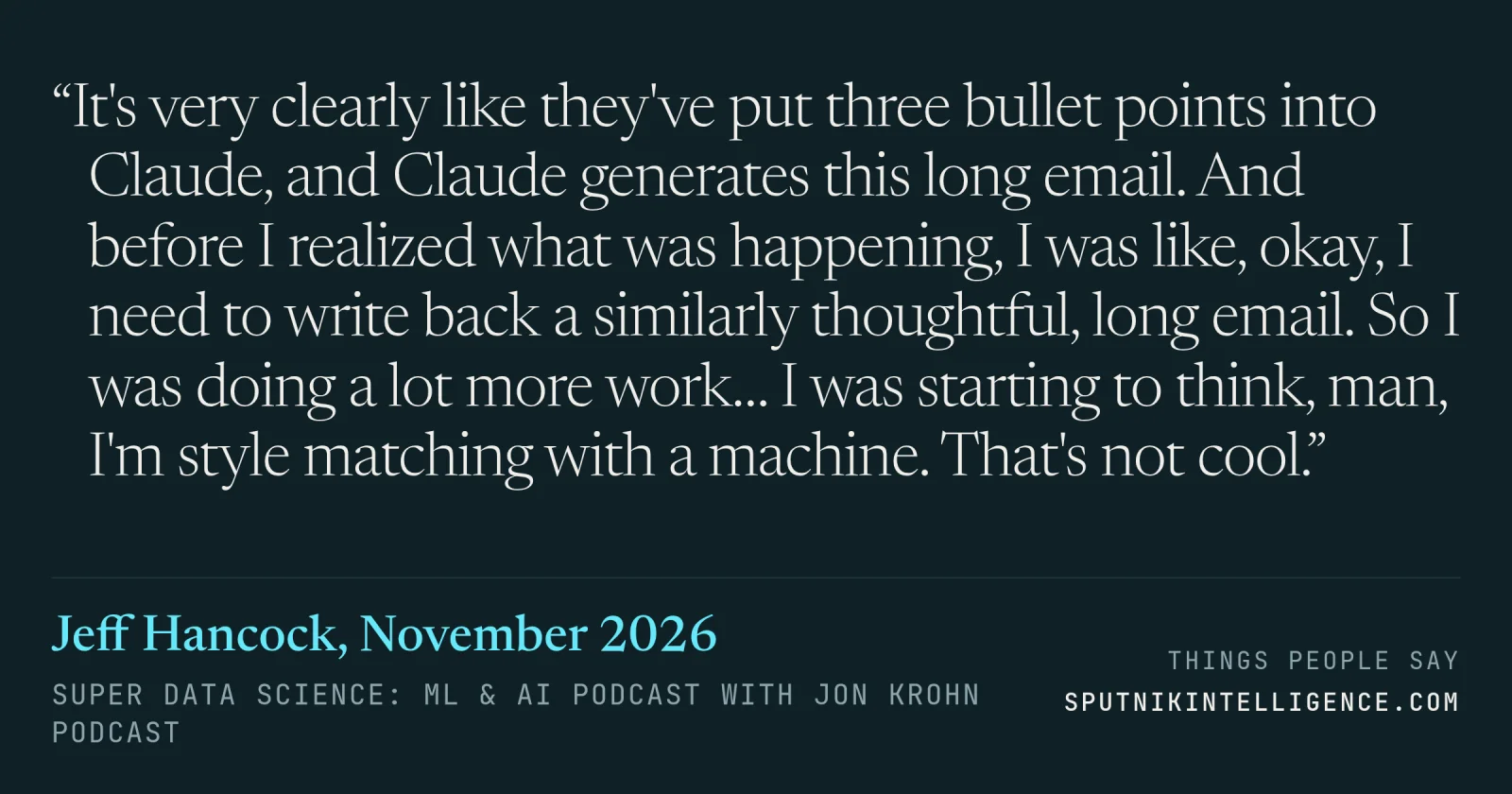
“It's very clearly like they've put three bullet points into Claude, and Claude generates this long email. And before I realized what was happening, I was like, okay, I need to write back a similarly thoughtful, long email. So I was doing a lot more work… I was starting to think, man, I'm style matching with a machine. That's not cool.” — Jeff Hancock, Super Data Science: ML & AI Podcast with Jon Krohn

Jon Krohn had described asking a client to send three bullets instead of long AI-written emails. Jeff Hancock describes catching himself mirroring a machine's length and effort in his replies.

Super Data Science: ML & AI Podcast with Jon Krohn · 2026-11-13 Permalink → Listen →
Super Data Science: ML & AI Podcast with Jon Krohn Around 15:53 into the episode
Speaker 4

…that shifts the burden. The burden is, for lack of a better word, this sounds so AI-generated, but the burden is real. You know, when you receive work from someone else that just doesn't take into account the context that you need to get the work done, that you rely on other people for, it matters.

Jon Krohn

…the client, I was like, I do not have time to be trying to distill from this long email that you wrote what is actually your opinion and what just happens to be randomly generated. And I think that was well received. I think people understand that. What do you guys do to combat work slop? Well, so,

Speaker 2

so. John, did you actually like confront the person, say, look, this is not working for me? And they changed? Or I replied all. I see. So you told everybody, look, I can't figure out these long emails.

Jon Krohn

Everyone that was in that thread, when that email sent, I said, you know, like send me three bullets that describe what you actually want, what you actually think, instead of all of this content because it dilutes. I think work slop often dilutes what the real message is that someone is trying to…

Speaker 2

Yeah, I think that's right. And one is like, you had to do that email. And so that was probably some emotional labor in there. Like, how is that going to be received? That's stressful. I've had the same experience. And there's another cost, which is, so this person I don't know well enough to be…

Speaker 4

The other thing that we've been studying more at Better Up Labs is about sort of good management in this era of AI. And I think a lot of what we're seeing is the importance of human skills, like relationship building, coaching, and alignment. And those come into play quite a bit when you're giving…
Speaker names come from our own diarization. The position is estimated from where the line sits in the episode.
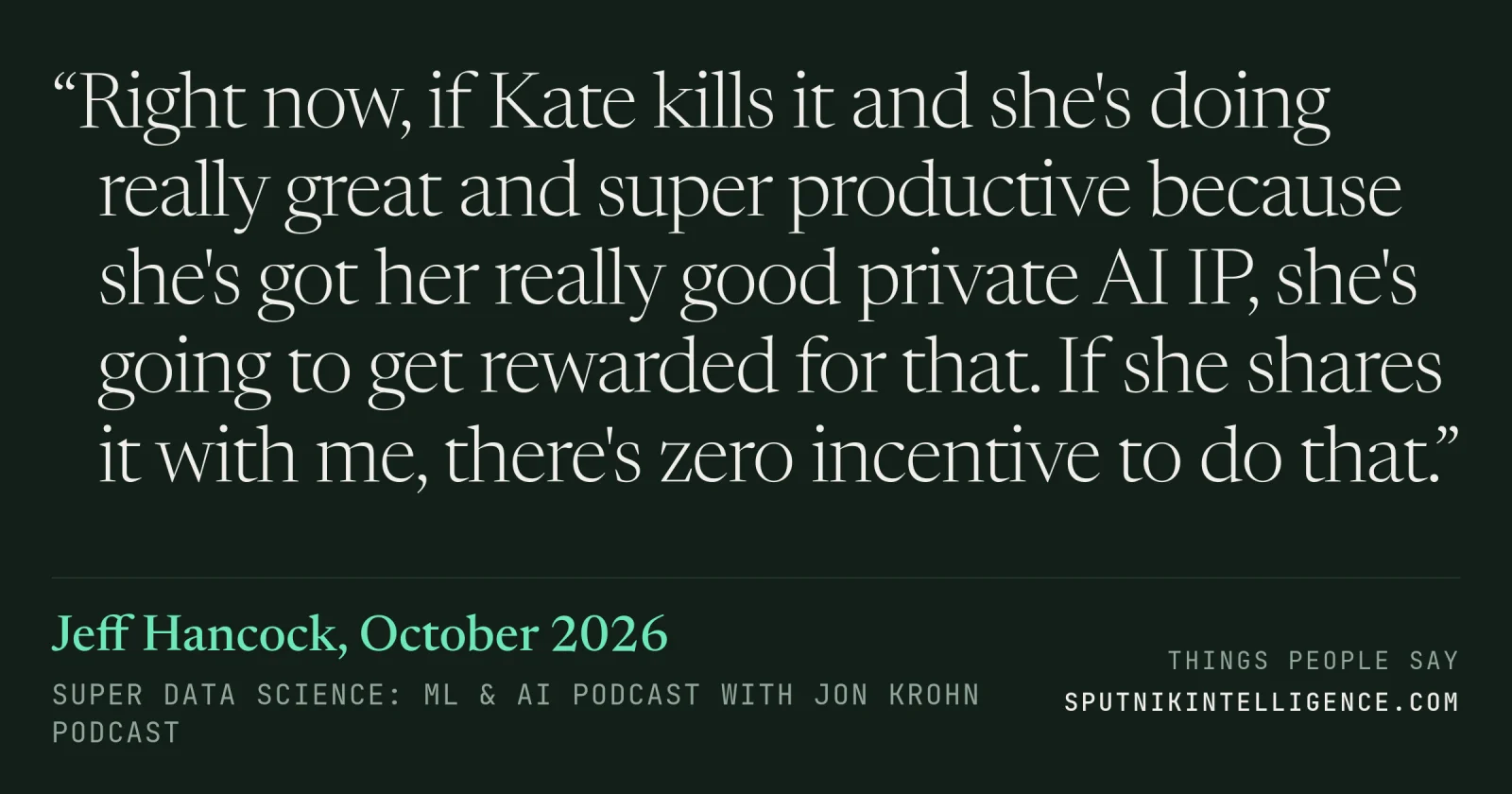
“Right now, if Kate kills it and she's doing really great and super productive because she's got her really good private AI IP, she's going to get rewarded for that. If she shares it with me, there's zero incentive to do that.” — Jeff Hancock, Super Data Science: ML & AI Podcast with Jon Krohn

Kate is Hancock's co-author Kate Niederhoffer, who was also on the episode. He was explaining why good AI practice doesn't spread through organizations: nearly everyone works with their AI tool alone, so nobody sees how a colleague got a result, and sharing prompts still feels odd. He named norms and incentives as the two things that have to change.

Super Data Science: ML & AI Podcast with Jon Krohn · 2026-10-06 Permalink → Listen →
Super Data Science: ML & AI Podcast with Jon Krohn Around 20:17 into the episode
Speaker 3

…much human potential it takes for it to be effective in the organization. Organization and how it can have these enhancing experiences if you use it with agency, if you're aware of the people around you, if you talk about transparently your usage of the tool so that we can effectively coordinate.

Speaker 1

…quickly, but not immediately. Maybe you both will know exactly what I'm talking about. There has been recent research that I think you both published on related to how metaphors of AI indicate that people increasingly perceive AI as warm and human-like. Do you want to tell us more about that paper?

Speaker 2

Yeah, that was actually one of our very first projects. So when Kate Niederhoffer I first started working together in 2023, we wanted to track how people were conceptualizing AI because it was like all in the news. Chat GPT was like, it just blew it up. And so we wanted to get in early and track how people were thinking about AI. It's difficult to ask people about it. Like you can't do a scale because, you know, it's messy and it's never stated. So we use a technique where we ask people about metaphors as a way of like kind of surfacing underlying kind of attitudes and fears, hopes, mindsets in some ways. And we found early on it was like, it's like a computer, it's an encyclopedia. And over from 2023 through, I guess was it end of 2024-ish, it was becoming more human. So more anthropomorphic metaphors, think assistant, teacher, child, moving away from computer, synthesizer, encyclopedia. And then, you know, in psychology, we know that when we meet somebody or a thing, like a robot, it goes, we measure…

Speaker 1

I was using the term wrong. You guys were so kind to me that you didn't even correct me. I kept saying relationship slipping.

Speaker 2

Well, Kate Niederhoffer I figured out that like after like four or five tries, it actually works. But the first few times, it's a bit like you can also use slippage if you like, John.

Speaker 1

I like to figure a sentence that goes, how does this work in a sentence? How's your relation slip going? Or is your relation slip getting worse?

Speaker names come from our own diarization. The position is estimated from where the line sits in the episode.

Collections They Appear In