Richard Socher

Things Richard Says on Podcasts

Founder and CEO of You.com, an AI search company, and of Recursive, a newer venture built around recursive self-improving AI for scientific discovery. He trained as an NLP researcher at Stanford and later ran AI as chief scientist at Salesforce after it acquired his startup MetaMind. His public commentary tracks that arc: large language models and AI agents, but increasingly AI applied to drug discovery, protein folding and computational biology, plus what recursive self-improvement could mean for research itself. He appears as a guest across a wide range of AI-focused podcasts rather than hosting one himself, including The MAD Podcast with Matt Turck, 20VC, Moonshots with Peter Diamandis, Gradient Dissent and The TWIML AI Podcast. He is also a co-founder of AIX Ventures, an AI-focused venture firm, and is frequently cited for early work on word vectors and prompt engineering.

Where to Find Them

Richard Socher has been a guest on This Week in AI (3 times) , The Twenty Minute VC (20VC): Venture Capital | Startup Funding | The Pitch (3 times) , TBPN (3 times) , The MAD Podcast with Matt Turck (3 times) , Moonshots with Peter Diamandis (3 times) , Gradient Dissent: Conversations on AI (2 times) , Bloomberg Tech (2 times) , AI Applied: Covering AI News, Interviews and Tools - ChatGPT, Midjourney, Gemini, OpenAI, Anthropic (2 times) , The TWIML AI Podcast (2 times) , Silicon Valley Girl: AI, Tech and Career Growth , How I Invest with David Weisburd , Raoul Pal: The Journey Man , The Most Interesting Thing in AI , Sourcery , The Information's TITV , The Gradient , Milk Road AI , Latent Space , Unsupervised Learning with Jacob Effron , TechStuff , The Cognitive Revolution" | AI Builders, Researchers, and Live Player Analysis , The Robot Brains Podcast and Super Data Science: ML & AI Podcast with Jon Krohn .

Recently: “Richard Socher on Self-Improving AI and Its Future” on AI Applied: Covering AI News, Interviews and Tools - ChatGPT, Midjourney, Gemini, OpenAI, Anthropic (October 2026); “1037: Recursive Self-Improvement: The Eureka Machine, with Dr. Richard Socher” on Super Data Science: ML & AI Podcast with Jon Krohn (October 2026); “Recursive's $670M Bet on Self-Improving AI, Sonnet 5.5 Hits 70%, Elon Co-Leads Pentagon Push | EP #299” on Moonshots with Peter Diamandis (October 2026); “Why OpenAI Should Buy Off the World’s Top Mathematicians | E32” on This Week in AI (September 2026); “Richard Socher: The Biggest AI Breakthroughs Haven’t Happened Yet” on Milk Road AI (September 2026); “Humanity’s Last Invention — Richard Socher of Recursive” on Latent Space (September 2026).

What They Said

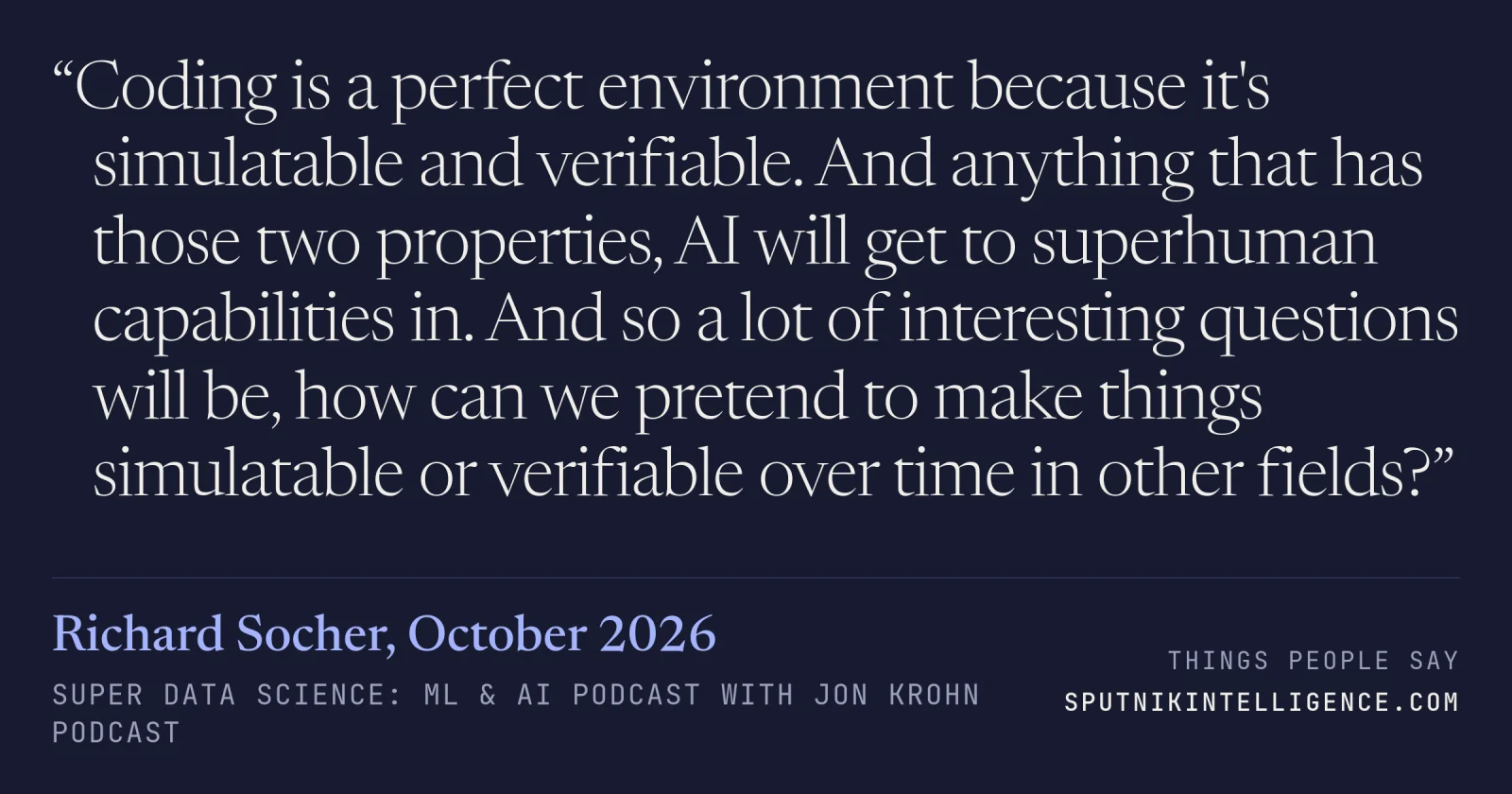
“Coding is a perfect environment because it's simulatable and verifiable. And anything that has those two properties, AI will get to superhuman capabilities in. And so a lot of interesting questions will be, how can we pretend to make things simulatable or verifiable over time in other fields?” — Richard Socher, Super Data Science: ML & AI Podcast with Jon Krohn

Jon Krohn asked about the jump in coding agents over the past year and whether code even needs to stay human-readable. Socher says he saw coding coming years ago and explains why. He also argues that people should keep learning to code, the way they keep going to the gym, even if machines do the lifting.

Super Data Science: ML & AI Podcast with Jon Krohn · 2026-10-20 Permalink → Listen →
Super Data Science: ML & AI Podcast with Jon Krohn Around 54:25 into the episode
Richard Socher

That's right. And again, AI and science will create a lot more of those, like that is kind of abundance.

Jon Krohn

…shared that he no longer writes or even reads raw code by hand. So if AI generated code, Richard, might as well be assembly that nobody reads. I wonder if there's even a point in code being human-readable. Maybe it would be more token efficient if we just had it in embedding layers or something.

Richard Socher

Yeah, I think it's not crazy to think about different ways. I do think ultimately, if something really, really matters, like there's some very important proof point for like, you know, a cryptographic protocol or something, right? Where you're like, that proof better be right. Otherwise, like, we cannot use this as like a tool, right? Then you do want to be able to go and still understand that code and have it be somewhat human readable. I guess, you know, most humans cannot actually read programming code, but at least a few humans should be able to read it. And so, but yeah, I think it could eventually result in new programming languages. Certainly, it's a new paradigm. And this is something that I think computer science has been better at as a field than almost any other field. And that is build tools and enable everyone to keep moving up in layers of abstraction. No one has to work on an assembler anymore. No one has to even work in C anymore and think about pointers and where that object is in RAM. I mean, it's always useful to have a few experts still know all these…

Jon Krohn

I think that mind gym idea makes a huge amount of sense. I think probably a lot of people on the planet wouldn't go for it voluntarily, just like they don't voluntarily go to lift weights. And it's an interesting thing because it seems like most people want to look fit, you know, want to be fitter.…

Speaker 3

That's right. I think that's exactly right.

Jon Krohn

The last thought. So I've got some audience questions for you based on a LinkedIn post that I recently asked. But just before we get there, the last thing that I want to end on is this constructive optimism philosophy that you've talked about. So I feel like it ties together a lot of what we've…
Speaker names come from our own diarization. The position is estimated from where the line sits in the episode.
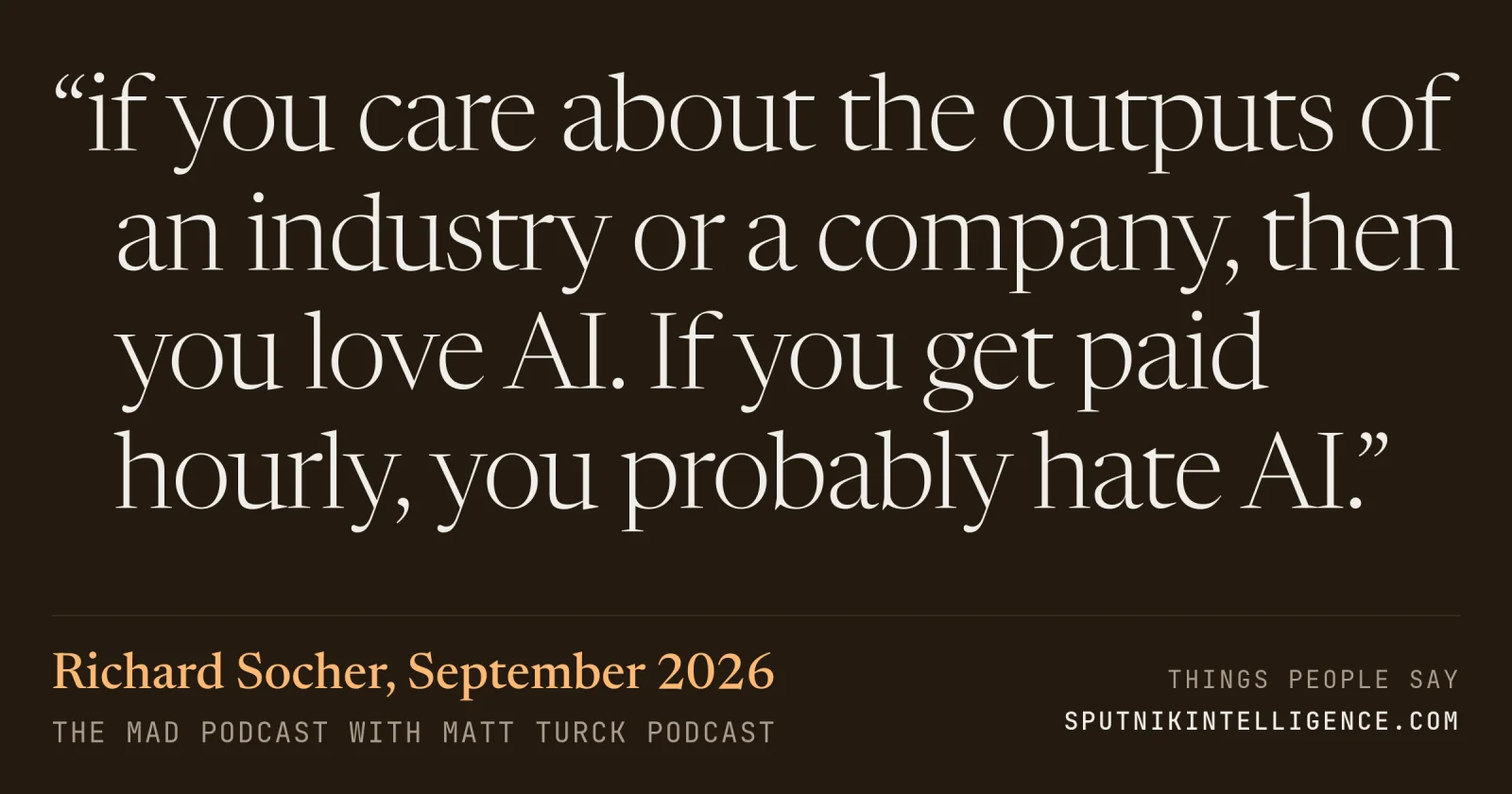
“if you care about the outputs of an industry or a company, then you love AI. If you get paid hourly, you probably hate AI.” — Richard Socher, The MAD Podcast with Matt Turck

Matt Turck had just asked about the industry's stock defense of itself — that AI is going to cure cancer. Socher doesn't answer that directly. He reframes the whole controversy as a split between people who own the output of a business and people who sell their hours to it, then argues the upside case for AI is that it pushes more people into the first group.

The MAD Podcast with Matt Turck · 2026-09-10 Permalink → Listen →
The MAD Podcast with Matt Turck Around 26:51 into the episode
Richard Socher

…in late stage trials, they actually within six to 18 months have multiple different drugs in like late stage two trials already. And by the time they'll go public, it'll be with like eight plus different drugs that are then also much more likely to succeed because we have better predictive models.

Matt Turck

…controversial, whether that's the job question or the data center question. The number one thing the industry keeps saying as a way to justify why AI is a great thing is AI is going to cure cancer. What is your sense of the reality of that claim and what it's going to take to get there? There's

Richard Socher

a lot to unpack there. Maybe at a very high level, I think if you care about the outputs of an industry or a company, then you love AI. If you get paid hourly, you probably hate AI. And so AI in the positive instantiation of this future is a huge force towards more entrepreneurial thinking. If you're an entrepreneur, generally you kind of love AI because it's making your things more efficient. You just get more done. You have to like, you have an unlimited list of things to do if you're a startup founder or just running a company. And to have an AI do many of those things…

Matt Turck

Is that precisely the point that cancer is just extremely complex and ultimately a system problem

Richard Socher

that AI

Matt Turck

is uniquely equipped to solve? Exactly.

Speaker names come from our own diarization. The position is estimated from where the line sits in the episode.

Collections They Appear In