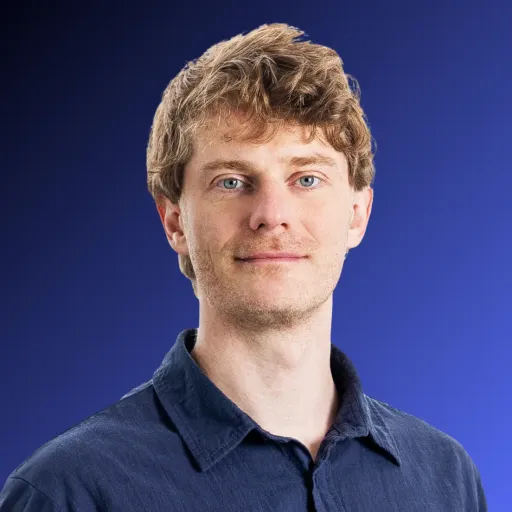
 Richard Socher
Founder and CEO of You.com, an AI search company, and of Recursive, a newer venture built around recursive self-improving AI for scientific discovery.
“Coding is a perfect environment because it's simulatable and verifiable. And anything that has those two properties, AI will get to superhuman capabilities in. And so a lot of interesting questions will be, how can we pretend to make things simulatable or verifiable over time in other fields?”
Super Data Science: ML & AI Podcast with Jon Krohn · AI Builders · October 2026
Jon Krohn asked about the jump in coding agents over the past year and whether code even needs to stay human-readable. Socher says he saw coding coming years ago and explains why. He also argues that people should keep learning to code, the way they keep going to the gym, even if machines do the lifting.
Transcript
That's right. And again, AI and science will create a lot more of those, like that is kind of abundance.
…shared that he no longer writes or even reads raw code by hand. So if AI generated code, Richard, might as well be assembly that nobody reads. I wonder if there's even a point in code being human-readable. Maybe it would be more token efficient if we just had it in embedding layers or something.
Yeah, I think it's not crazy to think about different ways. I do think ultimately, if something really, really matters, like there's some very important proof point for like, you know, a cryptographic protocol or something, right? Where you're like, that proof better be right. Otherwise, like, we cannot use this as like a tool, right? Then you do want to be able to go and still understand that code and have it be somewhat human readable. I guess, you know, most humans cannot actually read programming code, but at least a few humans should be able to read it. And so, but yeah, I think it could eventually result in new programming languages. Certainly, it's a new paradigm. And this is something that I think computer science has been better at as a field than almost any other field. And that is build tools and enable everyone to keep moving up in layers of abstraction. No one has to work on an assembler anymore. No one has to even work in C anymore and think about pointers and where that object is in RAM. I mean, it's always useful to have a few experts still know all these…
I think that mind gym idea makes a huge amount of sense. I think probably a lot of people on the planet wouldn't go for it voluntarily, just like they don't voluntarily go to lift weights. And it's an interesting thing because it seems like most people want to look fit, you know, want to be fitter.…
That's right. I think that's exactly right.
The last thought. So I've got some audience questions for you based on a LinkedIn post that I recently asked. But just before we get there, the last thing that I want to end on is this constructive optimism philosophy that you've talked about. So I feel like it ties together a lot of what we've…
More from Super Data Science: ML & AI Podcast with Jon Krohn