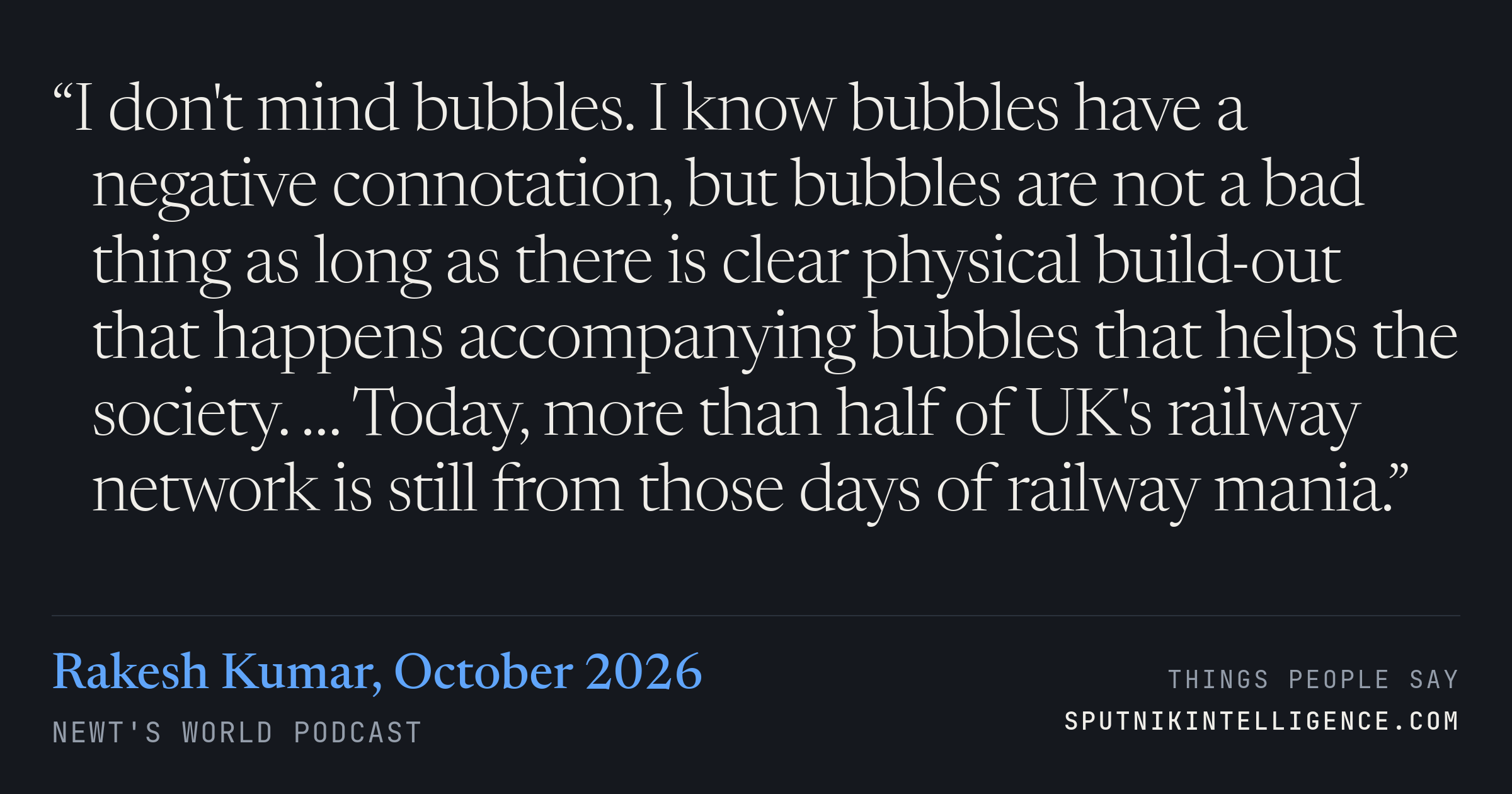
“I don't mind bubbles. I know bubbles have a negative connotation, but bubbles are not a bad thing as long as there is clear physical build-out that happens accompanying bubbles that helps the society. … Today, more than half of UK's railway network is still from those days of railway mania.”
Newt's World · US Politics · October 2026
Asked whether AI is a break point, the author of a book on the history of chips points to the 1840s railway mania and the fiber laid during the dot-com boom. What worries him is the debt financing AI, if it turns out to have exposure to public banks.
Transcript
…ships? We will see how this plays out, but this is a highly consequential competition here because some of the most strategic technologies of the world AI, quantum computing, biotechnology, renewable energy, who wins these races will depend critically on who owns the world's most advanced ships.
…And I think accelerating. When you look back on all this with The chip age, as you describe it, as your book is entitled. Do you think we're at a break point where artificial intelligence is a dramatic difference, or do you think this is just an acceleration of a momentum that was already underway?
…large quantum jumps in the society's productivity. And one of the reasons is that those who are really good with using these technologies get benefits disproportionately and those who get left out really get left out. So when you average it over the entire society, the benefits aren't as large. So we will see what is the impact that this has on society. society's productivity. The way I see it, I don't mind bubbles. I know bubbles have a negative connotation, but bubbles are not a bad thing as long as there is clear physical build-out that happens accompanying bubbles that helps the society. To give you an example, one of the well-known bubbles was in 1840s. It was called Railway Mania. This was in the UK where railways were relatively new back then and its boosters were started talking about how wonderful this new thing is. And then people, even retail investors, started putting their money into railway shares. And at some point, there was so much speculation that happened around…
Amazing. Listen, you have a remarkable knowledge about one of the most important areas of our generation. So, Rakesh, I want to thank you for joining me. Your new book, The Chip Age, How Semiconductors Became the World’s Most Powerful Resource, is available wherever books are sold starting October…
Thank you for inviting me. I really enjoyed the conversation.
Thank you to my guest, Rakesh Kumar. Newt's World is produced by Gingrich360 and iHeartMedia. Our executive producer is Garnsey Sloan. Our researcher is Rachel Peterson. Special thanks to the team at Gingrich360. If you've been enjoying Newt's World, I hope you'll go to Apple Podcasts and both rate…
More from Newt's World