 Jordan Schneider
ChinaTalk Founder and EIC
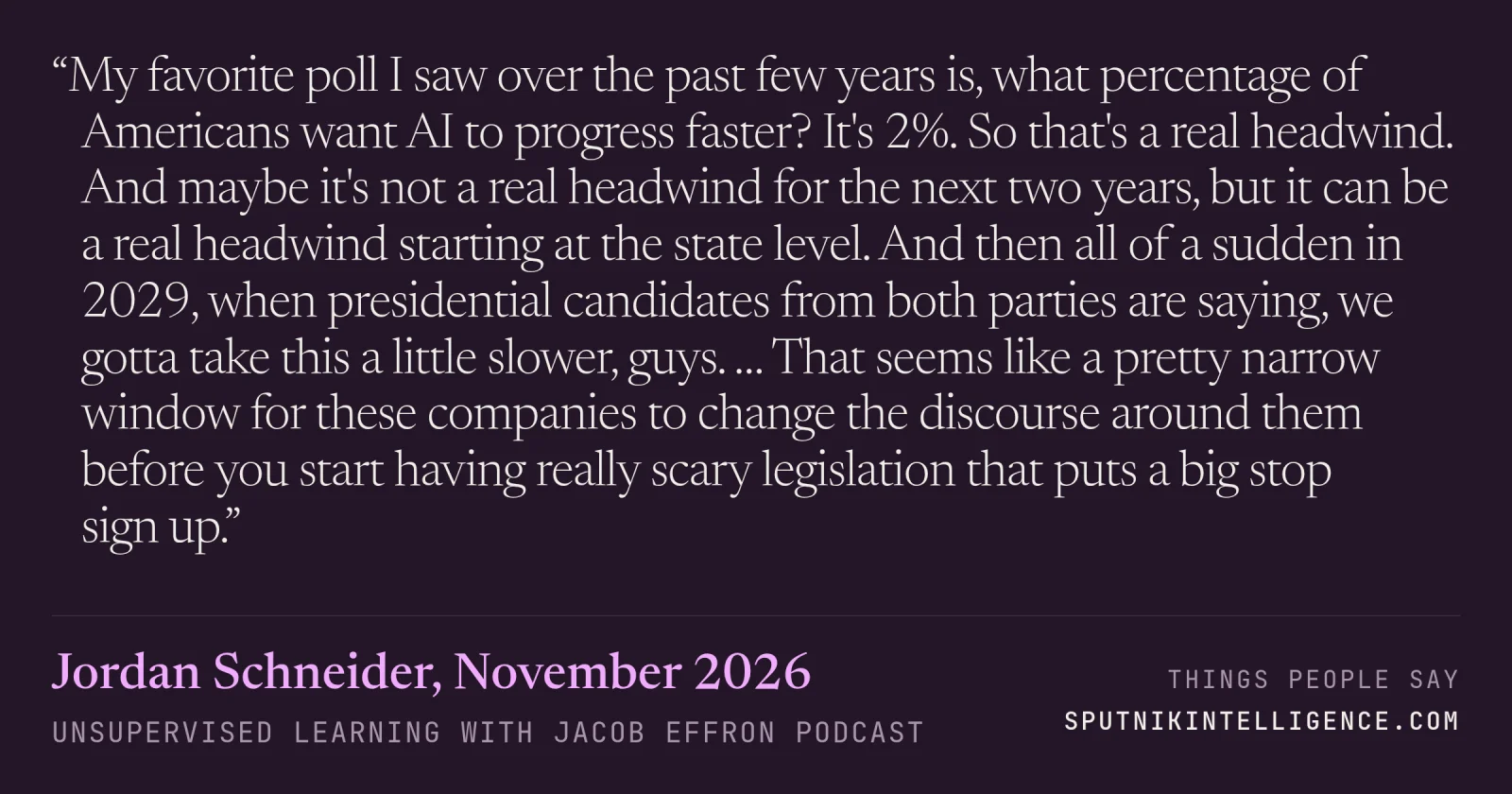
“My favorite poll I saw over the past few years is, what percentage of Americans want AI to progress faster? It's 2%. So that's a real headwind. And maybe it's not a real headwind for the next two years, but it can be a real headwind starting at the state level. And then all of a sudden in 2029, when presidential candidates from both parties are saying, we gotta take this a little slower, guys. … That seems like a pretty narrow window for these companies to change the discourse around them before you start having really scary legislation that puts a big stop sign up.”
Unsupervised Learning with Jacob Effron · AI Builders · November 2026
Context
After the host said Jensen Huang's return strengthens the AI build-out, Jordan Schneider points to the thing Nvidia can't control: public hostility to AI, and how it could turn into legislation.
Transcript
I guess I think the question is like the question at the end of the day is like, is the revenue going to be there? Right. For like, like, is AI going to deliver the productivity gains that it needs to over the next few years in order to keep the party going? I
…yes, he cannot control whether like scaling laws exist in robotics or biology. He cannot control whether like we cross the chasm from coding into other use cases like quickly or not. But if we do, he's going to accelerate like his him being in that place accelerates, I think, all of these things.
Yeah. I mean, I think the other thing he can't control, and this is kind of where I want to take the conversation, is like just how much people hate this stuff. So, you know, we've had the data center backlash, right? Like AI, like my favorite poll I saw over the past few years is like, what percentage of Americans want AI to progress faster? It's 2%. So like, you know, that's a trick. That's a real headwind. And maybe it's not a real headwind for the next two years, but it can be a real headwind starting at the state level. And then all of a sudden in 2029, like when presidential candidates from both parties are saying, like, we gotta, we gotta take this a little slower, guys. Like, we don't like what it's doing to our society, to our labor market, whatever. I mean, that seems like a that seems like a pretty narrow window for these companies to change the discourse around them before you start having like really scary legislation that presses a big, you know, puts a big stop sign up. And the other question is like, it's not just unpopularity, right? It's like the like, you know, cyber chaos, right? Like everyone was like blaming last week on AI, which is not like literally AI tax. But I don't know, you kind of got to get through the looking glass like pretty quickly before you start having political pushback, which really stops the diffusion of the…
Obviously, AI has like a big PR and marketing problem. And I think, you know, there's a reason for that. It's a lot of the way people have been talking about it. And like to date, you know, there's only some sub part of the population that is really, you know, if you're coding and math, you've seen…
you're not getting people's cancer drugs in three years, right? Like that's just not going to happen. Like you need to do tests. You got to like, like, I'm trying to understand what are the like developments that we can see over the next 18 months, which leads a Democratic president or even a…
Yeah. I mean, I think the optimistic side would be, you know, yes, sure, you're not going to have like drugs in clinic, but certainly like you could have very promising, like, you know, very promising assets that are like people are really excited about. Maybe some have emergency compassionate use…
More from Unsupervised Learning with Jacob Effron