 Jordan Schneider
ChinaTalk Founder and EIC
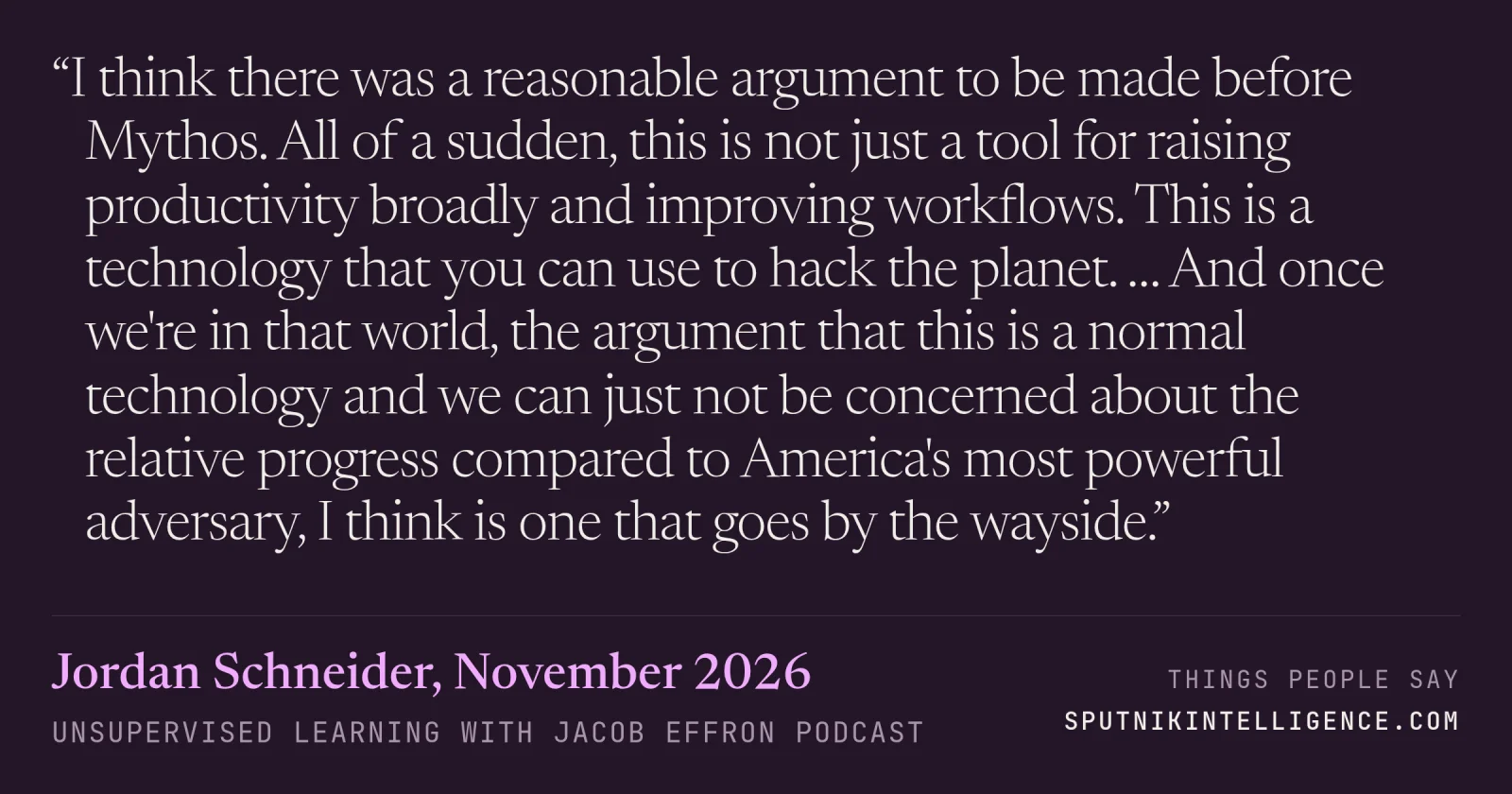
“I think there was a reasonable argument to be made before Mythos. All of a sudden, this is not just a tool for raising productivity broadly and improving workflows. This is a technology that you can use to hack the planet. … And once we're in that world, the argument that this is a normal technology and we can just not be concerned about the relative progress compared to America's most powerful adversary, I think is one that goes by the wayside.”
Unsupervised Learning with Jacob Effron · AI Builders · November 2026
Context
Asked what he'd say to people who think selling chips to China makes sense, Jordan Schneider says the "normal technology" premise collapsed once AI became a cyber weapon. It's the core of his case for tight export controls.
Transcript
Well, Trump said that they talked about it and they said she said like he's a brilliant man. And one of the things that Trump said on CNBC earlier today was like, he said, he said, I was worried that if he didn't get his job back, he would go work for a Chinese company. So
…people use to program kernels get stronger by the more volume that's that's done on a certain chip. And so, you know, why cede that to someone else? I know you have a strong opinion on this, but what would you say to the set of folks that believe this type of thing makes sense? Jensen clearly does.
Two points. So first, there's the sort of the Jensen postulate that this is a normal technology and that that doesn't have real national security implications. Because if it does, then you have to take this sort of thing seriously. And I think there was a reasonable argument to be made before Mythos, right? Because all of a sudden we have had, you know, this is not just a tool for like raising productivity broadly and improving workflows and whatnot. This is a technology that you can use to hack the planet, right? And we've seen that over the past nine months with all these, you know, all these AI-enabled cyber attacks. So by empowering, like, yes, it's a dual-use technology. It also does the other things. It also helps you cure cancer or whatever. But like very, very clearly, there is a direct tie to like how advanced your model is, how many chips you have to deploy it, and how well you can hack other countries. And like once we're in that world, the argument that this is a normal technology and we can just like not be concerned about, you know, the relative progress compared to America's most powerful adversary, I think is one that goes by the wayside. So then there's like another version of this, which is like, oh, they would…
Yeah. I mean, I thought the truth is probably somewhere in the middle where there's like, there is a virtuous cycle of like building models that are co-developed with chips. And in the process of that, like both optimizing them, like learning to optimize models for those specific pieces of…
This is all true, but it's like, okay, that's all true. But if the Western ecosystem has 15 times the amount of compute, it's just rounding. Like all the co-development crap is just a rounding error. And as long as the U.S. doesn't sell UV machines and fancy Esch and Dipo and Depot, and as well as…
depends on your timeframe. So I understand why the Anthropic folks are the most vehemently. If your timeframes are like the only thing that matters is the next 12, 18 months, and then it's kind of like game over, then yeah, you certainly don't want to like,
More from Unsupervised Learning with Jacob Effron