 Patrick McKenzie
Spent six years at Stripe working on payments infrastructure before moving to an advisory role there, after founding several small software companies over the p...
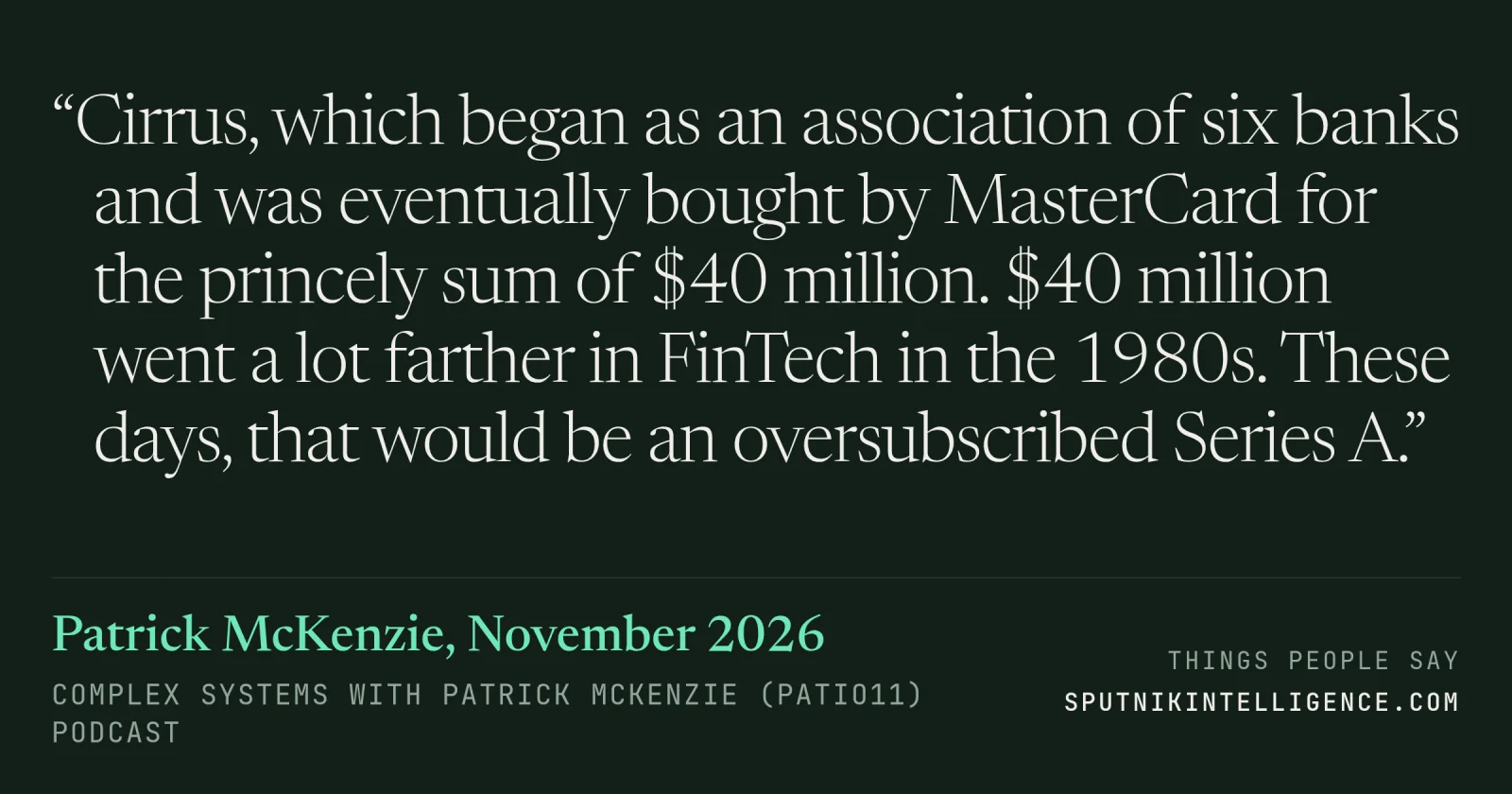
“Cirrus, which began as an association of six banks and was eventually bought by MasterCard for the princely sum of $40 million. $40 million went a lot farther in FinTech in the 1980s. These days, that would be an oversubscribed Series A.”
Complex Systems with Patrick McKenzie (patio11) · Startups & Venture · November 2026
Context
Reading his essay aloud, McKenzie explains how early ATM networks let operators negotiate once instead of with every bank. The aside compares one network's sale price with modern startup funding rounds.
Transcript
…want to be in the business of negotiating with operators who only have 10 ATMs. Operators would prefer to have the addressable market of everyone rather than a subset of the foot traffic in front of their ATM. Customers don't want to have to search overtown for a compatible ATM, particularly in the days before smartphones. And so so-called interbank networks began forming. One early one was Cirrus, which began as an association of six banks and was eventually bought by MasterCard for the princely sum of $40 million. $40 million went a lot farther in FinTech in the 1980s. These days, that would be an oversubscribed Series A. Cirrus's pitched operators was simple. For the price of one negotiation and integration, they could light up customers across multiple banks. Cirrus would continue working to expand the number of banks who worked with them, and this would passively increase the reach of any ATM bearing the Cirrus logo. In return for this, operators would pay Cirus a fee for transactions facilitated. And what did…
I think the acknowledgement of an ad read sounds cooler in Japanese.
Complex systems is presented by Mercury, celebrating the launch of Mercury Payroll. Payroll, benefits, and compliance built right into your Mercury account. Congratulations, you've done the hard work. Found someone great and figured out how to afford them, whether that was by raising or revenue.…
Thanks for tuning in to this week's episode of Complex Systems. If you have comments, drop me an email or hit me up at Patty11 on Twitter. Ratings and reviews are the lifeblood of new podcasts for SEO reasons, and also because they let me know what you like.
More from Complex Systems with Patrick McKenzie (patio11)