Going through the S-1's unusual governance and share structure, Patrick moves to the employee charitable-giving match. He contrasts it with a typical corporate match of one-to-one up to a few thousand dollars a year. Equity worth eight and nine figures, given away at 3:1, adds up to a very large cost.
Complex Systems with Patrick McKenzie (patio11) · 2026-11-06
Permalink →
Listen →
Complex Systems with Patrick McKenzie (patio11)
Around 16:46 into the episode
Patrick McKenzie
…do seem to be quote unquote more aligned than one would suggest for most tech companies at that stage with that employee count, at that revenue growth rate, et cetera, et cetera. Not that there is another company at that revenue growth rate to point to, but we will get to that in a moment, I think.
Zvi Mowshowitz
…people who have very, very cautiously signaled that they want to influence the future in general in good ways rather than build personal wealth and maximize profits. Those are the people who will ultimately make the tiebreaking vote in this situation. And that is exactly what that was selected for.
Patrick McKenzie
I couldn't find if this was explicitly called out in the S1, and I will edit the transcript if I missed it in my first two readings. But their matching program for employees might be one of the most expensive single corporate decisions ever made in the history of capitalism. The matching program for employees was, I hear, calibrated to essentially allow employees to do something similar to what the founders were doing and give away 80% of their economic stake. And to make those numbers work, they said that the corporation will basically match employee donations on a three-to-one basis, which is unheard of in the rest of capitalism. And additionally, like typically…
Zvi Mowshowitz
Yeah, but they got what they wanted out of it. And if you want to strongly differentiate, you know, how much it's worth to you, if you're committed to the mission, if you're not committed to the mission, it's going to be expensive. And when you turn out to be the fastest growing company in history…
Patrick McKenzie
I failed that control F prior to recording. The S1 does indeed mention the donation matching program in a few places. For example, it says that the class N shares are reserved against the need to make good on these commitments. And the company took a $2 billion non-cash charge in Q3 related to it.…
Speaker 1
I think the acknowledgement of an ad read sounds cooler in Japanese.
Speaker names come from our own diarization. The position is estimated from where the line sits in the episode.
In a postscript added after recording, Patrick revises his earlier view that Anthropic's slower Q3 growth reflected how customer cohorts stack up. He says the S-1 shows Anthropic buying GPUs on the spot market at a premium, so the slowdown points to a lack of chips, not a lack of customers.
Complex Systems with Patrick McKenzie (patio11) · 2026-11-06
Permalink →
Listen →
Complex Systems with Patrick McKenzie (patio11)
Around 24:40 into the episode
Patrick McKenzie
About 15x in the first half, right?
Zvi Mowshowitz
…There's also some talk about quarter three just being a slow period for growth, relatively speaking, due to the calendar. But my expectation is that quarter three was relatively slow, but that quarter four has picked up again, and you will see some very, very large growth. Numbers out of Anthropic.
Patrick McKenzie
…12 to 18 months in advance. And so in roughly Q1 or Q2 of 2025, they had to make a guess as to how compute efficient a yet to be released Opus 5.5 would be and how many customers would be willing to use it. Anthropic seems to have underestimated Horn's fees, parallelance elsewhere, seems perhaps simply not to have been aggressive enough in anticipatorily contracting against the coming demand. Their Q3 revenue softening isn't a demand story. It's a supply story. They're running all the GPUs they have and it just isn't enough. Supporting evidence. They talk about hitting the spot market for GPUs for $5 billion at substantially more than their multi-year commitments typically run in such a way as to eat 10% of the margin just from the shift in the mix. You'd assume low tens of percent of revenue is served by Spot Compute, but that spot compute made up 50% of their compute spend for the quarter. The S1 says short-term…
Zvi Mowshowitz
Yep, it's really hard to say. There's a lot of different factors. We have very little visibility for a variety of obvious reasons. Reasons, we have to endlessly hear the same people predict the imminent fall of OpenAI and Anthropic and the imminent commodification of the models and the imminent…
Patrick McKenzie
I think reasonably well-calibrated people could think, you know, just on priors, not paying much attention to what AI is doing. I've just heard this story before. This time is different as a meme. You know, this feels in some ways like the classic examples from Bern Hobart and Tobias's book on…
Zvi Mowshowitz
There are so many differences with that model that exists here, one of which is that the initial investment is not initially idle or useless. There is actually overwhelming demand for everything that you can get right now, while the systems get clearly better at a very rapid pace. So, even if…
Speaker names come from our own diarization. The position is estimated from where the line sits in the episode.
Patrick turns to the Binance hack, which he links to North Korea and AI-assisted hacking. He predicts a backlash against the labs even though he argues software was always insecure. The line frames the cost of fixing that insecurity as something the labs both caused and profit from.
Complex Systems with Patrick McKenzie (patio11) · 2026-11-06
Permalink →
Listen →
Complex Systems with Patrick McKenzie (patio11)
Around 1:10:03 into the episode
Patrick McKenzie
…thing to say when it's like the thing that will be economically irrelevant is the one that was doing 15x revenue gain on a base of more than a billion dollars. But we are priced into a wild, wild few years, regardless of what happens to stock prices or individual returns to securities, I think.
Zvi Mowshowitz
Yeah, I mean, I think that's pretty much guaranteed. And the pace of things are accelerating. The hacking is only getting worse, it looks like, over the last few days.
Patrick McKenzie
Can we discuss the hacking briefly? I think there's going to be a bit of backlash against the labs for this because I don't think it's true that the labs made us more vulnerable to it. Software has been insecure for the entire lifetime of software. That's the default way to create it. And we are lately getting exposed to the bill via AI-uplifted hack incidents, where the, in most cases, it seems like the actual tool used to uplift the hackers was not directly one of the labs products, but it was one of the open weights models that were created with substantial reliance on distilling the labs products. Although there have been cases of documented misuse of the labs products directly against various targets. And so yesterday we had like two major incidents where I started the morning thinking, wow, polymarket had a loss which was large and now inconsequential. And then Binance had a hack loss north of $5 billion and counting to North Korea, which speaking of like AI impacts on the global economy, we have already passed the portion at which AI is more than 5% of the GDP of a nation. It's more than 5% of the GDP of North Korea by enabling them to innovate in their business model of stealing money from crypto people. And I shouldn't kick crypto too much. They're only stealing the money from crypto people preferentially because that is like the lowest hanging fruit. After they have taken many…
Zvi Mowshowitz
No, I feel like you're painting kind of the optimistic case where there's this fixed set of technical debt that we endured. And mostly it's just the bill is coming due much faster than it would have otherwise come due, which is forcing you to deal with this via AI, which is going to cost you a lot…
Patrick McKenzie
I also don't think of it as a one-time bill, but just like the backlog is already priced into $500 billion.
Zvi Mowshowitz
Right. The issue is that, like, you know, the moment we get down to that 500 billion, you know, I don't think that that results in something that is now robust. I think that's like, you know, now the next level of things, the next set of dominoes start to fall. I think it was very reasonable…
Speaker names come from our own diarization. The position is estimated from where the line sits in the episode.
McKenzie was reading aloud his 2022 Bits About Money essay on charitable donations. He used the line to introduce donor-advised funds, which act as a kind of time machine for donors whose income arrives in a different year from when they want to give.
Complex Systems with Patrick McKenzie (patio11) · 2026-10-22
Permalink →
Listen →
Complex Systems with Patrick McKenzie (patio11)
Around 00:00 into the episode
Speaker 1
Welcome to Complex Systems, where we discuss the technical, organizational, and human factors underpinning why the world works the way it does. Hideo, everyone. My name is Patrick McKenzie, better known as Patty 11 on the internet. When I still worked at Stripe, I worked with Nan Ronzahoff, who did Stripe Climate and has done some other things as well. This year, she wrote an essay called The Third Wave of American Philanthropy, which focuses on the AI-generated tidal wave of charitable giving, which is coming down the pike. And as that gets increasingly metabolized by the rest of society, one word that you're going to hear a lot is DAF for donor-advised fund. As it happens, I wrote about donor-advised funds as both a user of them on the donor side and on the charity fundraising side a few years ago, and I think understanding this a little bit is going to be very useful for people. So I thought I would read a classic essay from Bits…
Speaker 2
I think the acknowledgement of an ad read sounds cooler in Japanese.
Speaker 1
Cool, right? So picture this. You've finally recruited that engineer you've been eyeing for months. The interview feedback was unanimous, totally cracked. Their salary and equity grant were pricey, but worth it. You can't wait to get them to work. On filing expense reports? No, of course. You've…
Speaker 2
Thanks for tuning in to this week's episode of Complex Systems. If you have comments, drop me an email or hit me up at Patty11 on Twitter. Ratings and reviews are the lifeblood of new podcasts for SEO reasons, and also because they let me know what you like.
Speaker names come from our own diarization. The position is estimated from where the line sits in the episode.
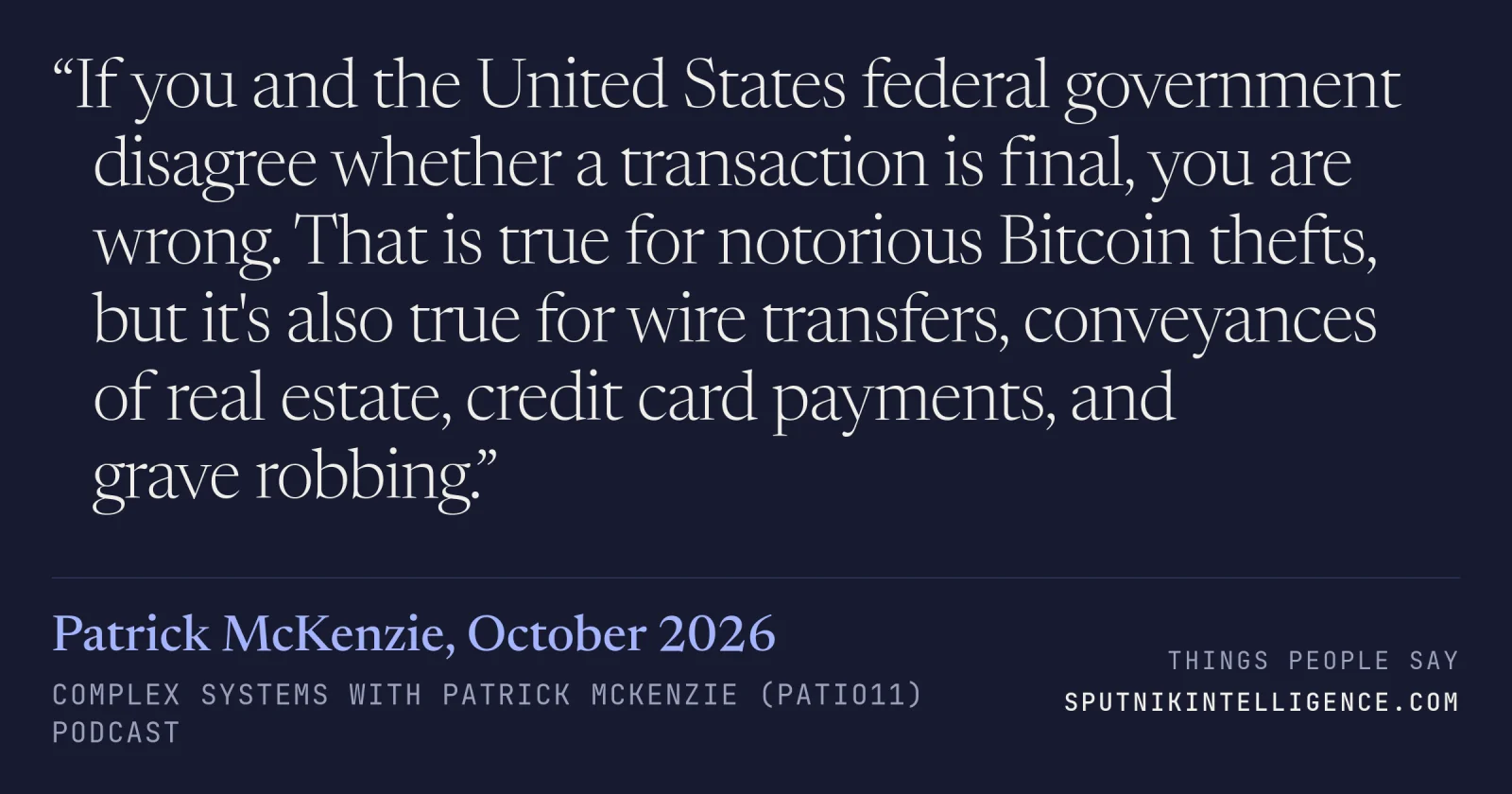
McKenzie reading aloud from his own 2022 essay, "Finality does not exist in payments". He has just described a 2016 Bitcoin transaction worth about $70 million that was partially voided in 2022, something no code base provides for. His argument is that finality is a social and legal construct, not a technical one.
Complex Systems with Patrick McKenzie (patio11) · 2026-10-08
Permalink →
Listen →
Complex Systems with Patrick McKenzie (patio11)
Around 00:00 into the episode
Patrick McKenzie
Welcome to Complex Systems, where we discuss the technical, organizational, and human factors underpinning why the world works the way it does. Most people have an intuitive ranking of payment finality. Put a $20 burger on your credit card, and you know if something goes wrong that you can dispute it. But you send a wire, and you think the money is just gone because wires are final. That's what wires are for. In August 2020, Citibank accidentally wired nearly $900 million to a group of lenders. Some sent it back. Some said, wires are final. We're keeping it. A federal judge agreed with them. Two years and one appeal later, they gave it all back. I have a classic essay on this topic, and then I'd like to riff a little bit to apply it to the Citibank case, which I think a lot of people misunderstand a bit. Finality does not exist in payments, originally published in Bits About Money on February 15th, 2022. Children have a culture all of their own, and one sacred ritual of it, and sometimes in places, is no takes these backseats. Like much…
Speaker 2
I think the acknowledgement of an ad read sounds cooler in Japanese.
Patrick McKenzie
Cool, right? So picture this. You've finally recruited that engineer you've been eyeing for months. The interview feedback was unanimous. Totally cracked. Their salary and equity grant were pricey, but worth it. You can't wait to get them to work. On filing expense reports? No, of course. You've…
Speaker 2
Thanks for tuning in to this week's episode of Complex Systems. If you have comments, drop me an email or hit me up at Patty11 on Twitter. Ratings and reviews are the lifeblood of new podcasts for SEO reasons, and also because they let me know what you like.
Speaker names come from our own diarization. The position is estimated from where the line sits in the episode.
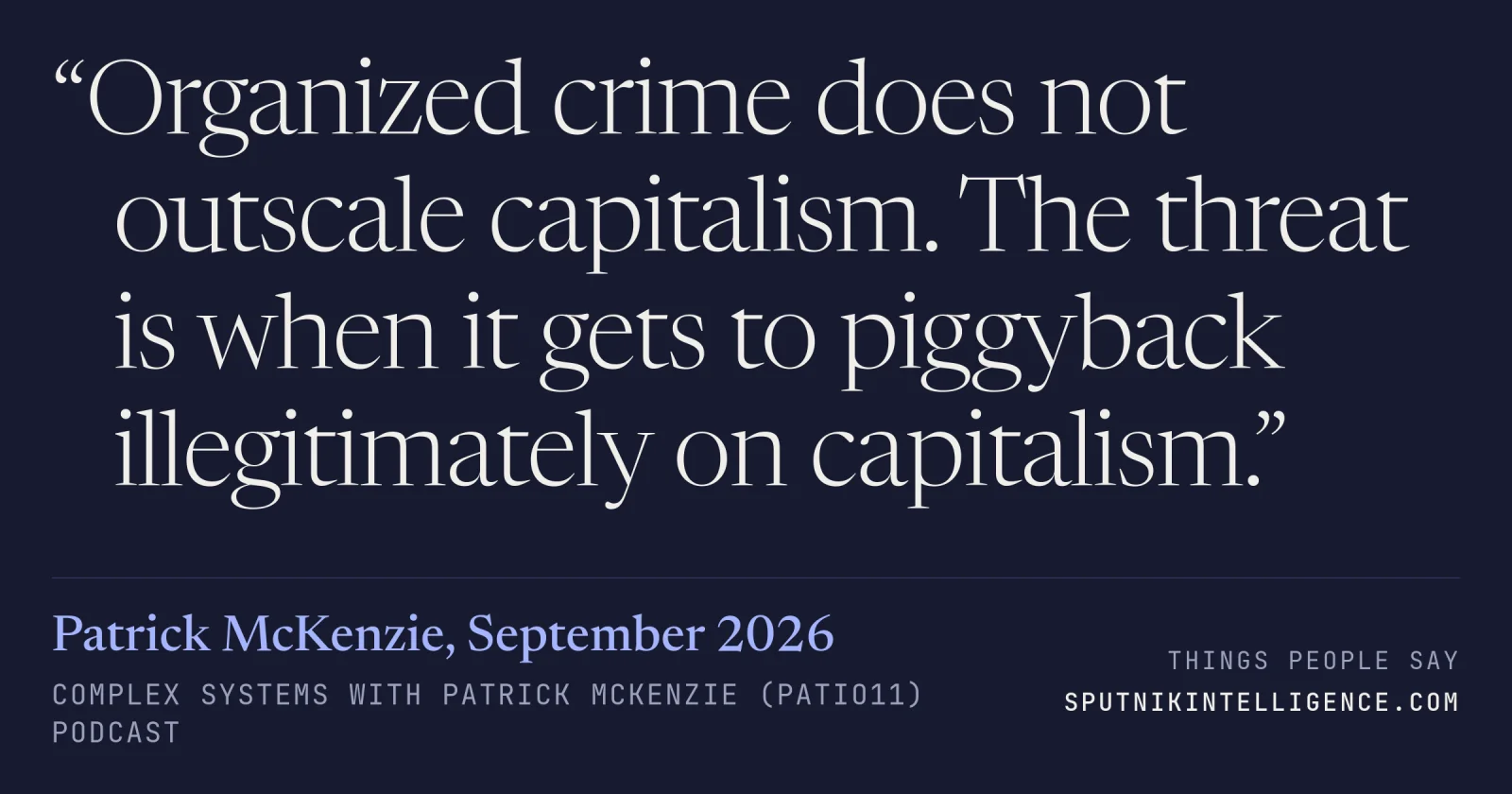
McKenzie is reading his own essay on the wallets business, and had just deflated the long-running media story about elaborate fake e-commerce sites built to harvest card numbers. His point is that the real volume of stolen card data comes from breaches at companies that were legitimately handed millions of cards in the course of business. It sets up why PayPal's original pitch — never show the seller your card number at all — was worth something.
Complex Systems with Patrick McKenzie (patio11) · 2026-09-03
Permalink →
Listen →
Complex Systems with Patrick McKenzie (patio11)
Around 00:00 into the episode
Patrick McKenzie
…or afterwards, but this would not be the first or last time the media convinced itself of an untruth and then was unable to find an industry insider to leak them a SQL query dispelling their fantasies. The largest source of poor bank credit card information is scaled breaches of card issuers or companies that were legitimately presented hundreds of thousands or millions of card in commerce. Organized crime does not outscale capitalism. The threat is when it gets to piggyback illegitimately on capitalism. And so that was the initial value proposition of PayPal. Convey money from your own payment instruments to others on the internet, by volume, mostly eBay auction sellers, without needing to show those potential devious hackers your actual credit card number. That way, your exposure was upper bounded at the single transaction in progress, and hopefully PayPal or your bank would intervene if…
Erik Torenberg
I think the acknowledgement of an ad read sounds cooler in Japanese.
Patrick McKenzie
Cool, right? So, picture this. You've finally recruited that engineer you've been eyeing for months. The interview feedback was unanimous, totally cracked. Their salary and equity grant were pricey, but worth it. You can't wait to get them to work. On filing expense reports? No, of course. You've…
Erik Torenberg
Thanks for tuning in to this week's episode of Complex Systems. If you have comments, drop me an email or hit me up at Patty11 on Twitter. Ratings and reviews are the lifeblood of new podcasts for SEO reasons, and also because they let me know what you like.
Speaker names come from our own diarization. The position is estimated from where the line sits in the episode.
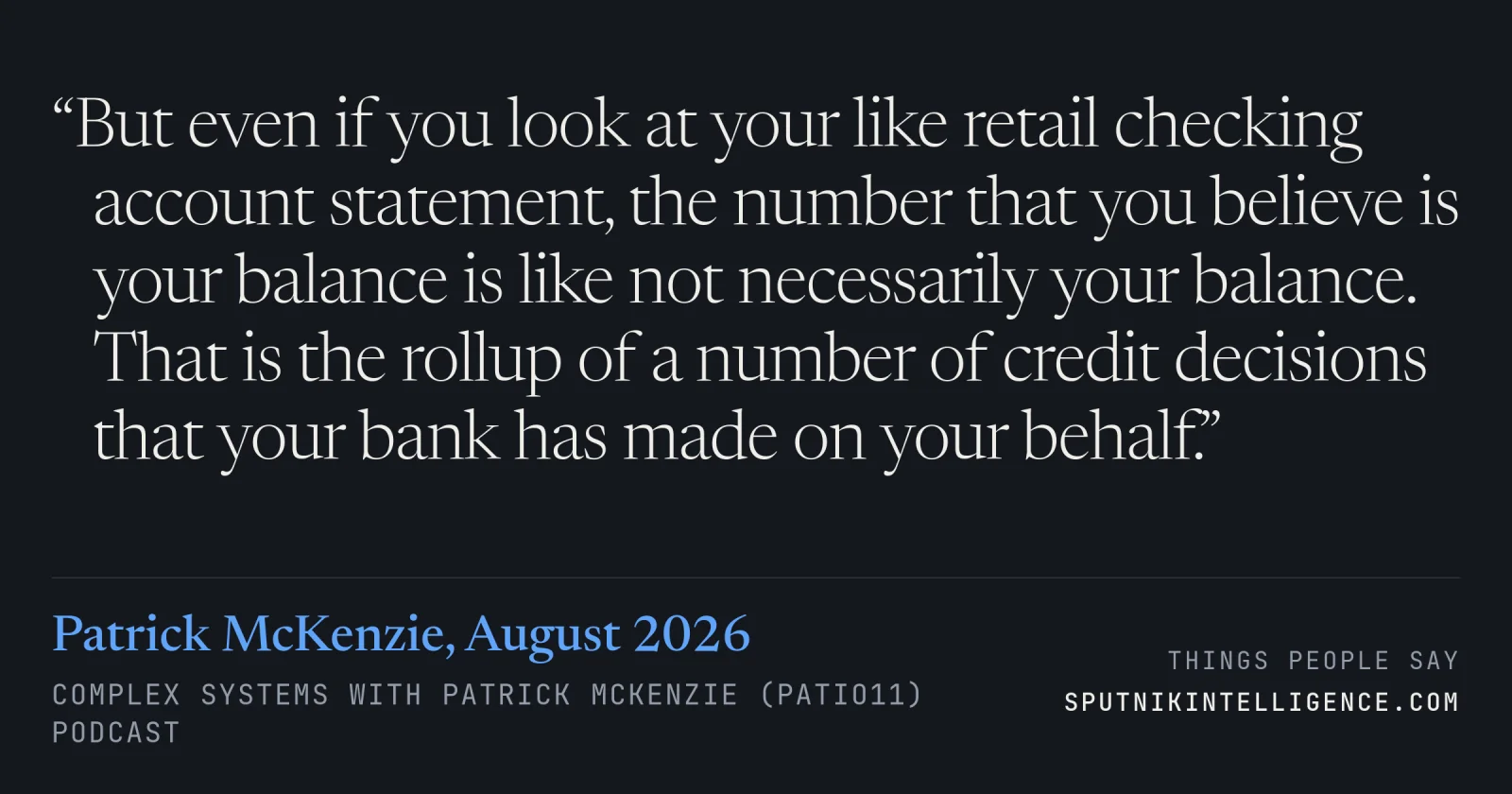
McKenzie and Alex Elliott spend the episode on the plumbing between banks and brokers: who extends credit to whom, and what happens when a counterparty vanishes overnight. He arrives at the retail version almost in passing, as an aside about how far credit reaches down. The turns on either side are about prime brokers and the 2008 collapses, which is the scale at which this point is usually made.
Complex Systems with Patrick McKenzie (patio11) · 2026-08-20
Permalink →
Listen →
Complex Systems with Patrick McKenzie (patio11)
Around 55:45 into the episode
Patrick McKenzie
…how much business do you do with Visa every day? And that's a weird one. But you can imagine vice versa, Visa. Okay, there are many people on the Visa network and each of them have some limit that we are comfortable being exposed to, even though I'm hand-waving away a lot of compliance. I can
Alex Elliott
…That person might not be at the firm anymore. So yeah, it's, yeah, it's, it's, it, to your point, you just assume it's all accounting, but then you realize there's a lot of fuzziness and you have to get to the right person and get them on the phone and they have to know how to handle it, et cetera.
Patrick McKenzie
…places as sort of like lubricant in the economy, where if we were doing everything cash and curry, if there was no credit extended between firms, there just simply isn't enough money to be at the various places. And that would generally have the effect of like raising the cost of capital to various firms, slow things down generally, et cetera, et cetera. It is broadly underappreciated by people. But even if you look at your like retail checking account statement, the number that you believe is your balance is like not necessarily your balance. That is the rollup of a number of credit decisions that your bank has made on your behalf. And there are other people that are making credit decisions vis-a-vis your bank, et cetera, et cetera. And so your quote-unquote settled balance is like a probabilistic statement about what we believe about millions of transactions at this exact moment in time. Be that as it may. At some point, like somebody at a prime broker has to say, you know, a couple of years ago when we got into this…
Alex Elliott
Yeah, it's well, sometimes there's just giant events. So, for example, in 2008, like Lehman just disappeared one day, or Bear Stearns just disappeared one day. And you had all of these interactions, like you were mentioning before about being tied to the hip. You don't even know who to call. Like…
Patrick McKenzie
The classic example on flow is payment for order flow where retail orders, people transacting their accounts at Schwab or Robinhood, are almost definitionally not hedge funds. And so it is extremely unlikely that they have material market moving information. And so they're transacting because my…
Alex Elliott
Sure. So I'm very active on Twitter. My user account is AlexPotato. I have a whole bunch of threads about all kinds of different topics. There's a large portion of that is about finance or technology. If folks are interested in what it's like being technologists in finance, there's a couple there.…
Speaker names come from our own diarization. The position is estimated from where the line sits in the episode.