 Taylor Monahan
Principal security researcher at MetaMask, working on the team that grew out of MyCrypto and MyEtherWallet, the Ethereum wallet she co-founded in 2015.
Taylor Monahan
Principal security researcher at MetaMask, working on the team that grew out of MyCrypto and MyEtherWallet, the Ethereum wallet she co-founded in 2015.
“If it breaks ... there will be signs, but also the first thing to break is not going to be Satoshi's coins. It's going to be the most powerful people on the planet hacking the second most powerful people on the planet. Meaning probably one government hacking another government.”
Unchained · Crypto & Web3 · October 2026
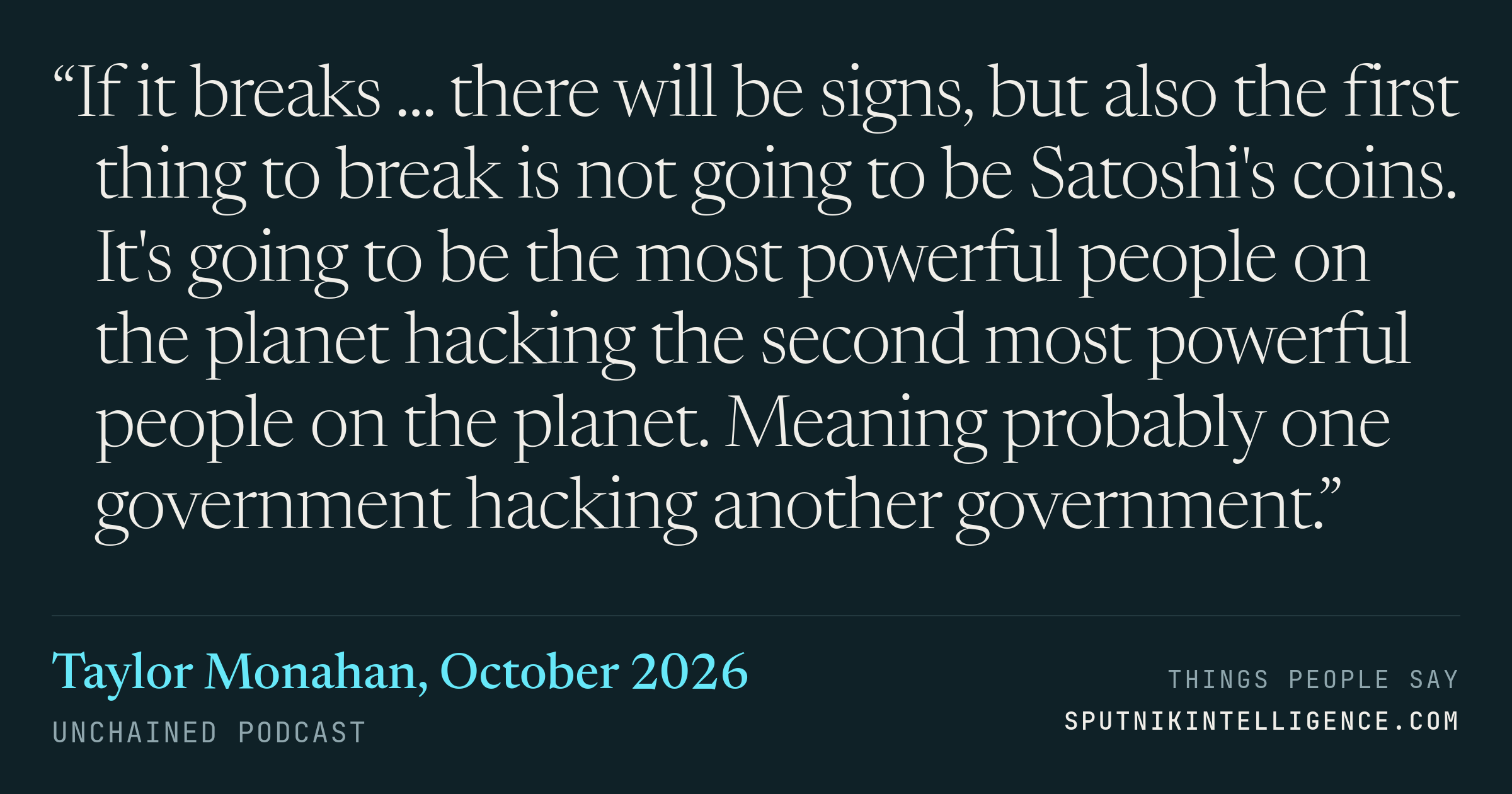
The hosts are discussing fears that new AI-produced mathematics could weaken the cryptography that protects crypto wallets. Monahan says this is how she has answered the "how do you know it's strong enough" question for a decade. Her point is that the same cryptography underlies much of the world's technology, so a break would show up elsewhere first.
Transcript
aliens landed, they could plug in and just like see everyone's internet traffic immediately. Yeah.
Right. Yeah. Yeah.
So this is like thing that I've always explained to people since for like a decade now, right? When they're like, but how do you know that the cryptography is stronger or strong enough? Or, you know, the answer is, well, we don't necessarily like forever know. However, if it breaks signs, there will be, there will be signs, but also the first thing to break is not going to be the toche's coins. It's going to be like the most powerful people on the planet hacking the second most powerful people on the planet. Meaning like, you know, probably one government hacking another government or the rest of the world or whatever. Like that's right. Because cryptography underlies a huge amount of the technology that the world operates on. So,
including, by the way, the traditional financial system, which I think, like to your question, Taylor, like, if this is, if this turns out to be true, which again, I put like relatively low odds on it, but let's say it is. If it turns out to be true, then you know, I think similar to the way, similar to what happened when these models suddenly got very good at cyber attacks recently, right? Like, finding bugs. I mean, two weeks ago, man. Two weeks ago. Like, yeah, like last night. Right. So I think open source got hit like hardest and first because the source code is there and it's open and it's permissionless and you can scan it and find bugs, right? But and but then in the long run, I think open source is going to be the most secure, right? Because for the same, the same reasons, like it's a permissionless bottom-up, like tons of eyes on it. Everybody's going to apply those resources to these open source code bases in a way that a you know closed source proprietary thing can't afford to do. And so I think you could actually see something play out similarly if it turned out to be something like this with the traditional financial system, you know, in the long run, being the worst place to have your money, actually. Like crypto networks get hit first, but then they can react and fortify and fix the bugs and patch node software and do rollbacks and all the messy, terrible things that would
happen. But then, you know, these legacy institutions, the financial system that is built on
they're not going to be as reactive. Yeah, they won't have the ability to react. They absolutely won't. Yeah.
More from Unchained