Collection · Crypto & Web3

Things People Say on Podcasts About Crypto & Web3

Crypto, blockchain and web3: protocols, markets, and the people building them.

Everything worth repeating from the Crypto & Web3 shows we follow. Updated every day — free to search and free to use, attribution included on every card.

49
Quotes
16
Shows read
8
People quoted
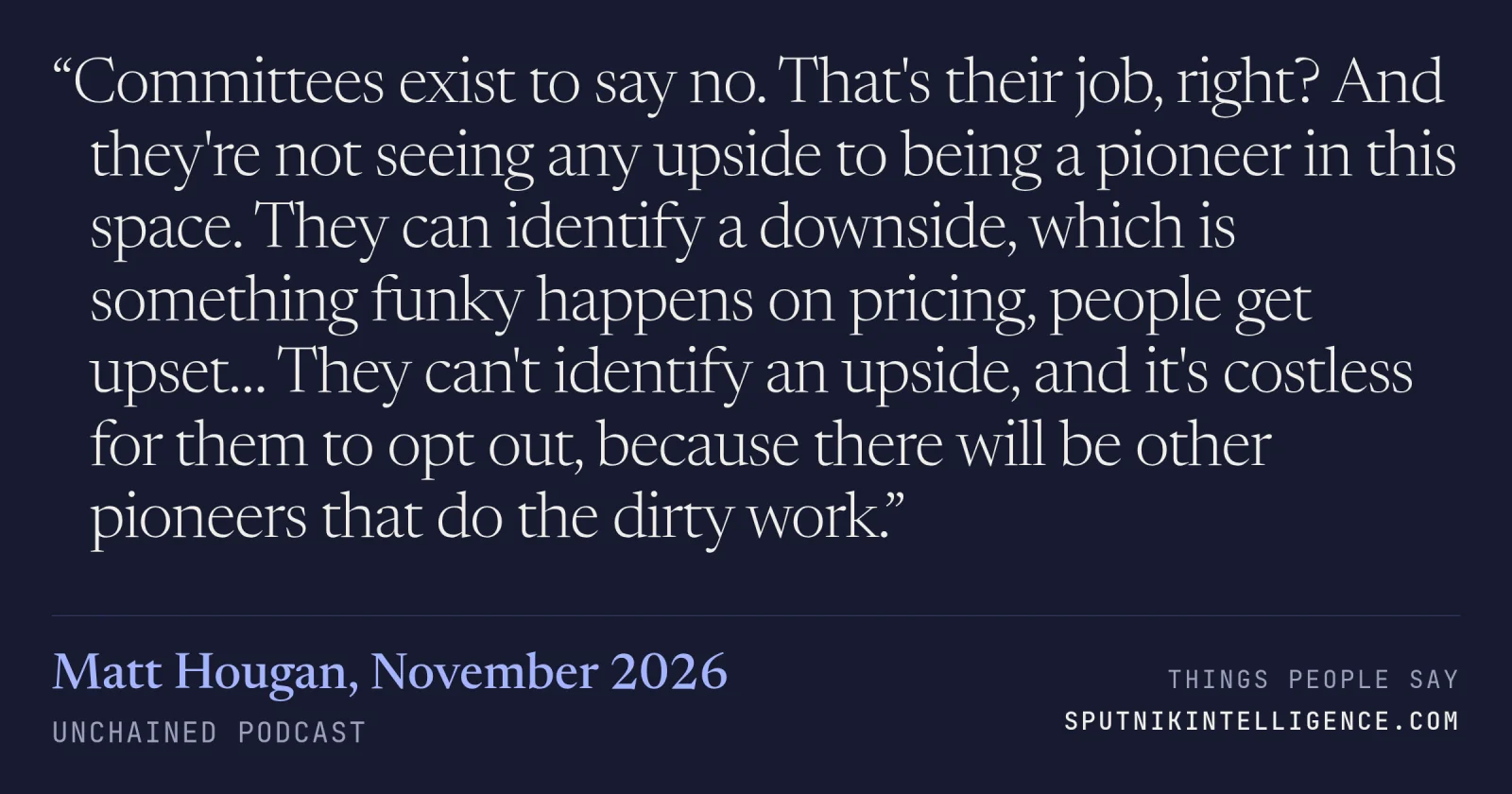
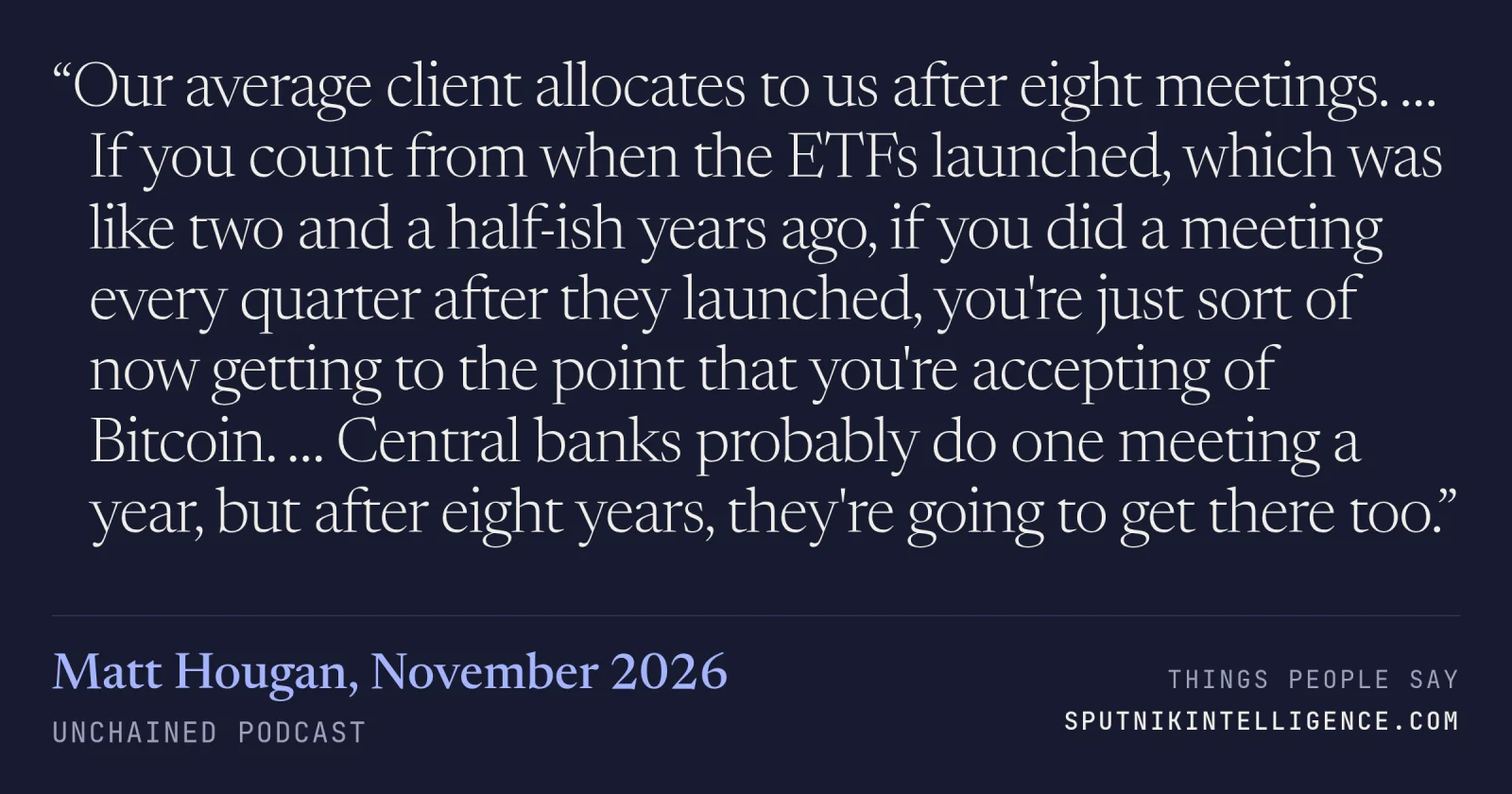
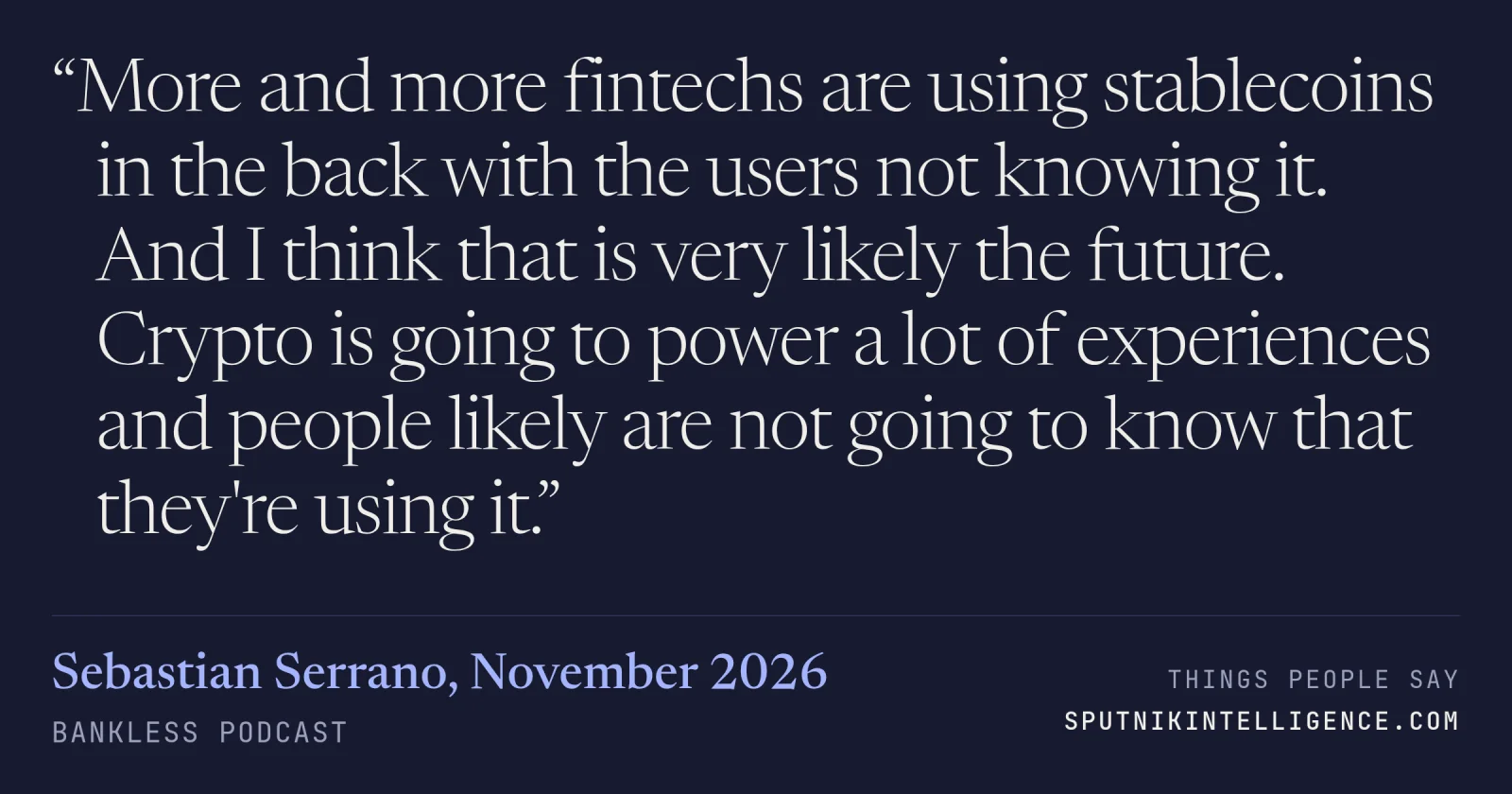
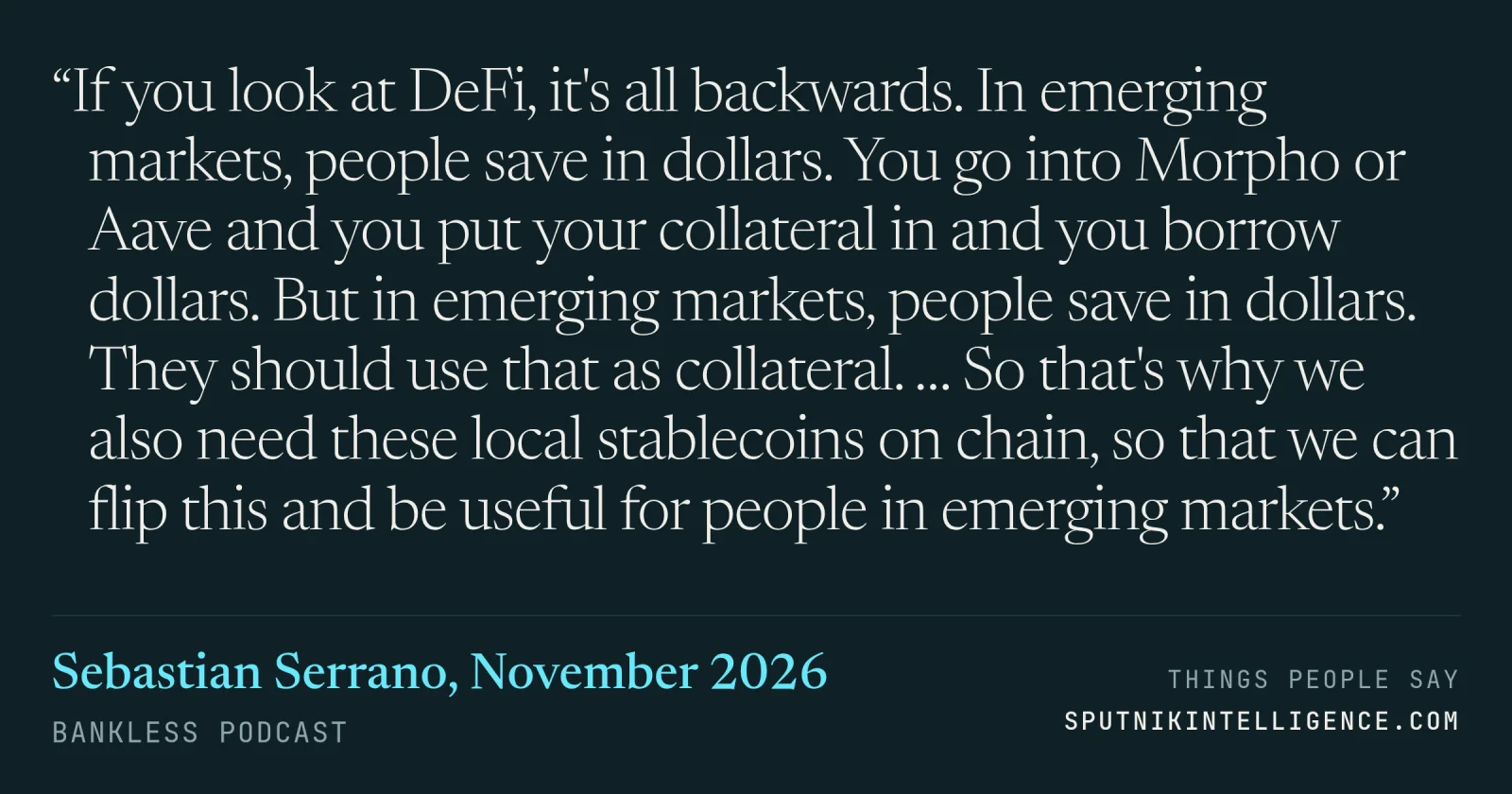
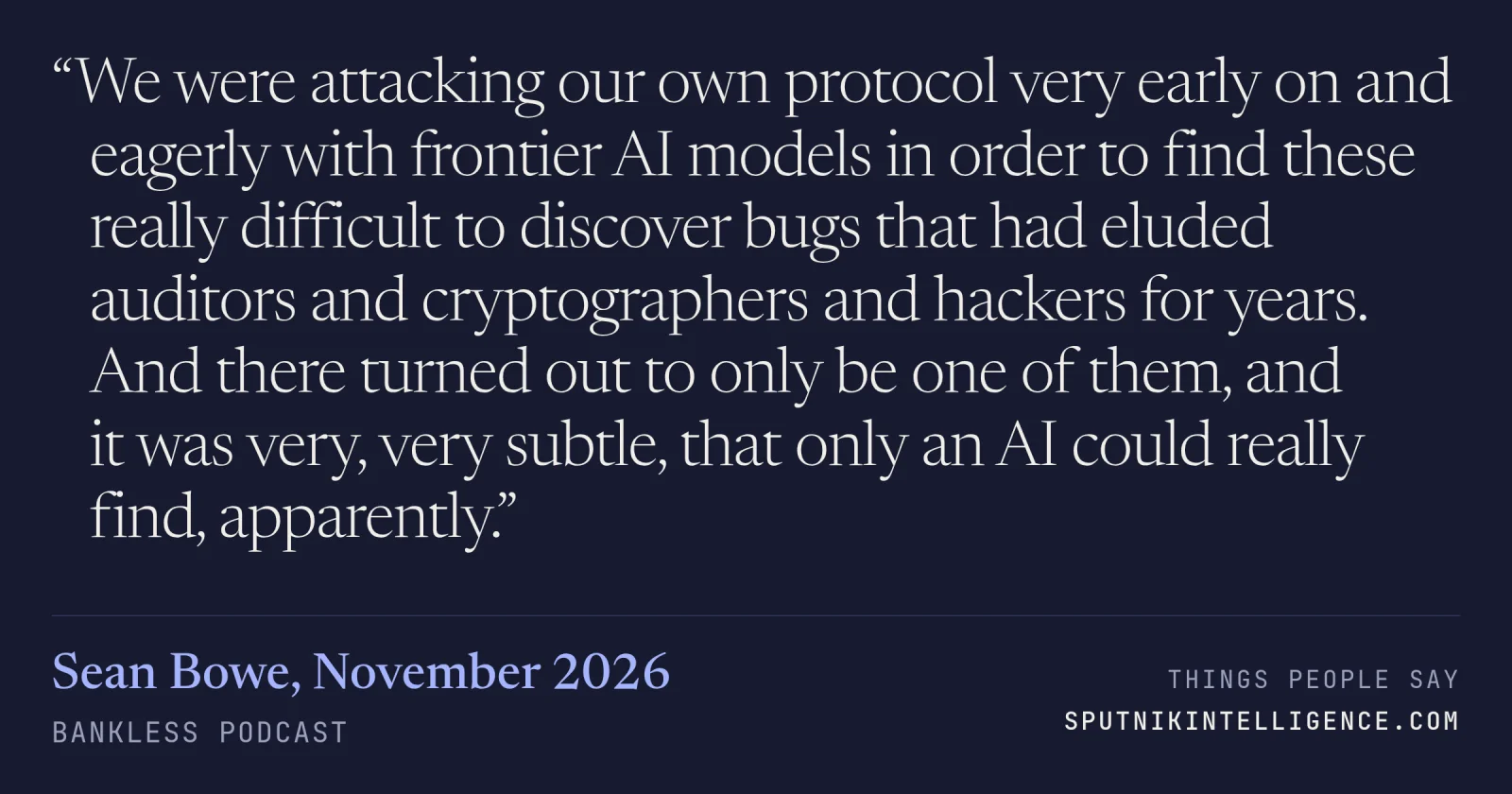
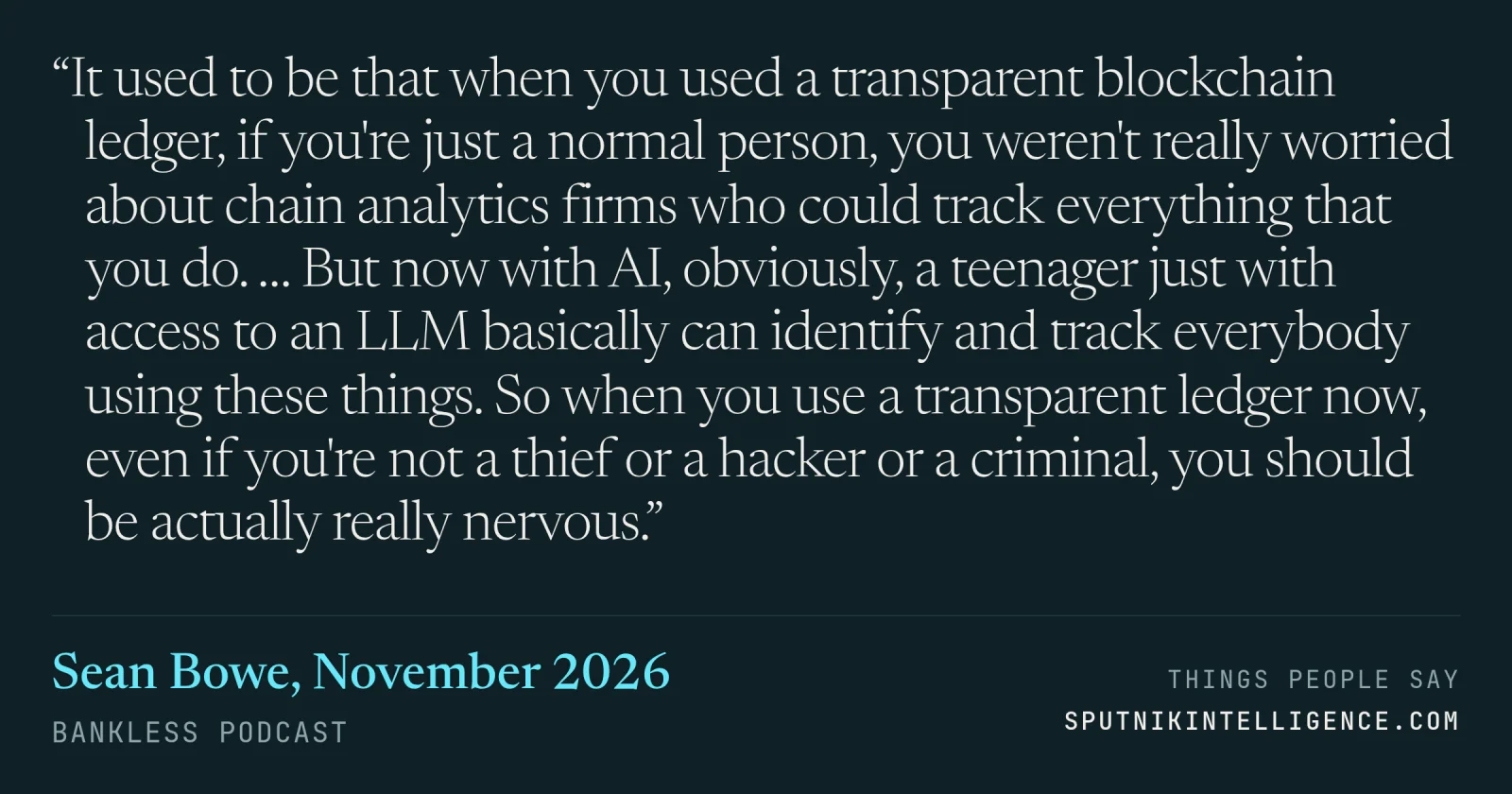
“We keep inventing memes to try and encapsulate this complex system into a four-second soundbite. And I was here for this. I probably had the bat speaker emoji on my X account for a while. But ultrasound money was such an effective meme that it took over the discourse. It became about what can we do to burn more. There were all these burn trackers. It got a little bit out of hand.” — Kain Warwick, Unchained “Blockchains are fundamentally these kind of leaky value systems where it's very hard to capture the value you're creating. Ironically, AI is the opposite. AI is extremely straightforward to monetize. It's just you charge by the token, and we've kind of figured out that that works quite well.” — Haseeb Qureshi, Unchained “That is the kill shot for anybody ever arguing against restrictions on exports to China. It's just the ultimate argument winner, because it's such a simple story. … The arguments around this were so complex and nuanced, and they will never be again.” — Haseeb Qureshi, Unchained “The institutions haven't generally been concerned about the hacks. … If you look at the 10 largest hacks in Bitcoin's history and look at the 30-day return after that, in five cases, Bitcoin is up. In five cases, Bitcoin is down.” — Matt Hougan, Unchained “Committees exist to say no. That's their job, right? And they're not seeing any upside to being a pioneer in this space. They can identify a downside, which is something funky happens on pricing, people get upset… They can't identify an upside, and it's costless for them to opt out, because there will be other pioneers that do the dirty work.” — Matt Hougan, Unchained “Our average client allocates to us after eight meetings. … If you count from when the ETFs launched, which was like two and a half-ish years ago, if you did a meeting every quarter after they launched, you're just sort of now getting to the point that you're accepting of Bitcoin. … Central banks probably do one meeting a year, but after eight years, they're going to get there too.” — Matt Hougan, Unchained “More and more fintechs are using stablecoins in the back with the users not knowing it. And I think that is very likely the future. Crypto is going to power a lot of experiences and people likely are not going to know that they're using it.” — Sebastian Serrano, Bankless “If you look at DeFi, it's all backwards. In emerging markets, people save in dollars. You go into Morpho or Aave and you put your collateral in and you borrow dollars. But in emerging markets, people save in dollars. They should use that as collateral. … So that's why we also need these local stablecoins on chain, so that we can flip this and be useful for people in emerging markets.” — Sebastian Serrano, Bankless “Every non-custodial wallet today, the call to action is buy. … At the end of that five, 10 minutes of onboarding, you finally see a PIX ID. You send a thousand reais, you end up buying USDC or USDT, and you now have 950 in it. So your first experience using crypto is losing money.” — Sebastian Serrano, Bankless “How is that a risk? That sounds so positive for the business.” — Robert Leshner, Unchained “There's almost like a law of physics around this. … They can easily use larger models to remove obliteration from smaller models very easily right now. That's the main way a lot of people do it. I don't think you're getting around that. … I don't think you're ever going to regulate this type of thing out of existence, no matter what Anthropic tells you.” — Tarun Chitra, Unchained “What that implies is a fundamental belief that we are hitting some ceiling on the ROI of getting more compute online. And that in fact, getting more compute online is just going to dilute the earnings and create more competition among the players who are there. … That's the sense in which I say the hedge funds are bearish on AI in aggregate in believing that data centers not coming online is good for Anthropic.” — Haseeb Qureshi, Unchained “Some of my hedge fund friends were talking about this exact topic. And the logic goes something like this. New capacity is going to come online slower than we previously thought. This disadvantages neoclouds. This theoretically advantages the existing hyperscalers who have already built tons of data centers. … If there's less compute to go around and less inference to go around, then they don't have to spend as much money.” — Robert Leshner, Unchained “There has never been the notion of bank heists in the trad bank world because they can just ledger entry update and undo the heist. … You can undo a transaction that's like 60 days old, a year old. You can go really far back with a court order. And so you're telling me that that narrative was violated by a trad bank getting heisted.” — David Hoffman, Bankless “They set up a fake job interview with a Binance employee. … They gave this person a coding task for the job interview, but the said coding task that the person downloaded was actually malware, actually spyware. So that got onto that person's computer because that Binance employee's computer was inside the Binance network. That software was able to spread to other people's computers … one of the computers that the software got access to had the private keys.” — David Hoffman, Bankless “Super PACs serve a purpose… but they're a crutch, not a skeleton key. You could have all the money in the world, it wouldn't have stopped this wave… You cannot think of super PAC spending as your first weapon. It is your last weapon of last resort.” — Justin Slaughter, Unchained “If Binance were to turn up today and say, 'Hey, guys, you can only take out a billion dollars a day for the next 90 days,' it would be over. You can't say that, because the adversarial nature of crypto is people go, 'Oh, you only have a billion dollars,' and everyone would freak out and start nuking everything.” — Kain Warwick, Unchained “Banks are not prepared for this. The thing that banks have relied on for like 100 years is the slowness of them.” — Kain Warwick, Unchained “There's actually a much more elegant solution that the clanker found in like seven seconds. You spent your whole life doing this, and then the clanker is just so much smarter than you. And literally, it was like, why don't you just use the token authority to create an approval to transfer the tokens?” — Kain Warwick, Unchained “There's no such thing as a price of an asset. It's a construct. People go, 'Oh, what's the price of Bitcoin?' Depends on how much you have. Depends on how motivated you are. The price of Bitcoin during a hack is not the same as the price of Bitcoin not during a hack, because you have a motivated seller that is willing to sell.” — Kain Warwick, Unchained “When we say that we want a system that is permissionless, that allows anyone to do anything and is censorship resistant, well, censorship resistance also means this. … Circuit breakers are needed. Protocols should start having controls that pause things when too big amounts of money are being moved.” — Pablo Sabbatella, Unchained “I will say that easily 90% of organizations in this ecosystem don't have someone that really knows operational security in their company. And the worst issue is that many of them think that they are okay, but they are not okay. … If there's one thing they can do without hiring any company, it's at least get an EDR. They say, 'Oh, it's a problem for my privacy.' And in the end, what happens? They get hacked, they have no privacy and no money.” — Pablo Sabbatella, Unchained “It's like saying you have, let's say, a pen in a bank that is used to write checks. Every customer that goes to the bank and wants to withdraw money, that pen is used to write the checks. They didn't steal the check, but they were able to access the pen inside the bank and sign transactions. … Nine out of ten of the big attacks that happened in the last three years all start with a laptop being infected.” — Pablo Sabbatella, Unchained “It turns out you can transform this problem into just a big matrix vector multiplication. And it turns out that our friends in the AI world have made big matrix vector multiplications very cheap and usable for us. Go have someone buy an H100 and go service for all of us. So these two things have come together: the cryptography side invented this, and AI land has really optimized GPUs to make this a viable world.” — Dev Ojha, Bankless “We were attacking our own protocol very early on and eagerly with frontier AI models in order to find these really difficult to discover bugs that had eluded auditors and cryptographers and hackers for years. And there turned out to only be one of them, and it was very, very subtle, that only an AI could really find, apparently.” — Sean Bowe, Bankless “It used to be that when you used a transparent blockchain ledger, if you're just a normal person, you weren't really worried about chain analytics firms who could track everything that you do. … But now with AI, obviously, a teenager just with access to an LLM basically can identify and track everybody using these things. So when you use a transparent ledger now, even if you're not a thief or a hacker or a criminal, you should be actually really nervous.” — Sean Bowe, Bankless

Most Quoted Here