 Lyman Stone
Demographer and director of the Pronatalism Initiative at the Institute for Family Studies, writing on fertility decline, birth rates and the cost of raising ch...
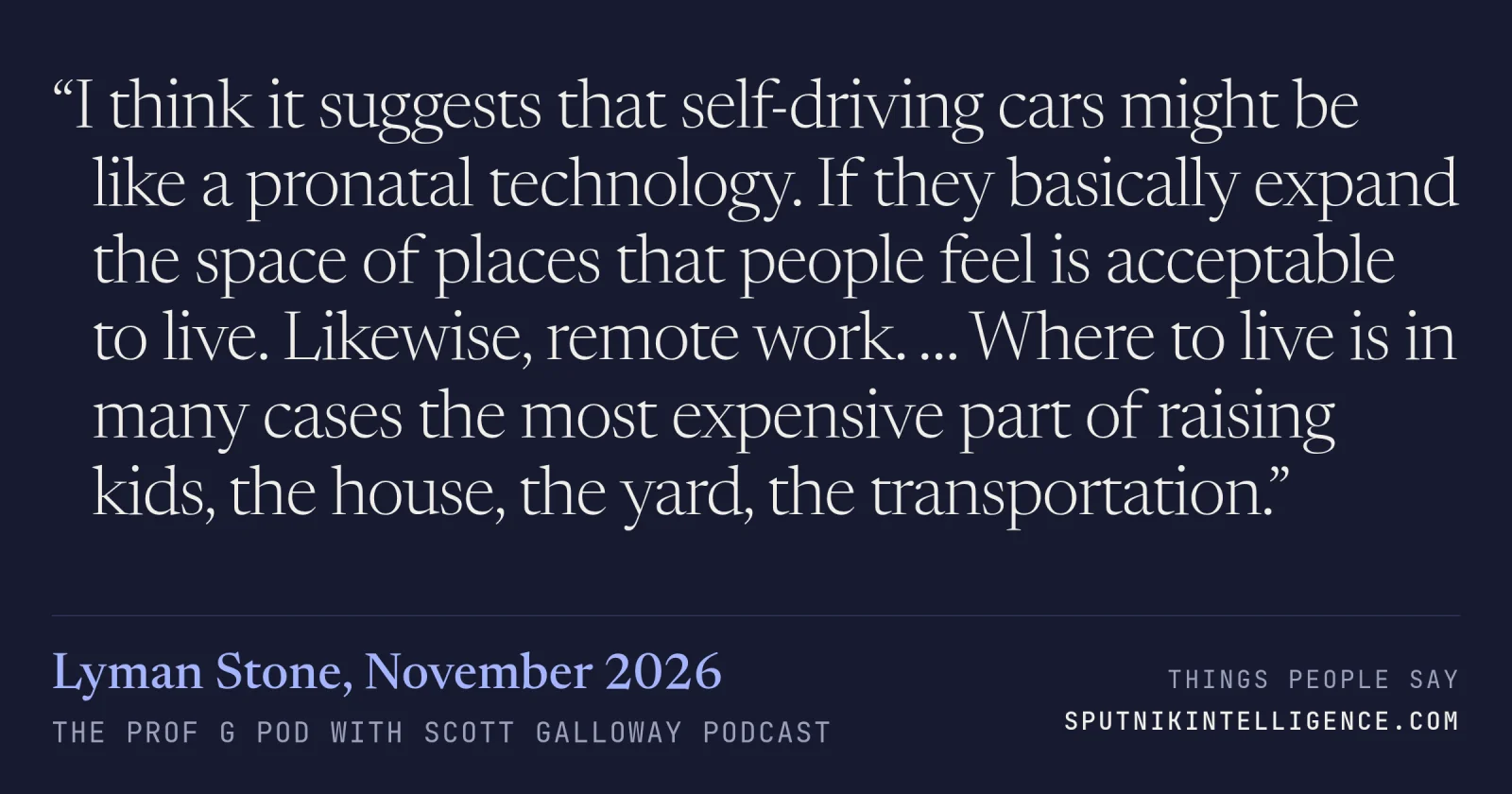
“I think it suggests that self-driving cars might be like a pronatal technology. If they basically expand the space of places that people feel is acceptable to live. Likewise, remote work. … Where to live is in many cases the most expensive part of raising kids, the house, the yard, the transportation.”
The Prof G Pod with Scott Galloway · Tech Strategy & Big Tech · November 2026
Context
Answering a question about housing costs and birth rates, Stone lays out a housing theory: cars once opened up cheap land, and technologies that widen where people can live could raise fertility.
Transcript
So just going back to the
…fertility rates go down 1%, that there still is something about owning a home that puts people kind of on a path towards having kids. Do you see any connection? And if so, does that perhaps offer yet another reason to try and create tax incentives for more affordable housing for young people?
…If they basically expand the space of places that people feel is are acceptable to live. Likewise, remote work. I'm able to live in a relatively cheap city because I work remotely. So things like remote work, things like self-driving cars, even things like improved transit are all the types of things you can imagine boosting fertility because they give people more options for where to live and where to live is in many cases the most expensive part of raising kids, the house, the yard, the transportation. So yeah, I mean, housing matters and building more housing. If you're not talking about building more housing in a policy plan to address low fertility, that's table stakes. There's a couple of these things. Like if you're not talking about increasing cash transfers to families, if you're not talking about building more housing, if you're not talking about marriage penalties, then you're not…
So are you bullish on fertility? What's your prediction around fertility rates in the United States?
It'll keep going down. I'm not bullish. To get an increase in fertility. In the next, you know, two decades. Um, you know, a meaningful increase. Obviously, there will be a year here or there where things tick up for one reason or another. But to get a really meaningful increase in fertility in the…
Support for the show comes from Gusto. Be honest, there's probably one task on your list you constantly push to next week because it's just
More from The Prof G Pod with Scott Galloway