 Richard Hanania
Political writer with a background in law and international relations, and president of the Center for the Study of Partisanship and Ideology.
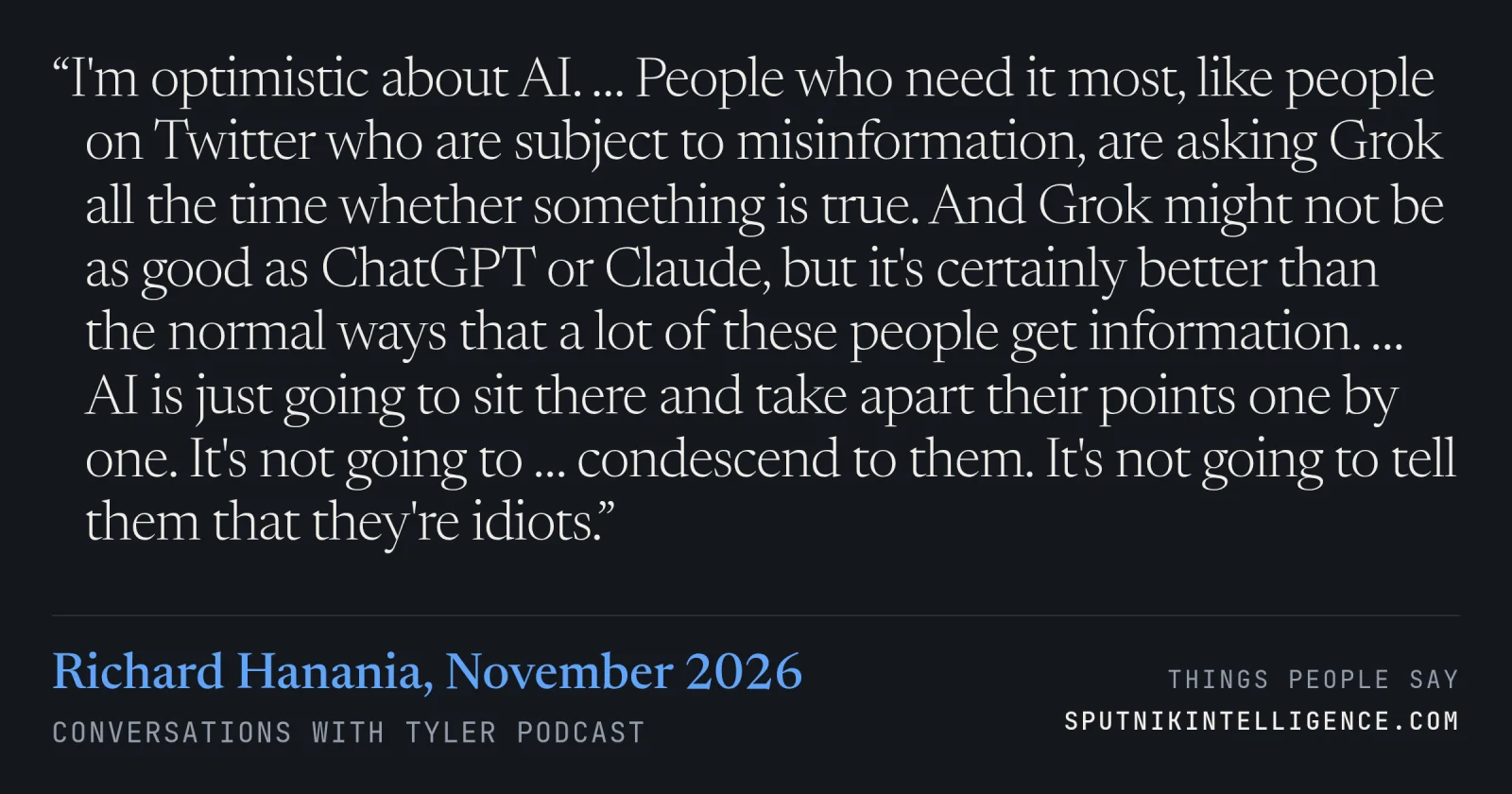
“I'm optimistic about AI. … People who need it most, like people on Twitter who are subject to misinformation, are asking Grok all the time whether something is true. And Grok might not be as good as ChatGPT or Claude, but it's certainly better than the normal ways that a lot of these people get information. … AI is just going to sit there and take apart their points one by one. It's not going to … condescend to them. It's not going to tell them that they're idiots.”
Conversations with Tyler · Ideas & Essays · November 2026
Context
Tyler Cowen asked whether media and online discourse are heading for a general collapse. Hanania says AI could reverse the slide, citing research that AI can talk people out of conspiracy theories, and argues it works because it answers each claim patiently.
Transcript
…in the book in the kind of grand level. It's like, yeah, things are bad, but things are bad with the media. You can sit there, you can critique them all day. I've done it a lot, but there's some anchor, some kind of institutional production of knowledge that we need that you can't just toss aside.
…But in essence, all the dominoes are falling and media looks better now. But just as a lot of parts of populism have spread to the Democratic Party in these terrible Bernie Sanders kinds of ways, that it's happening to media as well. And it's all going to end up the same mess. Agree or disagree?
…to be some core of people who want to read serious content. That doesn't seem like it's going to disappear completely anytime soon. The communications technology changes over time. I'm optimistic about AI. Things don't always have to get worse. Things don't always have to be like Twitter that make us stupider. AI, you know, there's amazing research out there that basically people trust it. Like people who need it most, like people on Twitter who are subject to misinformation, are asking Grok all the time whether something is true. And Grok might not be as good as ChatGPT or Claude, but it's certainly better than the normal ways that a lot of these people get information. Absolutely. And there's good research on how AI can talk people out of conspiracy theories. If you talk to conspiracy theorists, you don't know what they know, right? They have 10 different studies that you've never read. They know more about a topic than you have. So they're actually very difficult to argue with. But AI is just going to sit there and take apart their points one by one. It's not…
So who is the content creator on the populist right who is most insightful, most worth reading, most valuable?
On the populist right, who is most insightful. Not classical liberal, right? Yeah. Not centrist. It depends on how you, like, are you including like new right people or just anyone. I don't
even know what the phrase new right means anymore. Name some names and we'll see if I think they fit. Yeah.
More from Conversations with Tyler