 Dwarkesh Patel
Hosts the Dwarkesh Podcast, a long-form interview show on AI progress, timelines, and the people building frontier models, along with economists and historians.
Dwarkesh Patel
Hosts the Dwarkesh Podcast, a long-form interview show on AI progress, timelines, and the people building frontier models, along with economists and historians.
“If you look at the ELO score of chess bots since the 80s, there's just a very linear increase in ELO over time — but there's this huge discontinuity as they cross the human range: human experts always win against AIs, and then human experts never win against AIs. So far AI capabilities haven't been that big a deal in terms of their end economic impact, but that's because they're slowly rising in ELO relative to humans.”
Dwarkesh Podcast · AI Research & Frontier Labs · September 2026
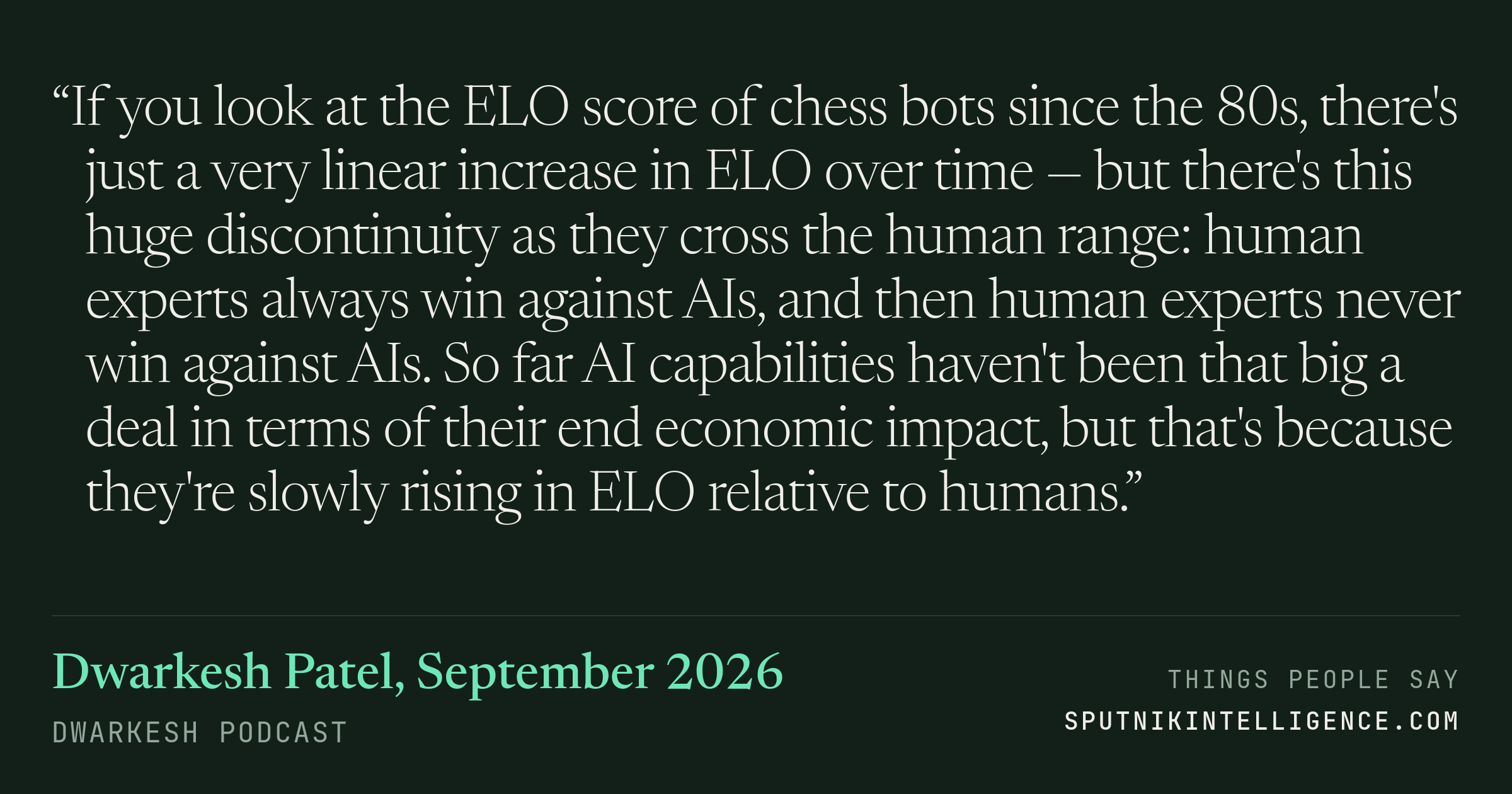
Offered against the argument that AI's modest economic impact so far is evidence the curve is flattening. His point is that a smooth underlying capability trend can still produce a sharp discontinuity in outcomes, because what matters is the crossing of the human band, not the slope.
Transcript
Sorry, but do you think the discontinuity will be harder than anything that's come since 2012?
If we had the answer to that, we'd kind of have the ability to implement it. But maybe there's the distinguish, we should distinguish between a discontinuity, which adds to the current paradigm. Again, it's cumulative. There's something beyond the RL that we have to discover. And maybe they're capable of connecting the dots in that straight line. Or again, how far off the global optimum are we? Do we have to go back and throw out gradient descent and neural nets in general? And I don't think if you continue to scale up the current paradigm and LLM. No matter how many LLMs you're running, they are capable of necessarily discovering that if it's too far away.
Yeah, the only hope really is if deep learning just can't get us to an AI which is at least can dominate human research and human development, including the human ability to come up with new paradigms and so forth. Or like, I don't know, maybe humans would also never have discovered the next learning architecture, but to the extent humans could have discovered it eventually. But it just seems like, I don't know, if you just look at the progress that's happened in 2012 till now, and you just continue that on. I mean, I know if that's been powered by huge amounts of compute scaling and so forth, but it would be weird if like it just didn't get to the point where it could dominate humans, at least in RD, especially over the next few years, there's going to be. Ryan Greenboff was on the podcast recently, and he made this point that you could imagine as AIs get more and more capable and are capable of making progress on simulations which incentivize getting better at not only AI RD, but generally at science. So this is a thing that all the labs are targeting, many startups are targeting. Or another intuition pump is if you look at the ELO score of chess bots since the 80s, there's just like a very linear increase in ELO over time. But there's this huge discontinuity as they cross the human range of human experts always win against AIs to like human experts never win against AIs as this linear increase in ELO happened and you could think, I agree with your point that so far, AI capabilities have not been that big of a deal in terms of their end economic impact in the world, but that is because they're slowly rising in ELO relative to humans.
Yeah.
Yeah, I mean, I agree. It would be very, I mean, the only way for this to not happen is if like, as you said, somehow asymptote just before basically, because we're already pretty close, in my opinion, to like where we'll start crossing the human ELO score and say, we'll need to asymptote before that. And like, that's the only way in this scenario you posed where somehow we're sitting here in 2035 and everything is normal for this to happen, I think. I mean, the only other way is there's some dramatic regulation on AI. This is kind of what I see is the most likely way for this scenario to happen, actually, rather than the technical thing.
Yeah, I think there's different kinds of research. There's like research where it's like the order research style where the objective is already specified very cleanly and you're optimizing that objective. And I think everyone is picturing if we continue along this path of like, you know, making pre-training loss go down, making our environments watermelons go up, that's going to lead to like improvement. But like, you know, maybe what Ryan is talking about is like this much more open-ended type of science, which is required for paradigm shifts, where we can't specify the objective and the AIs are definitely not able to specify that objective either. Like we have to be really, really careful about how we specify objectives for any of these things.
More from Dwarkesh Podcast