 Michael Lewis
On Ground Truths
Michael Lewis
On Ground Truths
“No one knows what he believes. He is like the quintessential NBA referee. Nobody can tell whose side he's on, and everybody thinks he's on their side.”
Ground Truths · October 2026
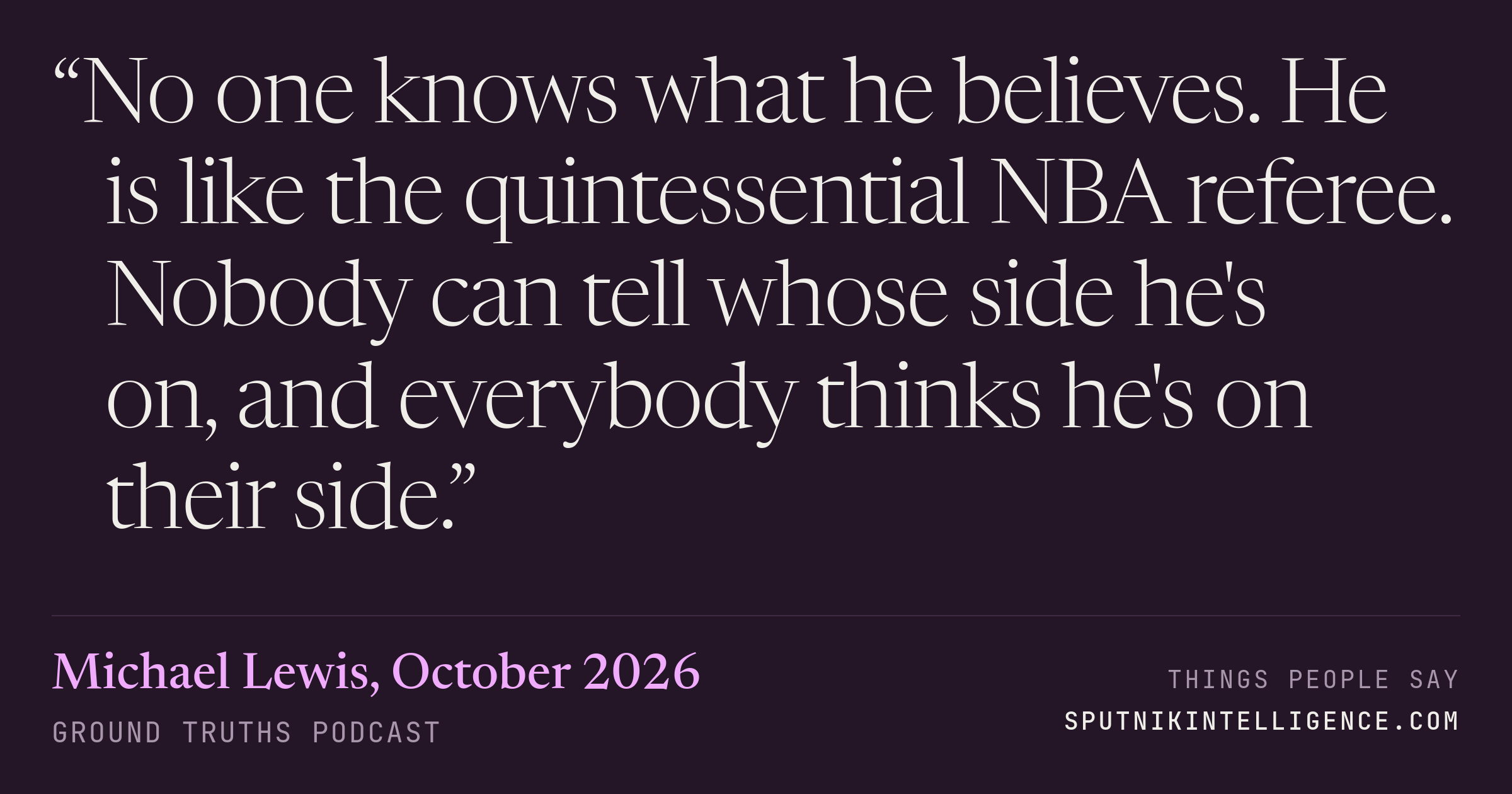
Lewis is describing one of the civil servants in his new book, a man who spent 35 years at the Office of Personnel Management refereeing disputes between the federal workforce and political appointees. Lewis says appointees of every administration assumed he was one of theirs, which is why both sides trusted him to settle problems.
Transcript
Well, he was the most challenging literary character I've ever had, but he was also like a Dickens character. He was wonderful and difficult at the same time. But he was, so Tim, let me tell you, he didn't head the Office of Personnel Management. He was in charge of the box on the org chart. And OPM is a small agency, and it's one of these meta-agencies. It's like the Office of Management Budget or the General Services Administration. The Office of Management budget, where Russell Vogt has installed himself, it touches all the money. OPM, the Office of Personal Management, touches all the people in the workforce. They sort of help the people who help the people who help the people. And the GSA runs all the buildings. And Musk knew enough, probably because Russell Vogue gave him a short course, that when he came in, this is where he sees he put his, he was actually sleeping in the general services administration with his team. Many of them were badged as Office of Personnel Management people. They were kept out of OPM because Russell, that was Russell Vogue's territory. And so what they knew coming in was that if you want to do anything with the entire workforce, the entire civilian, two million person workforce, the touch point, point of contact was that OPM. And Tim Curry, so who's Tim Curry? Tim Curry, Tim Curry. So what would people say about him? He's been in that job for a long time, many administrations.
35 years.
No one knows what he believes. He is like the quintessential NBA referee. Nobody can tell whose side he's on, and everybody thinks he's on their side. The Clinton people thought he was a Clinton person. The Obama people thought he was an Obama person. The Trump people thought he was, the Bush people thought he was a Bush person. He never tips. He's like, I mean, he's hard to draw because it's hard to write a colorful piece about a referee. But his job was to referee, essentially, I mean, this is putting it simply, to referee the disputes between the two million person workforce and the political and the politicals who come in to run it. And that border is a naturally fractious border because these people are nonpartisan. They have tasks. They have to obey the Constitution. The politicals, you know, a political person comes in the IRS and says, I want to get Eric's tax returns so I can blackmail him. The IRS person, the job of the IRS person is to say, no, you can't do that. Is it to say, you're my boss, here are his returns? Right. Right. So there's a lot of things like that. And Tim sits in the middle of it all. And a lot of his job is just preventing conflict from escalating. So again, so much of government is preventative. And he was that in spades. His, what was so interesting about him is he was such a neutral. He was so born to be in this. Role. He was so insistently bland while being quite funny secretly, but publicly kind of bland and couldn't see what he thought. And everybody trusted him. Both sides trusted him so he could sort out problems. And he was able to do it in the most extreme environments. But when Trump 2 happens, all of a sudden, he can't. And all of a sudden, he can't because he can see that fairness, which is his job to sort of provide. His job is to make everybody feel this is a fair environment, like a ref's job. The game's not rigged. Fairness was not going to be possible. That the game, that the president had called the ref and said, you're going to call the game for the American soccer team. You know, that and it's that there was a finger on the scale that was unlike anything he'd ever felt before. And what was it? What was one of the many interesting things about Tim to me was he was such a kind of repressed character, like he was never about himself, that when he got stressed, and the only other time he had this kind of physiological response was after 9-11, when he had been in the Pentagon, it was supposed to be where the plane hit the Pentagon. He should have been dead. And then the last minute change, and he had this kind of physiological, he had the same, this physiological reaction to the Doge. It was like, I can't be me. I don't exist anymore. I can't function in this environment. And he said it was going to kill him if he stayed. He thought he was going to have a heart attack. So that was after the guns, this was the next sort of precondition for everything else that happens in the book. You eliminate all the independent refs. You take rid of the get rid of the inspectors general. You queer the Justice Department. You make sure that there's no neutral, the Merit Systems Protection Board that adjudicates disputes between the civil service and the politicals when they escalate past him. You get rid of all the neutrals and you put the refs on the payroll and you make the refs your guys. And then all of a sudden, what happens? What have you done? You've basically eliminated the nonpartisan civil service. That's what you've done. And that is a profound change. That is a weaponization of a very powerful instrument. And that's what's going on. I mean, it's much messier than that. And there are a billion lawsuits and there are a billion stories, but that's the essence of what's going on. And Tim was there to preserve the old, the essence.
David's made a lot of comments, but one he put in was totalitarianism is defined by a destruction of civil society institutions. I think that's very clear. So now one more blocker, and then I want to get kind of the roundup of the overview, bigger picture. Kathleen Walters, she's the chief privacy officer at IRS. She kind of touched on the IRS. And they want to get the tax forms for all these 700,000 undocumented immigrants. How does that go?
So I'm flying. So she's the person between your tax return and a political person who wants to do you damage. And she's got the law on her side. And what happens is, this is interesting. There's a subtle thing here because this book just isn't about, it isn't just about Doge. It's only a third about Doge. There are other things. Doge is this blunt force instrument that doesn't do anything like what it says it's going to do. It doesn't end up saving any money, probably costing money, and doesn't make anything more efficient. None of that. But it does traumatize the workforce. And for what purpose? And there was a purpose. There were people who wanted to do things that a non-traumatized workforce, an empowered workforce, would not have allowed happen. And someone, probably Stephen Miller, had instructed the Department, well, the Department of Homeland Security was getting frustrated in its ability to round up every undocumented worker. And they found that they had dated addresses for them, couldn't find them. And the IRS has had since the 1990s this program. It's called the ITIN file, individual taxpayer, whatever number. But if you're an illegal immigrant here and you're working, this was a way, a mechanism so that you could pay taxes and start to demonstrate your good faith, right, to the society. You didn't have a social security number. You need to have one of these. And this database in the IRS has got 7 million names in it and the most current home address of the undocumented worker. And DHS came at Kathleen, first came, tried to go around her. And tried to get her to hand over the file so that they could send their cops in the dead of night to apartment complexes around the country and round people up. It was such a violation of the law and not just the law, the spirit of the law. Because IRS had been telling this population for 30 years that trust us, we're going to treat your information the way we treat the information of a citizen. They've paid hundreds of billions of dollars in taxes. You know, what's interesting about the situation is the undocumented population that pays taxes pays taxes often without getting many of the benefits. Like they don't get not eligible for an entitlement program. So I have a raw deal. But so we have told them, we've given the word of our country to this population that, yeah, it's a gray area relationship. It's a messy relationship. But we've told them this won't be weaponized against you. And in the history of our country, the only kind of analogous situation is the census information being used in World War II to round up Japanese Americans. And the difference between those two cases is that it was actually legal to use the census information, that that wasn't breaking the law. It was just this kind of spirit of the thing. This was breaking the law. And so Kathleen puts her body between that pile of information and ICE, and she has to go. And this is a career that she was devoted to.
Nobody there says anything
More from Ground Truths