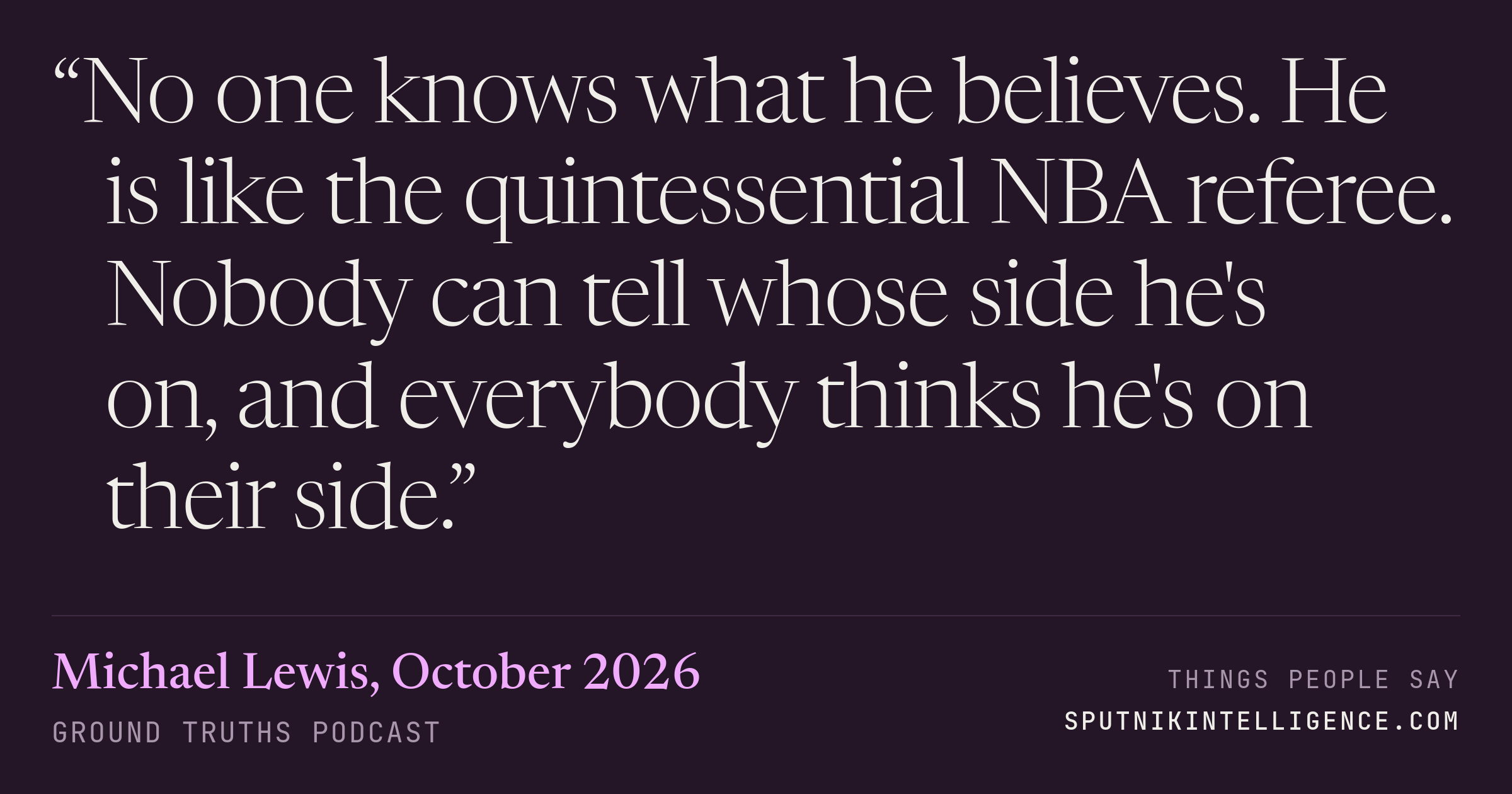
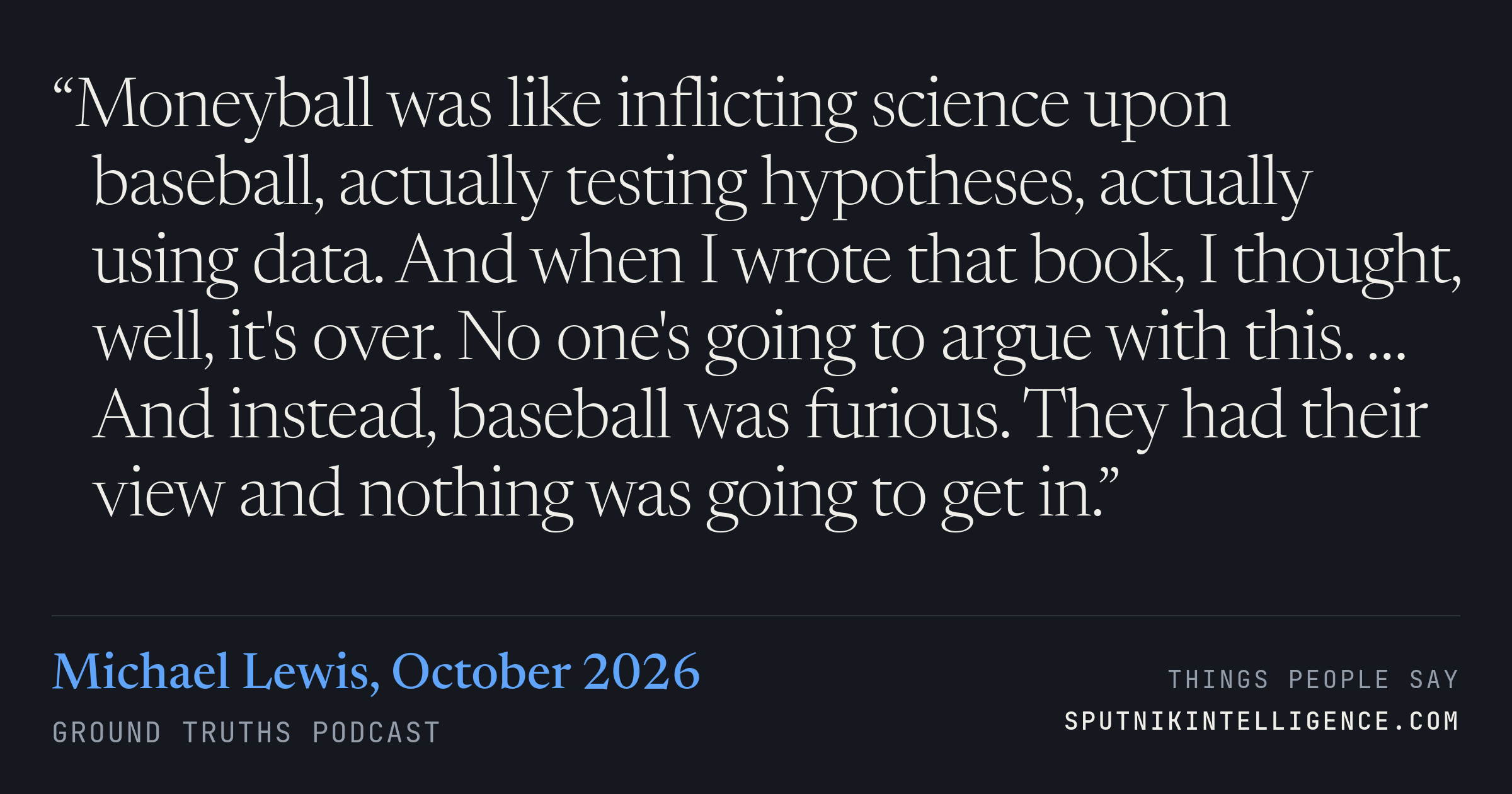
Lewis had just told a story from his book about a former NIH director trying to explain to the president why one friend's recovery was not evidence that a drug works. He used Moneyball to make a wider point about people who trust intuition over large samples, which he called a brick wall for a scientist to run up against.
I read it, and my podcast publisher, Pushkin, is bringing it out. And the bits I've listened to are just fun. They've just done really good things with it. It's a really good audio version. And that's not always been true of my books. Anna KS and politicians cut funding of research just like this when scientists decide what research is needed. Isn't this what makes America great? And why, you know, how can this go on? It's needed for humanity. I guess
we all would agree with these points, Anna. Well, before we leave this Collins chapter, which just was riveted, there were three funny parts of the, that is, the meetings of Trump with Collins. One that I just was blown away by was: so Trump is golf with Ernie Ells, who I've met. And one of the great things about Ernie is he's done a lot of work for autism. So now in this meeting, Trump is telling.
I don't know. So the question I, one of the questions I had with Francis with all the suspects was, what were your previous interactions? And with Trump, well, Trump had, he had had a meeting with Trump at Trump Tower before Trump reappointed him. And then he goes back about his business running NIH and he gets a call. He gets a call from Jared Kushner telling him Trump wants to see him. And he comes over without telling what it's about. And just to contextualize this, you know, Francis was used to this because Obama used to bring him in to like give him lectures about genomics. You know, it was like, it was like he was thinking science seminar. And instead, instead, Jared, Jared is outside the Oval Office and he says to Francis, don't bring up, don't talk about science. He said, no interest in it. You'll just like tune out. He has something he wants to talk to you about. Just listen. And he walks in and Trump says something like, Francis, I got this buddy, Ernie, who's got a hospital. I need you to send him some money. And Francis had to explain that that's not how the money got sent. And so they couldn't just send money to Trump's golfing buddy. So next, the next meeting is when they're just the two of them, Jared Kushner calls. Again, no explanation. It's early COVID, very early COVID. And he gets there and Trump's kind of in a good mood. And he's saying, my poll numbers are really good. And he says, but I think they'd be even better if America knew that there was a cure. And Francis, like, yeah, you know, probably would. But he says, my buddy, my, my buddy Jack had a bad case of COVID and he took, is it hydroxychloroquine? Yeah. And it just cured it. And Francis started to say that we've been doing studies and like there's no effect. And he goes, wait a minute, Trump goes in, get Jack Nicholas, get Jack Nicholas on the phone. And Jack Nicholas is now coming through the speakerphone. And he says, like, yeah, I had the, I had the COVID, it was bad. And I took the hydroxychloroquine and it just went away. And Trump's like, see, see? And Francis was trying to explain that, like, bad cases of COVID, they often will usually just go away on their own. And that, and you got to just, you got to study this to before you tell people to take it. But Trump was adamant that this was like proof. And Francis, this is a funny bit. Francis realized, I think he was walking out of there that he had met Jack Nicholas before, that he'd been at something at the Vatican. God, I don't know, it was miracle cures, who knows what it was. And Jack Nicholas appears on like a video screen to talk about stem cells being injected into his lower back to say to cure his back pain. And it was a similar sort of event. And it was, and you see, you know, I remember when I wrote Moneyball, that's ages ago, and which is, and I was an art history major. I'm not a scientist, but I get the difference between scientific thinking and the scientific method and how we, most of us, go through our lives. And Moneyball, you know, one thing it was was like inflicting science upon baseball, you know, actually testing hypotheses, actually using data. And I thought, like when I wrote that book, I thought, well, it's over. No one's going to argue with this. They think they've actually generated knowledge. This is what science does. And instead, like baseball was furious, like they had their view and that, and nothing was going to get in. And I just not, I don't, I don't, I don't know what to say to it. You know, it's like, people, if you, if you have a brain that does, it's not that you're stupid, it's just you just don't think like that. You, and you don't accept the idea of large sample sizes, of double-blind studies, all that stuff. You think that your intuition sort of trumps it all. It's a brick wall for a scientist to run up against. And I think Francis spent a lot of his career running up against it.
Well, and to his credit, and that's why he's always been a hero of mine for decades: is that he's a diplomat. He's gentle about it. He never is demeaning. And, you know, as you said earlier, he was loved by the Senate and he got the budget up at the NIH. And by the way, I think you mentioned it in the book. He resigned. He was going to just go back to his lab. And the senators, Republican senators, wouldn't take it. They said, you know, you have to stay on. And he rescinded his resignation. So, yeah, he's an amazing guy. And by the way, Gretchen Fawcett, one of our people here, said, What a travesty and a huge loss. And I think we would agree wholeheartedly about that. Now, there are other heroes and lots of villains. In fact, the ratio on the cover isn't enough. But you have one hero and you only have five villains. Okay. There's like hundreds of villains. But what gets me here is that you go, why? How did we get dozed? Now, since I don't know how to tell stories like you, I would have said, okay, let's go through the Institute of Peace. Let's go through the Office of Professional Management. No, what you do is you find the blocker, the hero, and you got all the intel and you tell the story. And it's masterful. So let's start out with the, I didn't even know about this place, the United States Institute of Peace, renamed the Donald J. Trump Institute of Peace. Tell us about Colin O'Brien, one of our blockers.
So this was the moment I thought this may be a book that I had, because of the fifth risk, I had on my office floor here all the agencies of the government in Manila folders trying to decide where I was going to go. So I thought I knew the entire federal government. And when I read in the paper that the Trump administration has stormed the Institute of Peace, I was like, why don't I know what that is? I've never heard of that. And you dig a little bit and you realize, because it's not exactly part, it's kind of part of the government. It's a nonprofit. It's a nonprofit that Congress has funded. And that in the beginning, the president does appoint board members, but they serve 15-year terms. And it was designed, it was George Washington's idea. We're going to have an Institute of War, West Point. We're going to have an Institute of Peace, never got funded until Reagan. And it's actually, I mean, they'd hate me saying this, but it's a quasi-intelligence agency, I think. It does a lot of things, but because it isn't of the government, it isn't controlled by American politicians. It's able to earn the trust of possible potential adversaries. It's able to broker conversations. It doesn't cost very much, and it's generated, it's generated hard returns. You can measure. David Petraeus wrote him a letter once saying, What you did in shutting in quelling the violence in Iraq's triangle of death kind of like paid for your budget for the for your whole life. You know, that you saved us a lot of a lot of blood and a lot of money by going in and just talking. And there are arts of peace and they are our soft power kind of instrument. So I never heard of them. And all of a sudden, this thing is, this building's invaded. And I was interviewing George. I went and found the guy around the place. His name is George Moose. And he started telling me about his security guard, the guy who was actually physically blocking the entry of Doge when they showed up. And I thought, I got to meet this guy. So his name is Colin O'Brien, former, former Army sniper, former DC or Baltimore cop, some acts of heroism in his past, wicked smart. Like he looks like, he looks like a football linebacker, but he thinks like a college professor. And he has a whole theory of security, like how it works, how to do it. And he was the most successful at beating back Doge. He actually, there were some, and some funny moments where he let people in and locked him in and sealed all the locks. So they became his prisoners. And there's a whole back and forth. But he made the quite serious point. There are two things that come out of that first chapter that I think that are like really important. One is he made the serious point that it is not trivial that these people who came in on us, when they came in on us, managed to collect all the guns that they had. The FBI was on their side because the FBI is in the administration, but they twisted the arm of the DC police. So the DC police became part, you know, a Doge helper. They blackmailed the private security company that he hired to protect the building. So their own guards turned on them. And it felt like a coup. It felt like that nobody got shot, but it was everybody, this operation was very aware. We have all the guns. And Colin was very aware. At some point, you couldn't do anything. The second thing that was so interesting about the story is that when Doge gets in and they get into the computers, they start to, Elon Musk starts tweeting stuff that is just blatantly false. Oh, yeah. And it's like nothing is true. Like, it isn't like, oh, some of there's some mistakes here. They are, it's just grotesque distortions and grotesque lies. And the one, the one that I just, that had my jaw on the floor was he tweeted that the U.S. Institute of Peace was giving money to a member of Taliban who was an American enemy in Afghanistan and put the guy's name on X. The guy was actually an American asset and he was not in Afghanistan. He'd been, because he was too dangerous for him to be in Afghanistan. He was Afghani. And he had been in the middle of sensitive negotiations between the State Department and the Taliban. He had been helping us every which way. And there was, he was suspected by the Taliban, I think, of being an American asset, but they didn't know. And when they read Elon Musk's tweet, ProPublica published this. This wasn't my scoop. They rounded up his cousins, his relatives, tortured, tortured them, beat them. And like, you know, that's treason. You know, that's, and I just, I'm amazed that we as a country have allowed this to go so far. I'm amazed that there is not a call for a trial, that it is, that you can't, if an ordinary citizen did this, you would be accused of treason. You expose an American asset and you put these people's lives at risk. It's so there's a long bill of particulars like this that come out of that incident that tell you, sort of give you the sense of the spirit of Doge. And Colin was just such an interesting eye on it. It's a short opening section, but I just thought it was short and sharp and it was the way to open the board.
Well, and it gives us a preview of the measures that were taken with a forged letter to get entry using the Intercon contract blackmail $460 million. I mean, Whatever it took to be deceptive and destructive. Finn Johnson says, Is it cruelty for cruelty's sake? That's his question.