 Nate Silver
Statistician and political analyst who founded FiveThirtyEight and served as its editor-in-chief until May 2023.
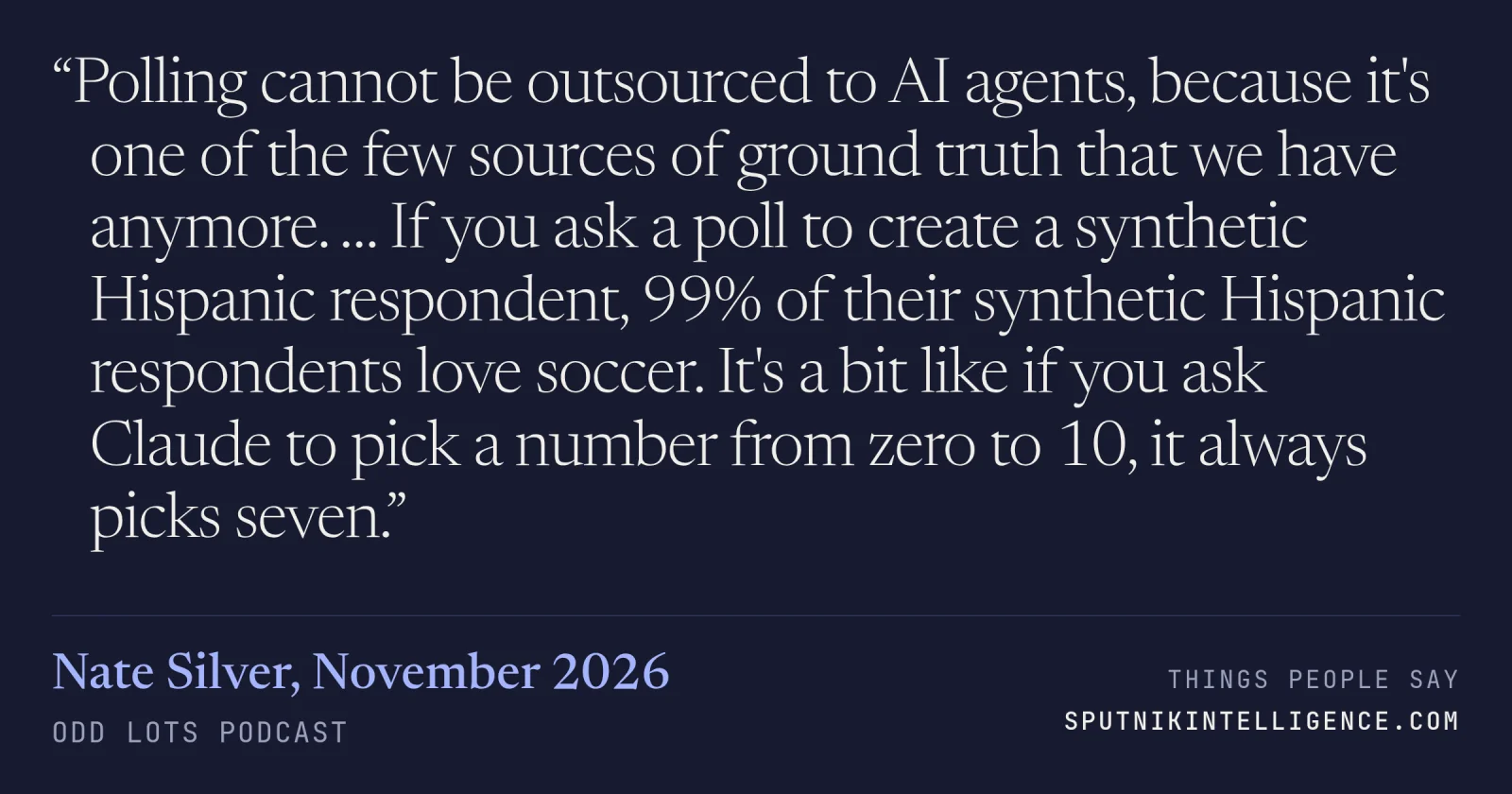
“Polling cannot be outsourced to AI agents, because it's one of the few sources of ground truth that we have anymore. … If you ask a poll to create a synthetic Hispanic respondent, 99% of their synthetic Hispanic respondents love soccer. It's a bit like if you ask Claude to pick a number from zero to 10, it always picks seven.”
Odd Lots · Money & Markets · November 2026
Context
The hosts asked why pollsters can't just build AI 'digital twins' of voters who always pick up the phone. Silver says the models flatten people into stereotypes, and that real polling data is still needed.
Transcript
This is the digital twin. Why don't
we just create a digital twin of all Americans?
So the problem is like, and by the way, I think these companies are smart. I know some people that work for them, right? But like polling cannot be outsourced to AI agents, right? Because it's one of the few sources of ground truth that we have anymore, number one. And also that the models are kind of, so if you ask a poll to create like a synthetic Hispanic respondent, right? 99% of their synthetic Hispanic respondents love soccer. It's a bit like if you ask like Claude to pick a number from zero to 10, it like always picks seven. It's a bit like, I mean, this gets into whole existential thing about how like large language models work and like they're kind of, it's kind of the ideal type or something. But like, but no, we need original data, right? Models like Flipper or prediction markets can aggregate that data, but but you know, because like voters aren't all that predictable, you know, I don't even like the kind of slicing and dicing that you see. Oh, the Hispanic vote, right? Well, the Hispanic vote is younger Hispanics and older Hispanics, people who are relatively new to the country and people who…
I feel like turnout in particular would be difficult for a digital twin to model. Like maybe you can come up with political preference based on demographics, but like predicting whether someone is actually going to leave the house and vote seems particularly difficult to me. But tell me if I'm…
we did a little simulation in South Carolina, which is one of the more surprising races to be polling closely. And, you know, and one more, frankly, be a bit more surprised to Democrats won, right? But like, you know, what if black voters in South Carolina turned out at 2024 rates and white voters…
The Democrats at 14% in Mississippi on polymarket.
More from Odd Lots