 Steve Ovens
Red Hat consultant specializing in OpenShift.
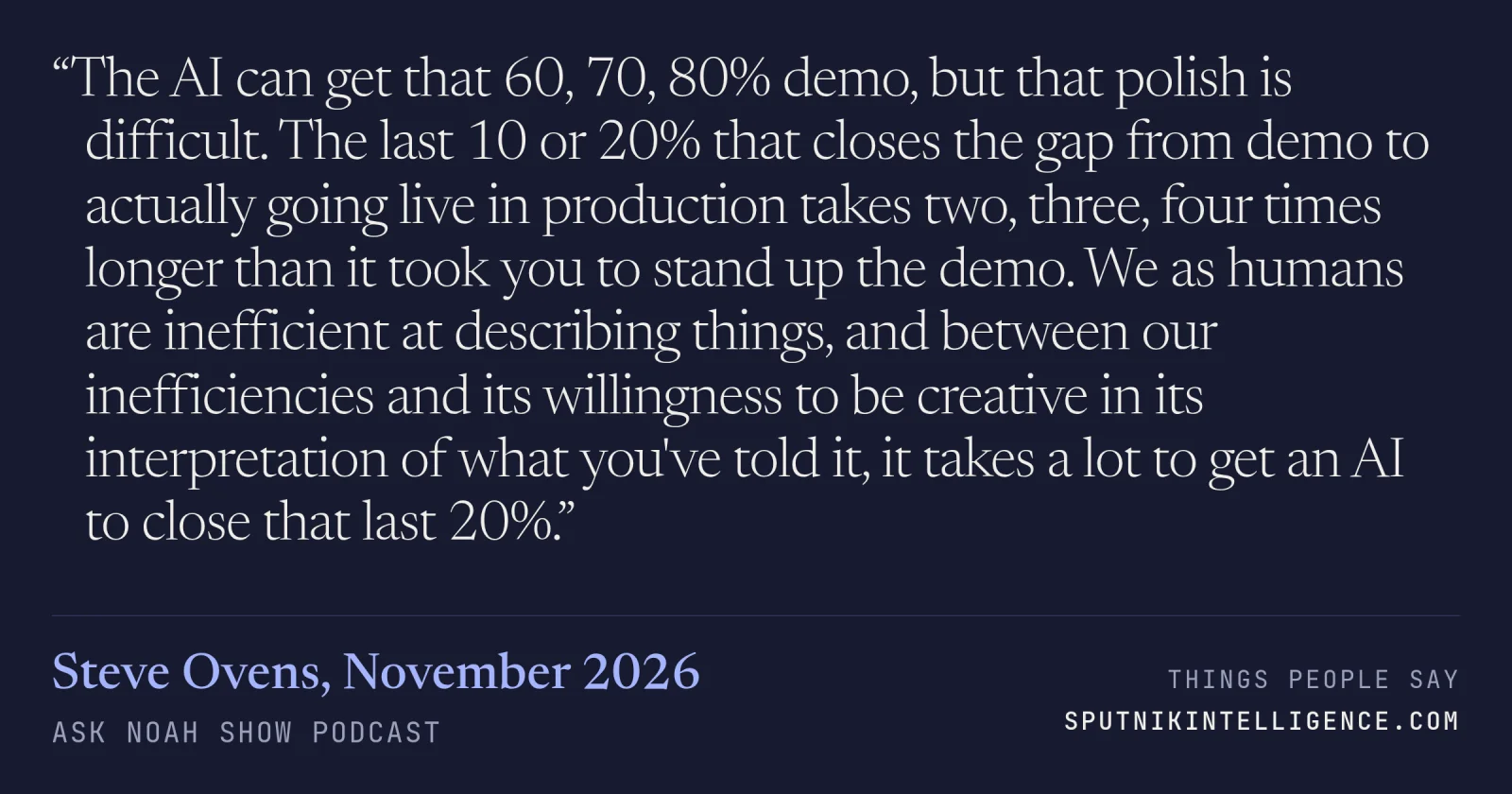
“The AI can get that 60, 70, 80% demo, but that polish is difficult. The last 10 or 20% that closes the gap from demo to actually going live in production takes two, three, four times longer than it took you to stand up the demo. We as humans are inefficient at describing things, and between our inefficiencies and its willingness to be creative in its interpretation of what you've told it, it takes a lot to get an AI to close that last 20%.”
Ask Noah Show · Hands-On Engineering Podcasts · November 2026
Context
A listener asked why refusing AI is seen as foolish. Steve ties AI coding to the old 80/20 rule: the demo comes fast, but getting to production takes far longer.
Transcript
…what? I did call this out. We went ahead because that was the direction that management wanted to go. We did that. And, you know, essentially, it's not on me. It's real hard. It is getting to the point where it's becoming a social skill is required in order to dance around these sort of things.
Because people see it as profitable. It seems like it's a fool's way not to do these things.
Because you get up to speed really quickly. Like, so you know how we've long talked about that 80-20 or 90-10 rule where it's like most of the work gets done up to like 80% finished or 90% finished. And that's kind of like the demo. The demo works and everybody's like, oh, this is so awesome. But that last 10% or 20% that closes the gap from demo to actually going live in production takes significantly longer, two, three, four times longer than it took you to stand up the demo. And that is kind of where that's kind of where we're at, right? The AI can get that 60, 70, 80% demo, but that polish is difficult. And the more that it edits or the more that it attempts to refactor or whatever it is you're working on, the more likelihood it is to not understand you. Now, when we come out with, if you're talking about like making graphs and stuff like that, if you come out with like a visual editor where you can drag stuff around and be like, do this, it'll probably catch on. But we as humans are inefficient at describing things. And so between our inefficiencies and its willingness to be creative in its interpretation of what you've told it, it takes a lot, a lot to get an AI to close that last 20%, let me tell you.
So the last part is Jeremy is really struggling to figure out how he approaches this. So he's saying, hey, it's kind of, he didn't use these words, but essentially what I'm taking out of this is it's robbing him of his motivation. You know, things that he used to enjoy, like reading books, hacking…
For me, part of it was reframing what value I bring. Ultimately, that's the question. That's the heart of the question: what is my value? Is my value the production of the thing, the idea that leads to the thing, the oversight? So let's give it a, for instance, okay. If I sat down and was like, you…
So as you stepped into the search, you're like, wow, this is a skill set or a thing I previously understood. And now I'm struggling to regain that muscle memory?
More from Ask Noah Show