 Ben Thompson
Writes Stratechery, a subscription newsletter analyzing the business strategy behind tech and media companies, and has built a reputation for framing how platfo...
Ben Thompson
Writes Stratechery, a subscription newsletter analyzing the business strategy behind tech and media companies, and has built a reputation for framing how platfo...
“OpenAI is kind of like mainline. They go to church every Sunday. They're sort of like evangelicals. That's Anthropic.”
Invest Like the Best (Patrick O'Shaughnessy) · Money & Markets · August 2026
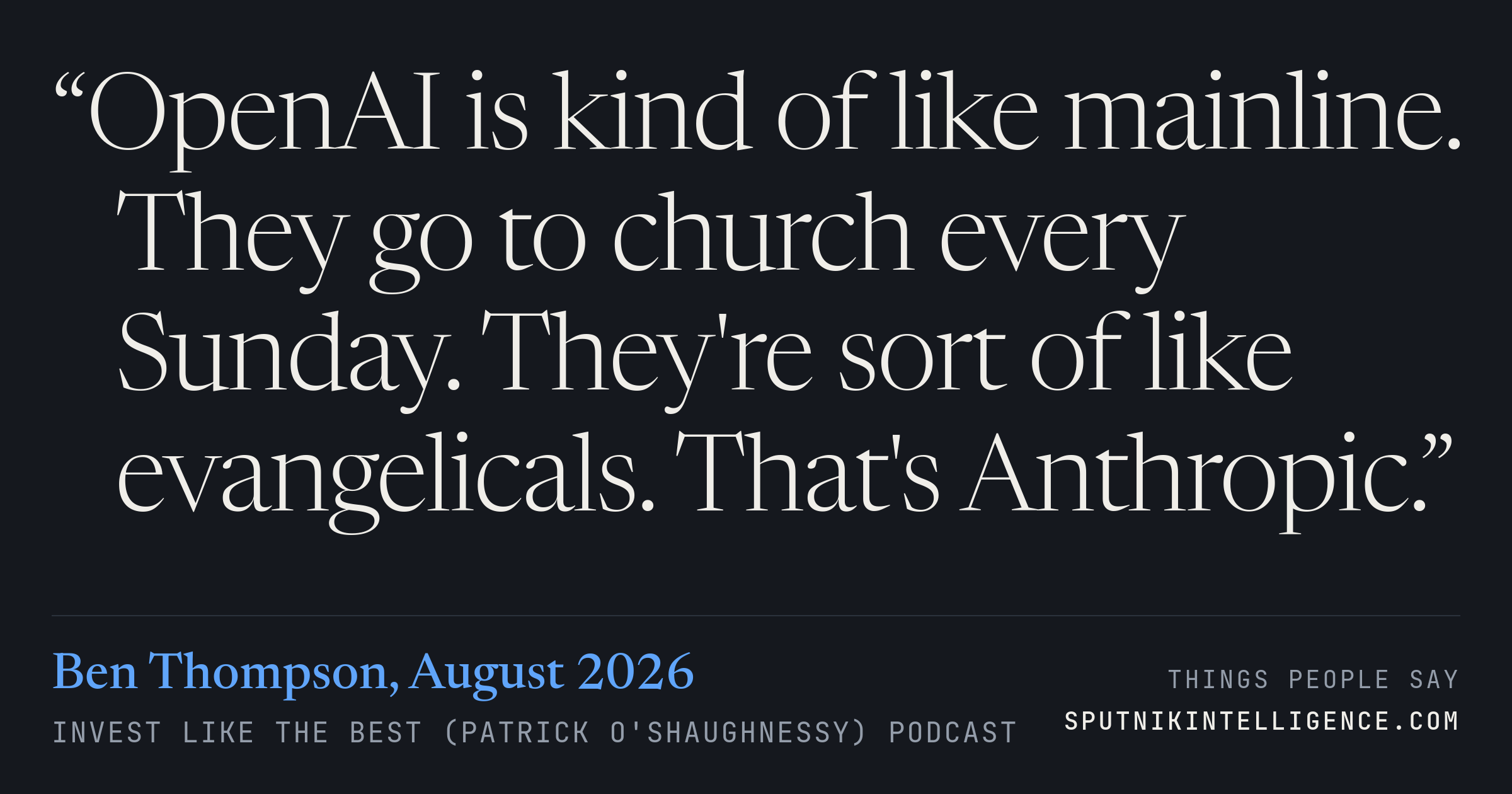
Ranking the frontier AI labs by their setups, Ben Thompson argues OpenAI and Anthropic have the biggest upside because of how completely their teams believe in the mission, comparing the two companies to different strands of religious devotion.
Transcript
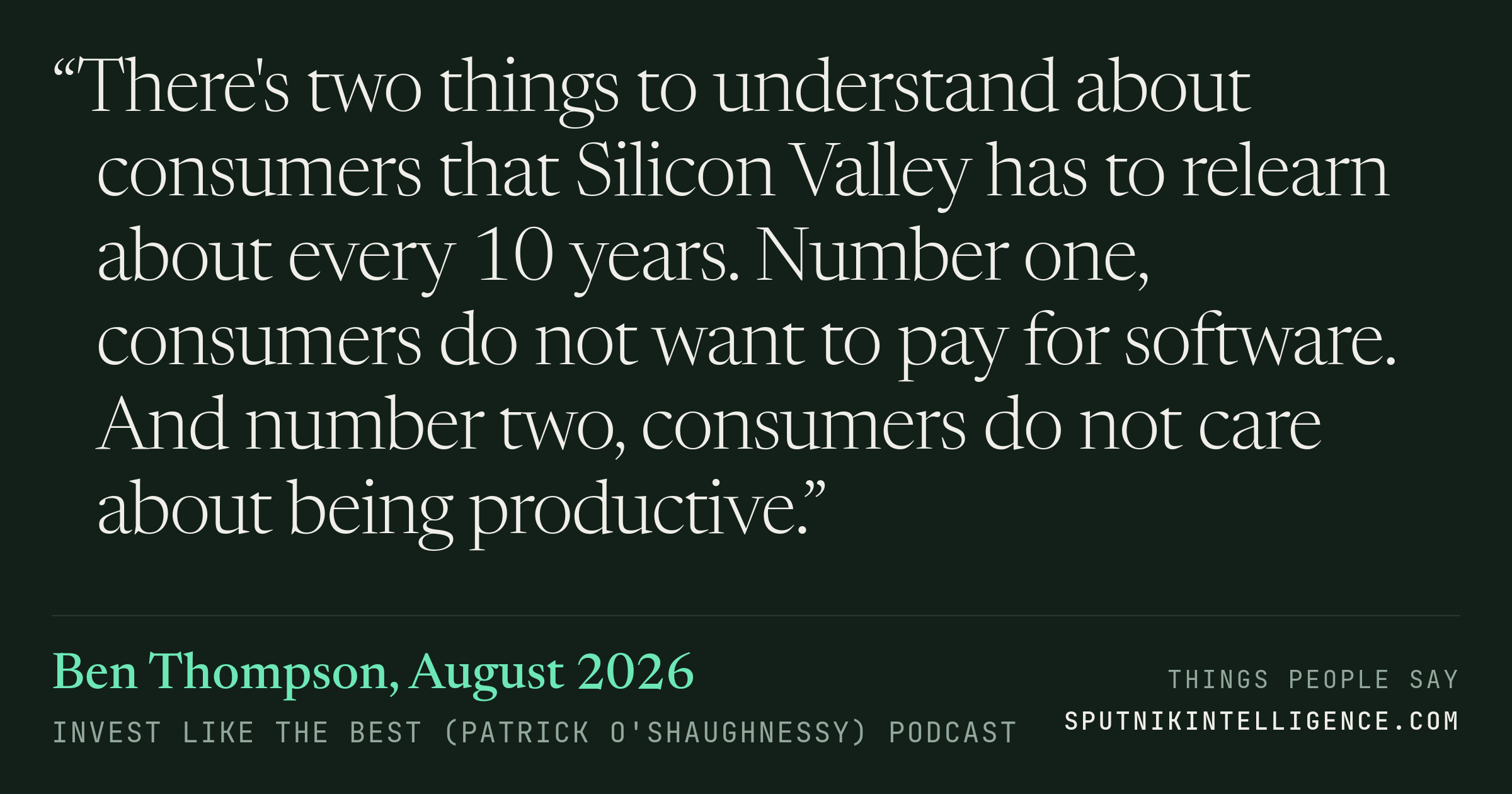
It feels like it might be a situation of better be lucky than good to a certain extent. Apple has their whole ecosystem. At the end of the day, they do own access to customers. So they can get suppliers. This is the classic aggregator play. If you own access to customers, suppliers come to you, not the other way around. So they can get suppliers for their AI as needed. And by the way, to the extent it's true that people don't want to be productive, they just want a sort of a chatbot. Not only can they serve them a chatbot and finally getting a Siri that works, but you can see a future where this absolutely can work on device. And they actually don't even need to pay for inference costs either because they're using the customer's electricity. I don't think we're quite there. There's a reason they're using Google Cloud and NVIDIA chips, but you can certainly imagine a future where that's the case. And they're in physical goods. Actually, making phones is hard. Having retail, having distribution for physical goods, they're more insulated. The smartphone is so perfect. It's small enough in your pocket. It's big enough to watch basically anything on it. You can run your whole life on it. All your entertainment is there. When we talk about customers who just want to be entertained, the TV is now an accessory. It's all on your phone. I don't see anyone taking over the phone. The question is, is the phone always going to be the center? Or is there a bit where, particularly in the home, this is where OpenAI's efforts here are very interesting, where you want sort of an ambient AI where you just talk to the AI and it tells you what you need. Apple is the best position to provide that, but can they provide that without having leading edge models? Can they provide that if they're so phone centric? Or is it like a Microsoft situation? Microsoft didn't miss mobile. They were very early to mobile. The problem is their mobile was a small PC. They assumed the PC would always be the center and their phones were going to be something that was off that. Apple realized, no, we need to reset. The phone is not going to be accessory to the Mac. The phone is going to be the phone. The iPod helped them realize that and going with Windows and all that. But will they fall into a Microsoft-like trap, assuming the phone's so good, it's always going to be the center. And then let's figure out around it. Or is this five the time when actually Ambient, the cloud, just in general, AI being everywhere, it can manifest through your phone, it can manifest through a device, it can manifest on your computer, is actually better and is actually disruptive to them. I think it's possible. I also think it's totally valid for Apple to double down on what they do. The other thing about the AI stuff is on what basis should we expect Apple to be good at this? At the most crude level, AI is this probabilistic endeavor. Apple is the king of deterministic products. A physical product, you ship that iPhone, you ship it once, and it's got to be good. If it's bad, it costs you billions and billions and billions of dollars. Apple's never had an iPhone recall. It's amazing. That care and decision making and diligence and fierceness in terms of your supply chain and making hard decisions is very, very different than everything that goes into like making great AI. I'm generally prefer companies to do what they're good at. So from my perspective, I'm fine with Apple not doing AI. I want them to keep making great devices. Of
the five potential frontier AI winners, so OpenAI Anthropic, Gemini, SpaceX AI, Grok, and Meta, which of those firms do you think has the most interesting setup?
Open AI and Anthropic obviously are the riskiest, but also have the biggest upside. Never discount, number one, the power of belief. They think they're creating God. The most impactful things in history have usually been fueled by religion. The two religious organizations in Silicon Valley are OpenAI is kind of like mainline. They go to church every Sunday. They're sort of like evangelicals. That's Anthropic. They're all in. It is core to their belief. That goes a long way. The fact you need to make a business work for you to survive goes a very long way. Google just needs search to not die too quickly. Meta has the huge advertising business. In a world where Meta was run by anyone other than Mark Zuckerberg, they would not be on the leading edge. That is one of the purest manifestations of founder energy, for better or for worse. Their business is so amazing. You see them just easily sort of doubling down on that. Google, there's a bit where they had Google Cloud, they have TPUs, they've been doing research in this. It makes sense why they're pursuing this. Meta being like, actually, we're going to hire a completely new team. We're going to start from scratch. This is all again is pretty insane. Credit to Mark Zuckerberg in that regard. Again, you can decide whether that's a good idea or not. And then SpaceX AI, data centers in space, the theory is there. Do they have to own their own model, though, to do that? They get better margins if they do. Then again, if we actually run out, whether through political opposition or power or whatever it might be, if we run out of data centers on Earth, they can run whatever model they want, as we're seeing with selling their capacity to Anthropic right now. They're all pretty interesting. Probably the case for SpaceX AI is probably the weakest because the data center and space play is so highly differentiated. If that plays out, I'm not sure to what extent they need to even have their own model. So why are you wasting billions and billions of dollars in the meantime? That's a fair question. From a tactical perspective, I love the cursor acquisition. That makes so much sense for both companies. And so I've been intrigued to see what they do. Meta is probably the most interesting.
You've written a lot about this recently.
I think there's a very good case to make that it is more reckless to not be on the frontier if you're a digital company. The counter to meta is actually Microsoft. Microsoft is not on the frontier. The reason why Microsoft has $20 million of free cash flow last quarter, Microsoft paid a $10 billion dividend last quarter. There's some money, but their play is, oh, we're going to play all these off each other. We're going to provide middleware. We're going to provide the platform that enterprises will build on us and we're going to sort of disintermediate the models. I think it's a rational play. It's the IBM play of the 90s. History echoes. Everyone talks about Google, Google like falling in Microsoft. Microsoft follows IBM. And you can see that to an extent. What
did IBM do? What's the analogy? Well,
More from Invest Like the Best (Patrick O'Shaughnessy)