 Tulsee Doshi
On Lenny's Podcast: Product | Career | Growth
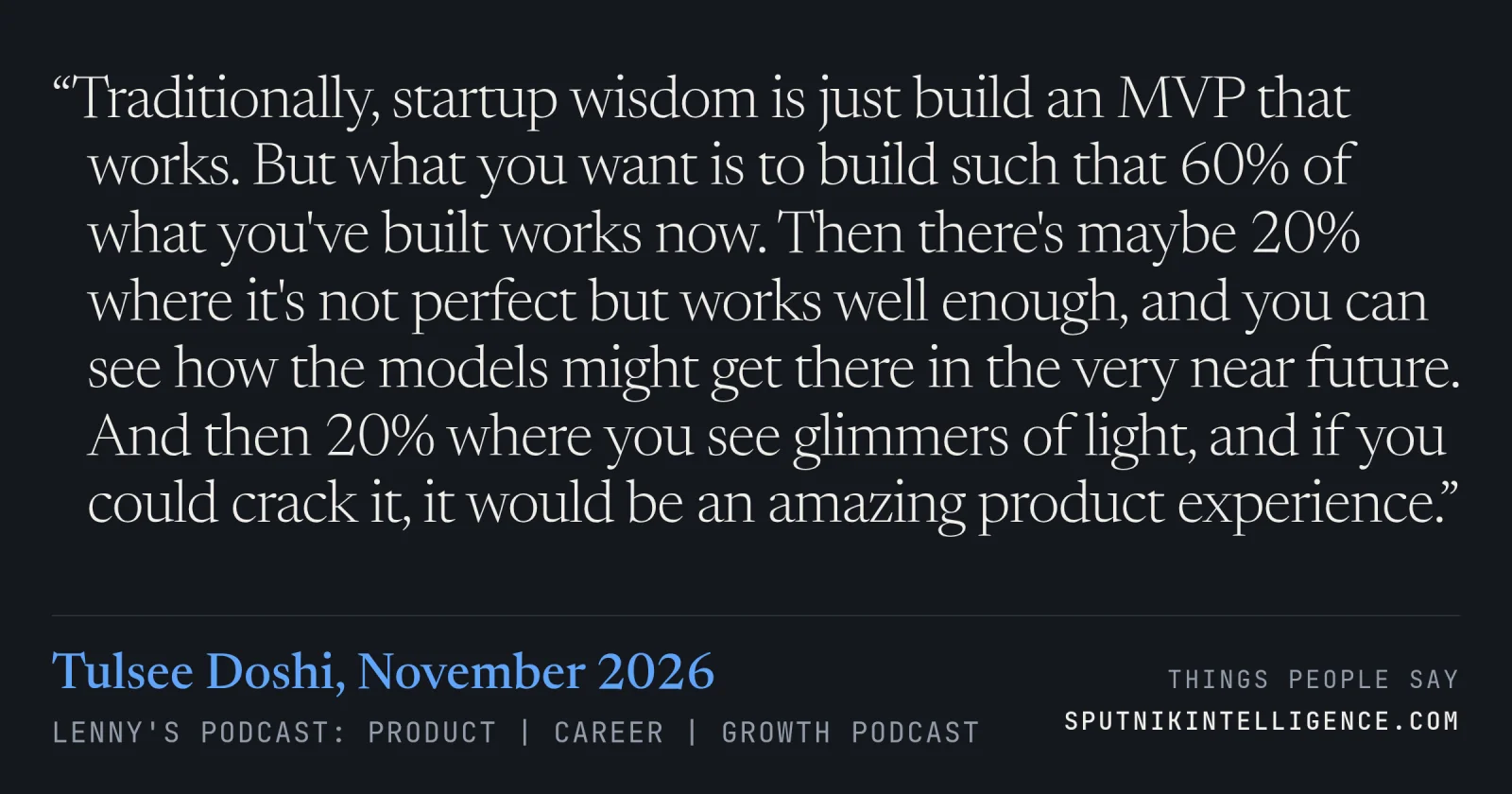
“Traditionally, startup wisdom is just build an MVP that works. But what you want is to build such that 60% of what you've built works now. Then there's maybe 20% where it's not perfect but works well enough, and you can see how the models might get there in the very near future. And then 20% where you see glimmers of light, and if you could crack it, it would be an amazing product experience.”
Lenny's Podcast: Product | Career | Growth · In-Depth Interviews · November 2026
Context
Lenny asked about Doshi's 60-20-20 framework for how far ahead of current model capability to build. She says the exact numbers are flexible, but the idea holds because model capabilities keep moving under you.
Transcript
It's just so interesting from like 12 years ago to today. Yeah.
…of changed? Okay, so going in somewhat of a different direction, you have this framework that I think is going to be really helpful to people around how far ahead to build in terms of how far AI is and how far your product should assume AI is going to be. You call it a 60-20-20 rule. Explain that.
I think the numbers are probably fungible here, but I think the thesis is the same, which is, I think, as you're building today and as you're a product developer building using these models, I think the important thing is to keep in mind that these models are consistently changing. And so the capabilities that you have today will not be the capabilities you have tomorrow or the next day. And so you want to actually build features that aren't necessarily always working today, right? So typically when you talk about like traditional startup wisdom, I think you're just like, build an MVP that works, right? But I think what you want to do is actually build such that like 60% of what you've built works now and your prototype is at least functional, right? Then there's a set of maybe the 20% where you're like, it's not perfect, but it like works well enough. And I can see how the models might get here in the very near future. And then here's where I want the models to be. And here's, I see glimmers of light. And I feel like if I could crack this, like this would be an amazing product experience. And I think if you build in that way, you are building a product that works today, but…
I've heard a lot of advice along these lines of how far ahead to build. And the most common is just like build like three months ahead of where the model is going to be. And this feels like a lot more practical where you can't just bet on the future. You also need to ship some things today that are…
trying to find that balance. Right. And I think also I find personally hard to know where the models, as someone who works on the model, to tell you exactly where the model is going to be three months from now. And so I think using more of your own proxies of like, where is my product? Where do I…
This reminds me of just another way of thinking about how to kind of create a portfolio of product bets on a product team. Like the way it used to be is like have some ambitious bold bets, but also have a lot of stuff that's very low risk, likely to move the metric, and you want to mix them…
More from Lenny's Podcast: Product | Career | Growth