
Tulsee Doshi

Things Tulsee Says on Podcasts

Where to Find Them

Tulsee Doshi has been a guest on Google AI: Release Notes (4 times) , The Skip , Lenny's Newsletter , The Skip Podcast , Lenny's Podcast: Product | Career | Growth and The Cognitive Revolution" | AI Builders, Researchers, and Live Player Analysis .

Recently: “What it actually takes to build frontier models | Tulsee Doshi (Head of Product for Gemini)” on Lenny's Newsletter (November 2026); “Why PMs are suddenly valuable again | Tulsee Doshi (Head of Product, Gemini)” on Lenny's Podcast: Product | Career | Growth (November 2026); “Inside Gemini: How Google Runs Product for Its Model” on The Skip (September 2026); “Inside Gemini: How Google Runs Product for Its Model” on The Skip Podcast (September 2026); “Google I/O 2026 Recap with Logan Kilpatrick, Josh Woodward and Tulsee Doshi” on Google AI: Release Notes (June 2026); “The Model Eats the Scaffolding: DeepMind's Logan Kilpatrick & Tulsee Doshi on 3.5 Flash, Omni & More” on The Cognitive Revolution" | AI Builders, Researchers, and Live Player Analysis (May 2026).

What They Said

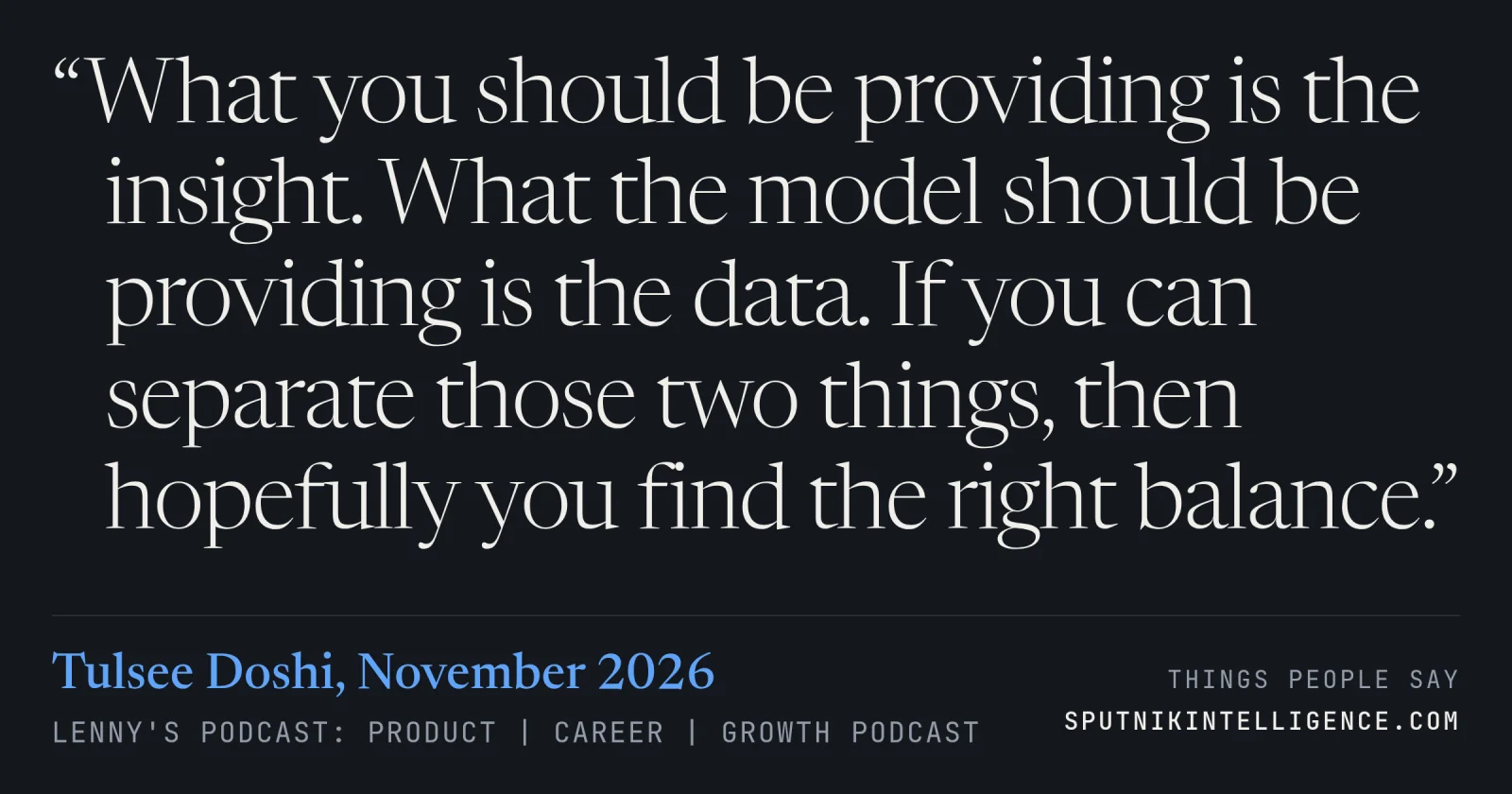
“What you should be providing is the insight. What the model should be providing is the data. If you can separate those two things, then hopefully you find the right balance.” — Tulsee Doshi, Lenny's Podcast: Product | Career | Growth

Lenny asked about 'AI slop', colleagues sending documents written by AI. Doshi gives her rule for when AI-written documents help: for example, a post-launch report that pulls usage and feedback from dashboards and social media faster than any person could.

Lenny's Podcast: Product | Career | Growth · 2026-11-08 Permalink → Listen →
Lenny's Podcast: Product | Career | Growth Around 42:45 into the episode
Tulsee Doshi

…tell you meaningfully different things about why they come to work every day and what they find value out of. And so I feel like part of it for me as like an org leader also is to think about what motivates the individual and how do we make sure that they are set up for success in that setup too.

Lenny Rachitsky

…lot of the issue was spending time writing docs and now it's like reading docs is the problem because you're just all this AI written stuff. Do you have any kind of, I don't know, processes or policies you've put in place in your team to help avoid this rise of AI written content across the teams?

Tulsee Doshi

One of the things that we talk about a lot is where are these docs useful, right? So like, for example, I think where AI generated docs are actually quite helpful, for example, is after you launch something and let's say two weeks later, you want to pull the latest of like who's using it, how are they using it, what's the feedback. That's the kind of document that AI is fantastic for, right? Because it will actually do that just so much faster than you, right? It will go and pull from various dashboards and metrics. It'll give you an update. It'll pull kind of strengths and weaknesses. It'll pull from Twitter analysis and Reddit or whatever. And so I think one of the things we talk about is be intentional about where is AI helping you drive content in the doc that is helpful versus where is it content that should come from you, right? Where is it insight? And so what you should be providing is the insight. What the model should be providing is the data. And…

Lenny Rachitsky

That's actually something I was wanting to ask about. So in terms of the PM role, AI has clearly made a big dent on prototyping. You can prototype telecows come home now versus having a designer or an engineer build a thing. So that's clearly a place the role has changed with AI. The other area…

Tulsee Doshi

Yeah, prototyping is a great one. I think you're right that like data science is probably like, I think you are more empowered to have the data at your fingertips to make data-driven decisions. I also think actually, like to our earlier conversation, you know, you see these on social a lot, these…

Lenny Rachitsky

Awesome. Okay. That aligns with a lot of what I'm hearing. Tulsi, is there anything else that you wanted to share? Is there anything else you think you want to double down on that we've talked about that you want to say before we get to our very exciting lightning round?

Speaker names come from our own diarization. The position is estimated from where the line sits in the episode.
“Start with even just five prompts. We often think, oh, I need to build some massive large-scale evaluation or benchmark. But even a mini evaluation, 20 prompts that stress test a set of capabilities, where you can see signal between model A and model B, is already so powerful. Start with yourself as the rater, looking at a prompt and deciding if the response is good.” — Tulsee Doshi, Lenny's Podcast: Product | Career | Growth

Lenny asked how someone who has never written an eval should begin. Doshi admits Google is still upskilling its own PMs on evals, and recommends starting tiny with your own judgment as the grader.

Lenny's Podcast: Product | Career | Growth · 2026-11-08 Permalink → Listen →
Lenny's Podcast: Product | Career | Growth Around 20:27 into the episode
Tulsee Doshi

…it again and rewriting it, right? And so, I think PMs who are constantly keeping an eye out on the environment, on the market landscape, and actually consistently reinterrogating, like, what are we doing and why are we doing it? As opposed to assuming that there was a fixed kind of plan of action.

Lenny Rachitsky

This is awesome. Okay, so vibes, evals, adaptive. I want to poke at these a little bit. So, with evals, say someone doesn't really know how to write an eval, how to approach writing an eval, their first eval. What are some tips to start getting better at the skill of writing evals?

Tulsee Doshi

Yeah, and to be honest, we're still figuring that out internally with our PMs as well. And I would say, like, we see some PMs who are stronger at this than others. And so, we're kind of working to upskill our whole team here. I think for me, a big thing is start with even just five prompts, right? Like, start, you don't have to start large. I think we often think about like, oh, I need to build some sort of massive large-scale evaluation or benchmark. I think often, like, even just a mini evaluation where you get to like 20 prompts that can really stress test a set of capabilities where you can see signal between, you know, your model and another model or model A and model B. I think that already is so powerful. And that's an unlock because it doesn't require you to think as critically about all of the pieces, right? Like, start simple. Start with even just yourself, like, you as the rater, you looking in a prompt, you trying to decide if the result and the response is good, especially when you're talking about these like long, multi-step, multi-turn trajectories. Just even being able to identify how you're thinking about good is really hard…

Lenny Rachitsky

Awesome. Okay, that is really good advice. There's this debate, I don't know, six months ago on Twitter around evals versus vibes. And it's interesting, your advice is both actually a really important structured evals or rubrics and also getting good at getting the vibes. So, on that vibes piece…

Tulsee Doshi

There isn't necessarily a one-right answer to this because you ideally want to stress test the model on things that you are excited about, right? That's where you're going to also see magic in the model, I think. And so I actually see that different people have very, very different notions of this…

Lenny Rachitsky

This is great advice. So what I'm hearing is stick to things you actually care about and watch the models evolve on how good they are at this thing. Could be writing a PRD for you, could be writing strategy doc, could be generating graphics. Okay. I have a couple of eval stories that one of your…

Speaker names come from our own diarization. The position is estimated from where the line sits in the episode.
“Traditionally, startup wisdom is just build an MVP that works. But what you want is to build such that 60% of what you've built works now. Then there's maybe 20% where it's not perfect but works well enough, and you can see how the models might get there in the very near future. And then 20% where you see glimmers of light, and if you could crack it, it would be an amazing product experience.” — Tulsee Doshi, Lenny's Podcast: Product | Career | Growth

Lenny asked about Doshi's 60-20-20 framework for how far ahead of current model capability to build. She says the exact numbers are flexible, but the idea holds because model capabilities keep moving under you.

Lenny's Podcast: Product | Career | Growth · 2026-11-08 Permalink → Listen →
Lenny's Podcast: Product | Career | Growth Around 26:57 into the episode
Tulsee Doshi

It's just so interesting from like 12 years ago to today. Yeah.

Lenny Rachitsky

…of changed? Okay, so going in somewhat of a different direction, you have this framework that I think is going to be really helpful to people around how far ahead to build in terms of how far AI is and how far your product should assume AI is going to be. You call it a 60-20-20 rule. Explain that.

Tulsee Doshi

I think the numbers are probably fungible here, but I think the thesis is the same, which is, I think, as you're building today and as you're a product developer building using these models, I think the important thing is to keep in mind that these models are consistently changing. And so the capabilities that you have today will not be the capabilities you have tomorrow or the next day. And so you want to actually build features that aren't necessarily always working today, right? So typically when you talk about like traditional startup wisdom, I think you're just like, build an MVP that works, right? But I think what you want to do is actually build such that like 60% of what you've built works now and your prototype is at least functional, right? Then there's a set of maybe the 20% where you're like, it's not perfect, but it like works well enough. And I can see how the models might get here in the very near future. And then here's where I want the models to be. And here's, I see glimmers of light. And I feel like if I could crack this, like this would be an amazing product experience. And I think if you build in that way, you are building a product that works today, but…

Lenny Rachitsky

I've heard a lot of advice along these lines of how far ahead to build. And the most common is just like build like three months ahead of where the model is going to be. And this feels like a lot more practical where you can't just bet on the future. You also need to ship some things today that are…

Tulsee Doshi

trying to find that balance. Right. And I think also I find personally hard to know where the models, as someone who works on the model, to tell you exactly where the model is going to be three months from now. And so I think using more of your own proxies of like, where is my product? Where do I…

Lenny Rachitsky

This reminds me of just another way of thinking about how to kind of create a portfolio of product bets on a product team. Like the way it used to be is like have some ambitious bold bets, but also have a lot of stuff that's very low risk, likely to move the metric, and you want to mix them…

Speaker names come from our own diarization. The position is estimated from where the line sits in the episode.
“The model isn't predictable. It's kind of like Snape's potions class. You can put all the ingredients in and be thoughtful about what you expect, but you also have to expect that there will be a little bit of magic. And that magic is going to be surprising and unique. So your job as a PM is not just to shape what goes into the model, but also to look at what comes out the other side and identify where the model shines.” — Tulsee Doshi, Lenny's Podcast: Product | Career | Growth

Asked what people misunderstand about how frontier models are built, Doshi says PMs set goals and capabilities but cannot fully predict the result of a training run. The Harry Potter comparison became the episode's recurring image.

Lenny's Podcast: Product | Career | Growth · 2026-11-08 Permalink → Listen →
Lenny's Podcast: Product | Career | Growth Around 06:30 into the episode
Tulsee Doshi

…Gemma, our suite of open models. And then one set of models that actually falls under our Gemini umbrella, but I feel like we don't talk about as much is our audio models. So dialogue, audio understanding, text to speech, translation, all a part of the portfolio of how we build frontier models.

Lenny Rachitsky

…every week, it feels like. You have a really unique lens in being able to see these models from research to pre-training, post-training launch. What's something that you think people maybe misunderstand about how models are created or something that may surprise people about how models are made?

Tulsee Doshi

Yeah, it's a good question. I mean, maybe what I'll say, especially coming from a product management lens, is one thing that I think, you know, when you typically talk about product management for anything, including a model, you talk about what are the goals you have for a model, right? What are the capabilities you want to set? What are the outcomes you want to drive? What goals do you want to hit on a set of evals? And often when I talk to customers or even internal users, you know, they'll ask me, okay, what are the goals that you're setting? And they'll sort of expect that we can really make sure that the model will deliver on those goals in a very traditional product sense. And I think for me, what has often been surprising, but also exciting about model development and being a PM for the model is you should do that and you should have an intentional view, but the model isn't predictable. And so it's kind of like Snape's potions class, right? So you can put all the ingredients in and you should be thoughtful about what you expect, but you also have to expect that there will be a little bit of magic. And that that magic is going to be surprising and that magic is going to be unique. And so your…

Lenny Rachitsky

It's so interesting that it's just like this code that we have written that we feed data and we need to, like, we don't exactly know what's going to happen and how it works. I recently had an interpretability research person on the podcast from Anthropic, and we talked a lot about this, this idea…

Tulsee Doshi

You know, of course, there's brilliant research that goes into these models. And so many aspects of it are predictable in the sense that we are consistently monitoring these runs. We have researchers who are tracking them, who are identifying when to intervene, who are seeing different metrics…

Lenny Rachitsky

This episode is brought to you by this season's presenting sponsor, WorkOS. What do OpenAI, Anthropic, Cursor, Replit, Sierra, Clay, and hundreds of other winning companies have in common? They're all powered by WorkOS. If you're building for enterprises, you have felt the pain of integrating…

Speaker names come from our own diarization. The position is estimated from where the line sits in the episode.
“When you can build anything, and you can build anything so easily, building something great actually is now a unique value add. And taste is now really important. Someone who can really pull the signal from the noise… And when this is so easy, someone who can bring people together and drive consensus and turn chaos into order becomes really important, because speed can basically introduce chaos if you're not able to bring clarity and structure to that.” — Tulsee Doshi, Lenny's Podcast: Product | Career | Growth

Lenny Rachitsky asked about the trend of product managers becoming more valuable again. Doshi, who heads product for Google's Gemini models, agrees and argues that when building is cheap, the scarce skills shift to taste and getting people aligned.

Lenny's Podcast: Product | Career | Growth · 2026-11-08 Permalink → Listen →
Lenny's Podcast: Product | Career | Growth Around 18:35 into the episode
Tulsee Doshi

…If you think about like search or the Gemini app or, you know, YouTube or labs, but also working with external customers to really understand where are they going? What are their needs? What would meaningfully change their experience? And how do we actually build that flywheel of feedback too?

Lenny Rachitsky

…out what is worth building, what problems people have that are worth solving, what it great looks like, what good looks like once you're done. Aligning people behind one cohesive vision. Is that something you're noticing? Thoughts on that kind of PM ascendance that is starting to happen again.

Tulsee Doshi

I like the phrase PM ascendance. I'm going to use that. Yeah, I think, I mean, I think you actually said it very well, right? Which is, I think, look, I'm obviously biased because I am a PM. So I would like to believe that, you know, PM Ascendance is here and we're back. But I actually think, you know, exactly what you said, which is when you can build anything and you can build anything so easily, building something great actually is now a unique value add, right? And taste is now really important. Someone who can come in and actually really pull in what is the signal from the noise, right? And what is that insight that will actually unlock a great experience? And that is truly what a good PM does, right? Is bring that insight and help unlock. I think the other part that you noted that I particularly feel in a place like Google, where we are building a number of products, is again, when this is so easy, someone who can bring people together and drive consensus and turn chaos into order, I think becomes actually really important because, in the absence of that, and the ability to build as quickly as we now can, speed can basically introduce chaos if you're not actually able to kind of bring clarity to that and bring structure to that.

Lenny Rachitsky

So, on that, as you're hiring PMs these days, is there anything you look for more and more, kind of a skill that might be trending up in the PMs that you hire that you think is really important to be really successful? Or just broadly, skills that you find are really important to be successful in…

Tulsee Doshi

Yeah, I mean, I think more and more so, we are looking for PMs who, for lack of a better way of putting it, like understand the vibes of our models or other models. Like, I want PMs who have an opinion, who are playing with these models every day, who have their own use cases for how they judge…

Lenny Rachitsky

This is awesome. Okay, so vibes, evals, adaptive. I want to poke at these a little bit. So, with evals, say someone doesn't really know how to write an eval, how to approach writing an eval, their first eval. What are some tips to start getting better at the skill of writing evals?

Speaker names come from our own diarization. The position is estimated from where the line sits in the episode.
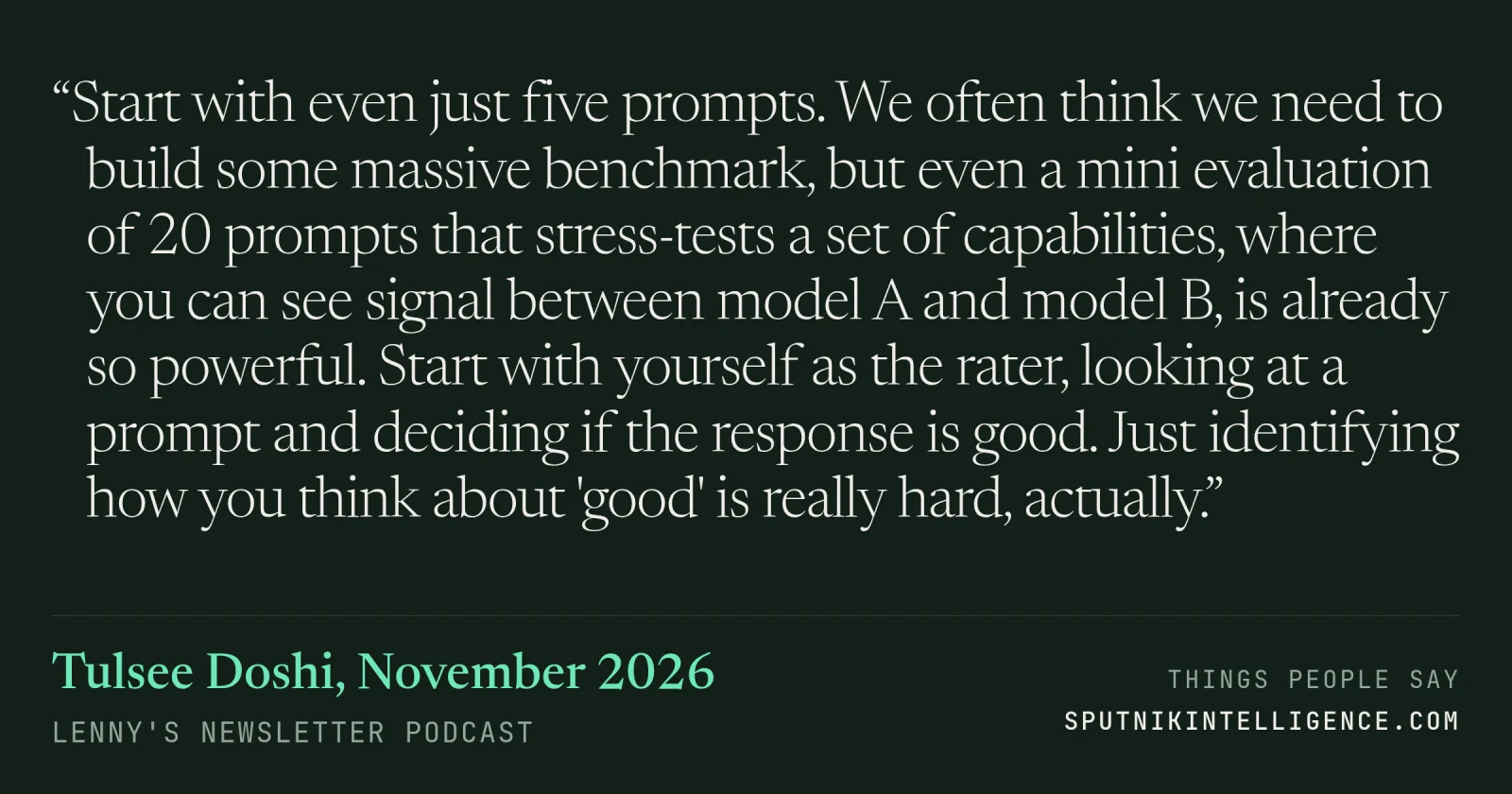
“Start with even just five prompts. We often think we need to build some massive benchmark, but even a mini evaluation of 20 prompts that stress-tests a set of capabilities, where you can see signal between model A and model B, is already so powerful. Start with yourself as the rater, looking at a prompt and deciding if the response is good. Just identifying how you think about 'good' is really hard, actually.” — Tulsee Doshi, Lenny's Newsletter

Asked how a product manager who has never written an eval should start, Doshi says Google is still upskilling its own PMs on this, and advises starting tiny with your own judgment as the baseline.

Lenny's Newsletter · 2026-11-08 Permalink → Listen →
Lenny's Newsletter
Tulsee Doshi

…it again and rewriting it, right? And so, I think PMs who are constantly keeping an eye out on the environment, on the market landscape, and actually consistently reinterrogating, like, what are we doing and why are we doing it? As opposed to assuming that there was a fixed kind of plan of action.

Lenny Rachitsky

This is awesome. Okay, so vibes, evals, adaptive. I want to poke at these a little bit. So, with evals, say someone doesn't really know how to write an eval, how to approach writing an eval, their first eval. What are some tips to start getting better at the skill of writing evals?

Tulsee Doshi

Yeah, and to be honest, we're still figuring that out internally with our PMs as well. And I would say, like, we see some PMs who are stronger at this than others. And so, we're kind of working to upskill our whole team here. I think for me, a big thing is start with even just five prompts, right? Like, start, you don't have to start large. I think we often think about like, oh, I need to build some sort of massive large-scale evaluation or benchmark. I think often, like, even just a mini evaluation where you get to like 20 prompts that can really stress test a set of capabilities where you can see signal between, you know, your model and another model or model A and model B. I think that already is so powerful. And that's an unlock because it doesn't require you to think as critically about all of the pieces, right? Like, start simple. Start with even just yourself, like, you as the rater, you looking in a prompt, you trying to decide if the result and the response is good, especially when you're talking about these like long, multi-step, multi-turn trajectories. Just even being able to identify how you're thinking about good is really hard, actually. And so, even getting that set of good…

Lenny Rachitsky

Awesome. Okay, that is really good advice. There's this debate, I don't know, six months ago on Twitter around evals versus vibes. And it's interesting, your advice is both actually a really important structured evals or rubrics and also getting good at getting the vibes. So, on that vibes piece…

Tulsee Doshi

There isn't necessarily a one-right answer to this because you ideally want to stress test the model on things that you are excited about, right? That's where you're going to also see magic in the model, I think. And so I actually see that different people have very, very different notions of this…

Lenny Rachitsky

This is great advice. So what I'm hearing is stick to things you actually care about and watch the models evolve on how good they are at this thing. Could be writing a PRD for you, could be writing strategy doc, could be generating graphics. Okay. I have a couple of eval stories that one of your…

Speaker names come from our own diarization. The position is estimated from where the line sits in the episode.
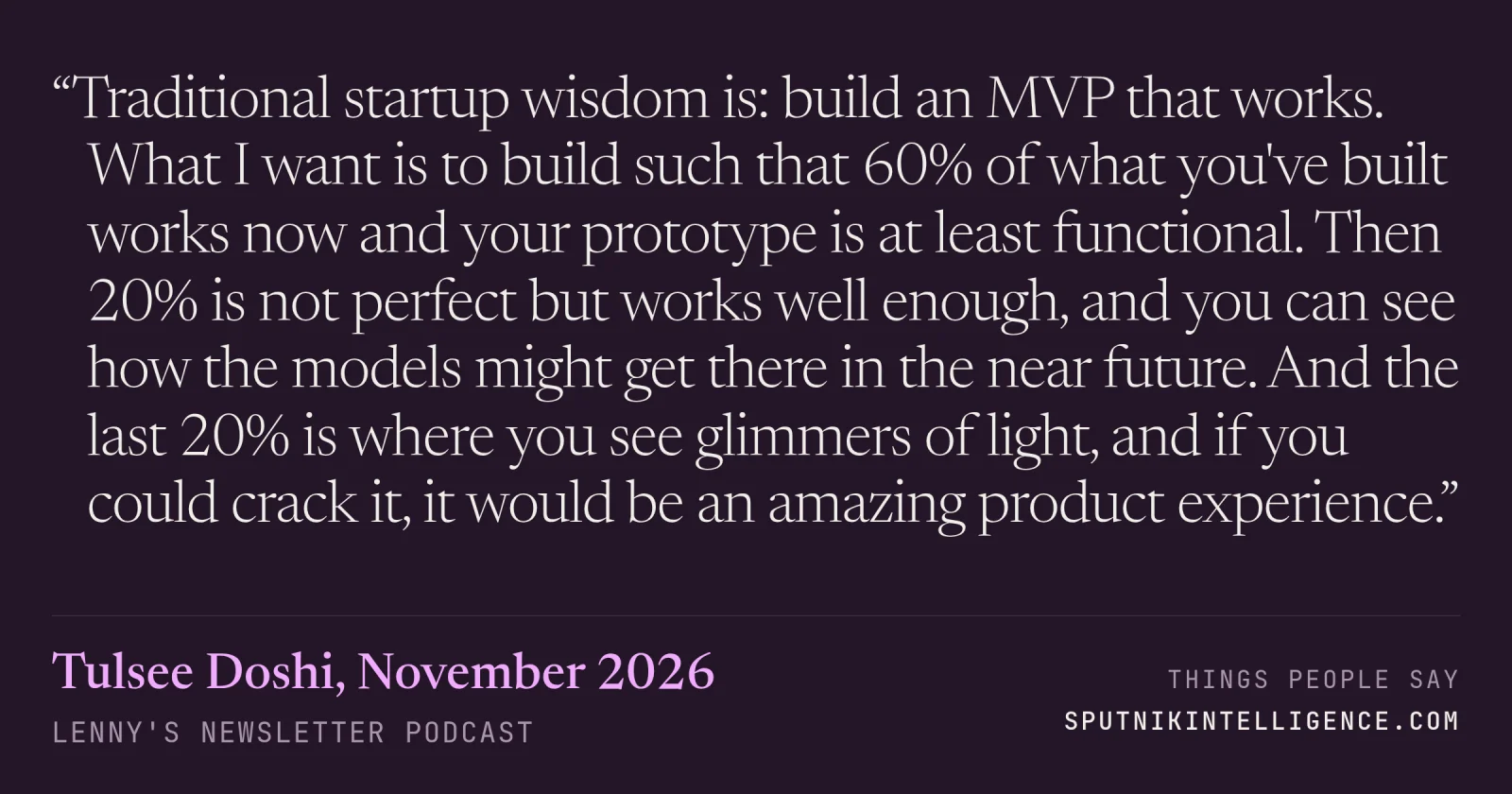
“Traditional startup wisdom is: build an MVP that works. What I want is to build such that 60% of what you've built works now and your prototype is at least functional. Then 20% is not perfect but works well enough, and you can see how the models might get there in the near future. And the last 20% is where you see glimmers of light, and if you could crack it, it would be an amazing product experience.” — Tulsee Doshi, Lenny's Newsletter

Lenny Rachitsky asked her to explain her 60-20-20 rule for how far ahead of current AI capability to build. The idea is to ship something that works today while leaving room for models to catch up.

Lenny's Newsletter · 2026-11-08 Permalink → Listen →
Lenny's Newsletter
Tulsee Doshi

It's just so interesting from like 12 years ago to today. Yeah.

Lenny Rachitsky

…of changed? Okay, so going in somewhat of a different direction, you have this framework that I think is going to be really helpful to people around how far ahead to build in terms of how far AI is and how far your product should assume AI is going to be. You call it a 60-20-20 rule. Explain that.

Tulsee Doshi

I think the numbers are probably fungible here, but I think the thesis is the same, which is, I think, as you're building today and as you're a product developer building using these models, I think the important thing is to keep in mind that these models are consistently changing. And so the capabilities that you have today will not be the capabilities you have tomorrow or the next day. And so you want to actually build features that aren't necessarily always working today, right? So typically when you talk about like traditional startup wisdom, I think you're just like, build an MVP that works, right? But I think what you want to do is actually build such that like 60% of what you've built works now and your prototype is at least functional, right? Then there's a set of maybe the 20% where you're like, it's not perfect, but it like works well enough. And I can see how the models might get here in the very near future. And then here's where I want the models to be. And here's, I see glimmers of light. And I feel like if I could crack this, like this would be an amazing product experience. And I think if you build in that way, you are building a product that works today, but you're…

Lenny Rachitsky

I've heard a lot of advice along these lines of how far ahead to build. And the most common is just like build like three months ahead of where the model is going to be. And this feels like a lot more practical where you can't just bet on the future. You also need to ship some things today that are…

Tulsee Doshi

trying to find that balance. Right. And I think also I find personally hard to know where the models, as someone who works on the model, to tell you exactly where the model is going to be three months from now. And so I think using more of your own proxies of like, where is my product? Where do I…

Lenny Rachitsky

This reminds me of just another way of thinking about how to kind of create a portfolio of product bets on a product team. Like the way it used to be is like have some ambitious bold bets, but also have a lot of stuff that's very low risk, likely to move the metric, and you want to mix them…

Speaker names come from our own diarization. The position is estimated from where the line sits in the episode.
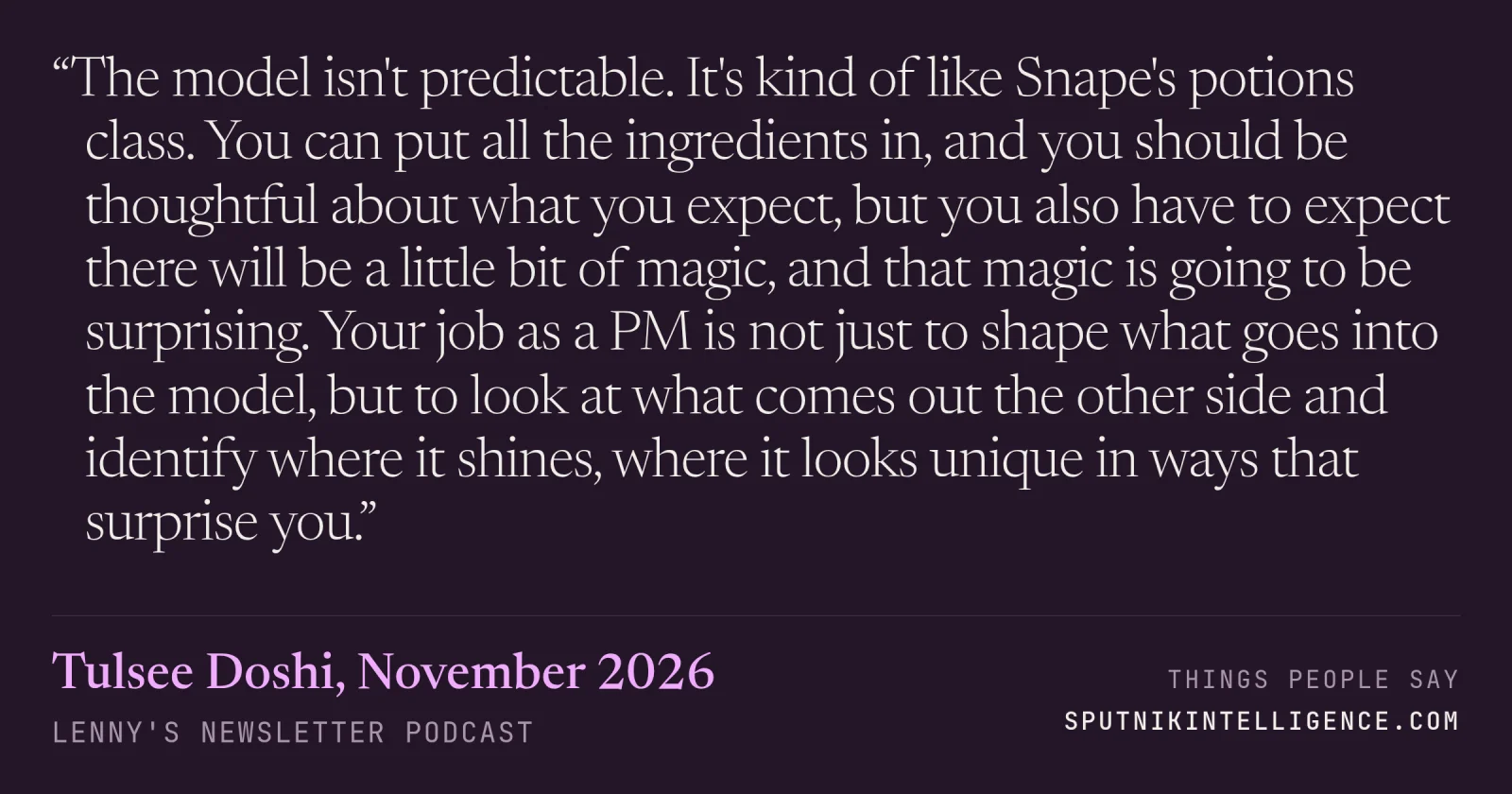
“The model isn't predictable. It's kind of like Snape's potions class. You can put all the ingredients in, and you should be thoughtful about what you expect, but you also have to expect there will be a little bit of magic, and that magic is going to be surprising. Your job as a PM is not just to shape what goes into the model, but to look at what comes out the other side and identify where it shines, where it looks unique in ways that surprise you.” — Tulsee Doshi, Lenny's Newsletter

Asked what people misunderstand about how frontier models get made, Google's head of product for Gemini models says goal-setting for a model does not work like normal product management, because training outcomes can't be fully predicted.

Lenny's Newsletter · 2026-11-08 Permalink → Listen →
Lenny's Newsletter
Tulsee Doshi

…Gemma, our suite of open models. And then one set of models that actually falls under our Gemini umbrella, but I feel like we don't talk about as much is our audio models. So dialogue, audio understanding, text to speech, translation, all a part of the portfolio of how we build frontier models.

Lenny Rachitsky

…every week, it feels like. You have a really unique lens in being able to see these models from research to pre-training, post-training launch. What's something that you think people maybe misunderstand about how models are created or something that may surprise people about how models are made?

Tulsee Doshi

Yeah, it's a good question. I mean, maybe what I'll say, especially coming from a product management lens, is one thing that I think, you know, when you typically talk about product management for anything, including a model, you talk about what are the goals you have for a model, right? What are the capabilities you want to set? What are the outcomes you want to drive? What goals do you want to hit on a set of evals? And often when I talk to customers or even internal users, you know, they'll ask me, okay, what are the goals that you're setting? And they'll sort of expect that we can really make sure that the model will deliver on those goals in a very traditional product sense. And I think for me, what has often been surprising, but also exciting about model development and being a PM for the model is you should do that and you should have an intentional view, but the model isn't predictable. And so it's kind of like Snape's potions class, right? So you can put all the ingredients in and you should be thoughtful about what you expect, but you also have to expect that there will be a little bit of magic. And that that magic is going to be surprising and that magic is going to be unique. And so your job as a PM is not just to try…

Lenny Rachitsky

It's so interesting that it's just like this code that we have written that we feed data and we need to, like, we don't exactly know what's going to happen and how it works. I recently had an interpretability research person on the podcast from Anthropic, and we talked a lot about this, this idea…

Tulsee Doshi

You know, of course, there's brilliant research that goes into these models. And so many aspects of it are predictable in the sense that we are consistently monitoring these runs. We have researchers who are tracking them, who are identifying when to intervene, who are seeing different metrics…

Lenny Rachitsky

This episode is brought to you by this season's presenting sponsor, WorkOS. What do OpenAI, Anthropic, Cursor, Replit, Sierra, Clay, and hundreds of other winning companies have in common? They're all powered by WorkOS. If you're building for enterprises, you have felt the pain of integrating…

Speaker names come from our own diarization. The position is estimated from where the line sits in the episode.

Collections They Appear In