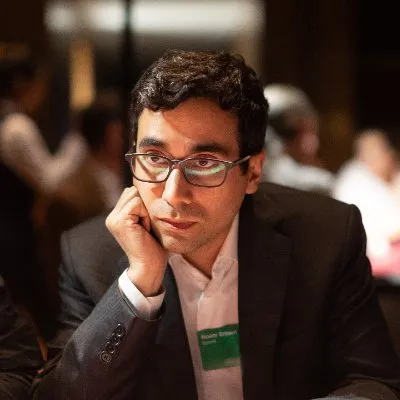
 Noam Brown
Research scientist at OpenAI working on reasoning, reinforcement learning, self-play and multi-agent AI, and a foundational contributor to the reasoning models...
“I would go to some places and say, look, reasoning is going to be this essential ingredient. And people would tell me, well, actually, we should just pre-train a bigger model and that'll solve all the problems. GPT-4 can't play Go, it sucks at chess, it sucks at poker, but a few more orders of magnitude of training, maybe it'll just work. And I would point to the evidence and say, actually, no. If you look at how much you would have to scale it up by to play Go competently, it would be about six orders of magnitude.”
Training Data · AI Research & Frontier Labs · November 2026
Context
Noam Brown recalls pitching general-purpose reasoning to AI labs in 2022, when most were convinced that scaling pre-training alone would get there. It's the counter-bet that took him to OpenAI.
Transcript
…with a model of human irrationality. So we train these models that their purpose is to imitate people as closely as possible. And then we train the AI with these imitation humans and do a lot of training. And then we can deploy that in the real world with actual humans. And that's what does best.
…in our brains. And we sort of have these solutions. That are imperfect. And you can explain why it happens from behavioral economics point of view, but it isn't the rational, reasoned approach. How have you sort of incorporated that into like reasoning and doing research and reasoning at OpenAI?
Yeah. So after the diplomacy results, I had an interesting choice in my career at that point because this was around 2022. I think around early 2022, it was becoming clear that the game theory approach, it was not working in diplomacy. And actually, that the right approach was this kind of like more modeling of human behavior. And this was kind of like a crisis of faith moment for me because my entire career up until that point had been about game theory, right? I was by area was computational game theory. My expertise was computational game theory. And I had to wrestle with the fact that actually that was not the path to general intelligence. That actually, if you look at the evidence, it was this training on a lot of human data, modeling people really well, and then teaching the model to interact with that environment. And then also the scaling up of reasoning thing. And so I had to choose between like, okay, well, do I stick with computational game theory despite me thinking that this is not the most important direction, the most promising path to general intelligence? Or do I pivot and do I work on what I think is actually the most valuable thing, despite it not being my, you know, what I'm an expert at, which is general purpose reasoning in RL. And I ultimately decided to go the path of what I…
What changed over the last few years? What was it the breakthroughs that allowed them to, as you said, it's not just scaling it up? So what were the major breakthroughs along the way?
I think the major takeaway from my work on poker, diplomacy, and then also looking back at games like Batgammon and chess was that you needed these AIs to think before acting. So when I started working on poker bots in 2012 and 2013, there was no reasoning going into these models. They would just…
Great. I have a few more questions, but hey, start thinking about what you would like to ask known because we're going to open it up for QA. I think a lot of people here are incredible. The people here were smarter when I was in college. They're all very mathy people, very AI-pilled people. They're…
More from Training Data