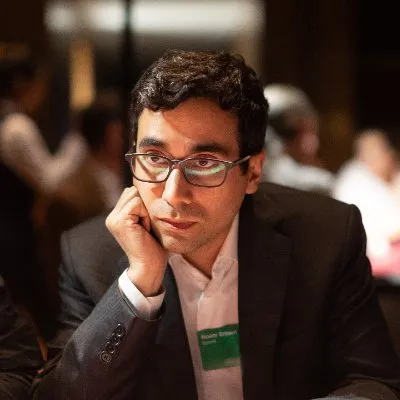
Noam Brown

Things Noam Says on Podcasts

Research scientist at OpenAI working on reasoning, reinforcement learning, self-play and multi-agent AI, and a foundational contributor to the reasoning models behind o1. Earlier at Meta's FAIR lab, his team built CICERO, the first AI to reach human-level play in the strategy game Diplomacy. With his Carnegie Mellon advisor he built the poker AIs Libratus and Pluribus, which beat top human professionals. Appears on Training Data, No Priors, Latent Space, the Dwarkesh Podcast, Unsupervised Learning and the Lex Fridman Podcast. Libratus received the Marvin Minsky Medal for Outstanding Achievements in AI, and he was named to MIT Technology Review's 35 Innovators Under 35 in 2019.

Where to Find Them

Noam Brown writes Unsupervised Learning with Jacob Effron . They have also been a guest on Training Data (3 times) , No Priors (2 times) , Latent Space (2 times) , Lex Fridman Podcast , Begin Proof , Dwarkesh Podcast , The Robot Brains Podcast and Super Data Science: ML & AI Podcast with Jon Krohn .

Recently: “OpenAI’s Noam Brown: Why Game Theory Didn’t Lead to General Intelligence (Live at No Limit Finals)” on Training Data (November 2026); “Noam Brown – Agent swarms, alignment, & recursive self-improvement” on Dwarkesh Podcast (September 2026); “Really Big Test-Time Compute in AI Changes Benchmarks, Safety and Research with OpenAI Research Scientist Noam Brown” on No Priors (June 2026); “Begin Proof — Noam Brown” on Begin Proof (June 2026); “OpenAI’s IMO Team on Why Models Are Finally Solving Elite-Level Math” on Training Data (July 2025); “Scaling Test Time Compute to Multi-Agent Civilizations: Noam Brown” on Latent Space (June 2025).

What They Said

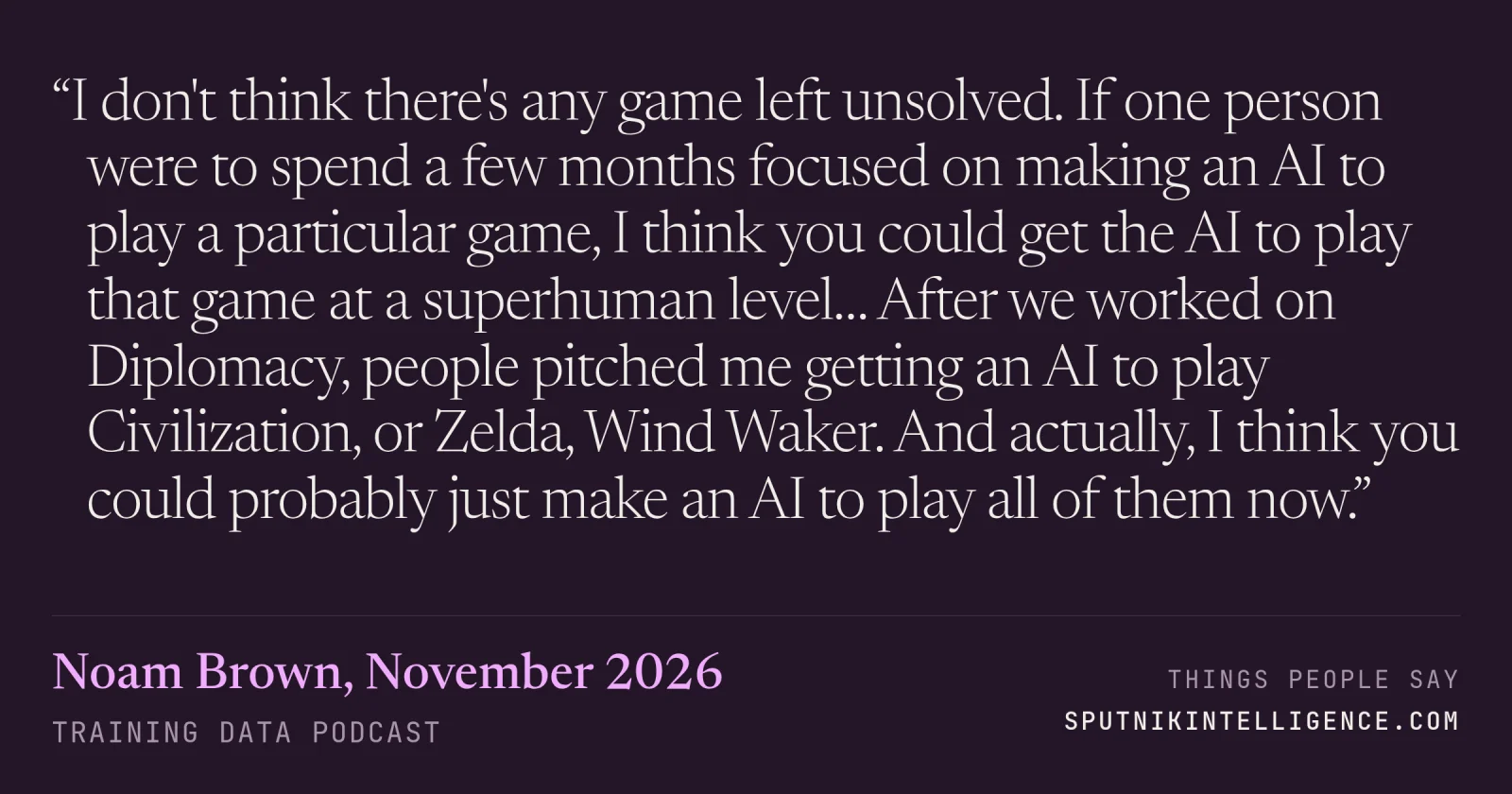
“I don't think there's any game left unsolved. If one person were to spend a few months focused on making an AI to play a particular game, I think you could get the AI to play that game at a superhuman level… After we worked on Diplomacy, people pitched me getting an AI to play Civilization, or Zelda, Wind Waker. And actually, I think you could probably just make an AI to play all of them now.” — Noam Brown, Training Data

In the lightning round, Noam Brown was asked which unsolved game he'd like to see AI crack. His answer is that there isn't one left.

Training Data · 2026-11-24 Permalink → Listen →
Training Data Around 23:39 into the episode
Noam Brown

Seems like it's a selfie group. Love to chat.

Speaker 1

All right. Before we let you go, a few lightning round fun questions, random questions. Is there a game in AI that a game that AI has not solved that you would like to see solved?

Noam Brown

No Limit don't think there's any. I think if a team were to spend even a few months focused on even one person, actually, if one person were to spend a few months focused on making an AI to play a particular game, I think you could get the AI to play that game at a superhuman level. I struggle to think of any, I mean, we chose diplomacy because we thought it would be the hardest game to make an AI for, the hardest game to make an AI for. And I can't think of anything that would be harder. You can even think of things like, you know, after we worked on diplomacy, there were various things that were pitched to me. Get an AI to play civilization, get an AI to play Zelda, Wind Waker, all these things. And actually, I think you could probably just make an AI to play all of them now.

Alfred Lin

Wow.

Noam Brown

I will say, I think the next challenge is using games as an evaluation. That ideally you don't make the AI specifically for that game, but you make a general purpose LLM and then evaluate it on that game. And certainly right now, the LLMs are not able to play real-time strategy games. They're not…

Speaker 1

Who's the best human poker player that you've watched?

Speaker names come from our own diarization. The position is estimated from where the line sits in the episode.
“Perhaps my most controversial take is that if somebody is a promising student, the best thing to do is actually to drop out and join the labs now. Things are going fast and it's an exciting time, so it's not a great time to sit on the sidelines. I've hired a few people that have just dropped out and skipped their senior year of college, and they do exceptionally well.” — Noam Brown, Training Data

Noam Brown says AI progress has sped up over the past six months and he expects a very steep climb over the next year or two. This is his advice to students.

Training Data · 2026-11-24 Permalink → Listen →
Training Data Around 21:30 into the episode
Noam Brown

Can you apply RSI to a problem? I mean, making poker bots or playing poker?

Speaker 4

They're the same, right? Like, RSI basically, like, you can self-improve yourself to become a better.

Noam Brown

I mean, like I said, yeah, I asked all the latest models to make poker bots, and I think they are getting pretty good at iterating and like running experiments and recognizing when they could do better. As far as RSI, it is a real thing. In some ways, it's not a novel concept. You know, what's if you think about all of human technological progress, it really is just one giant RSI loop where we use technology to advance our ability to do technology, to make technology or to make scientific discoveries. We make the telescope so we can explore deeper into space. We make computers and then we start off using punch cards, and then we progress to compilers. And this accelerates our ability to do research and make new technology. What humans end up doing then shifts to what the models are bad at? This goes back to my point that the models are jagged right now. So when we go from like punch cards to compilers, a lot of what people end up doing becomes focused on what the models are still bad at, what the computers cannot do. And when we go from compilers to things like LLMs, again, like the work that a person does shifts. No Limit think what's different today…

Speaker 1

All right. Well, so if you, so you're wanting to recruit some new people here for sure.

Noam Brown

Seems like it's a selfie group. Love to chat.

Speaker 1

All right. Before we let you go, a few lightning round fun questions, random questions. Is there a game in AI that a game that AI has not solved that you would like to see solved?

Speaker names come from our own diarization. The position is estimated from where the line sits in the episode.
“If you think about all of human technological progress, it really is just one giant RSI loop, where we use technology to advance our ability to make technology or to make scientific discoveries. We make the telescope so we can explore deeper into space. We make computers, and then we start off using punch cards, and then we progress to compilers. What humans end up doing then shifts to what the models are bad at.” — Noam Brown, Training Data

An audience member asked how soon recursive self-improvement (RSI) will arrive. Noam Brown argues it's not a new idea, since every generation of tools speeds up the next. What's new is how general and how fast it is.

Training Data · 2026-11-24 Permalink → Listen →
Training Data Around 21:30 into the episode
Noam Brown

Can you apply RSI to a problem? I mean, making poker bots or playing poker?

Speaker 4

They're the same, right? Like, RSI basically, like, you can self-improve yourself to become a better.

Noam Brown

I mean, like I said, yeah, I asked all the latest models to make poker bots, and I think they are getting pretty good at iterating and like running experiments and recognizing when they could do better. As far as RSI, it is a real thing. In some ways, it's not a novel concept. You know, what's if you think about all of human technological progress, it really is just one giant RSI loop where we use technology to advance our ability to do technology, to make technology or to make scientific discoveries. We make the telescope so we can explore deeper into space. We make computers and then we start off using punch cards, and then we progress to compilers. And this accelerates our ability to do research and make new technology. What humans end up doing then shifts to what the models are bad at? This goes back to my point that the models are jagged right now. So when we go from like punch cards to compilers, a lot of what people end up doing becomes focused on what the models are still bad at, what the computers cannot do. And when we go from compilers to things like LLMs, again, like the work that a person does shifts. No Limit think what's different today is two things. One, the generality of the…

Speaker 1

All right. Well, so if you, so you're wanting to recruit some new people here for sure.

Noam Brown

Seems like it's a selfie group. Love to chat.

Speaker 1

All right. Before we let you go, a few lightning round fun questions, random questions. Is there a game in AI that a game that AI has not solved that you would like to see solved?

Speaker names come from our own diarization. The position is estimated from where the line sits in the episode.
“I would go to some places and say, look, reasoning is going to be this essential ingredient. And people would tell me, well, actually, we should just pre-train a bigger model and that'll solve all the problems. GPT-4 can't play Go, it sucks at chess, it sucks at poker, but a few more orders of magnitude of training, maybe it'll just work. And I would point to the evidence and say, actually, no. If you look at how much you would have to scale it up by to play Go competently, it would be about six orders of magnitude.” — Noam Brown, Training Data

Noam Brown recalls pitching general-purpose reasoning to AI labs in 2022, when most were convinced that scaling pre-training alone would get there. It's the counter-bet that took him to OpenAI.

Training Data · 2026-11-24 Permalink → Listen →
Training Data Around 10:45 into the episode
Noam Brown

…with a model of human irrationality. So we train these models that their purpose is to imitate people as closely as possible. And then we train the AI with these imitation humans and do a lot of training. And then we can deploy that in the real world with actual humans. And that's what does best.

Alfred Lin

…in our brains. And we sort of have these solutions. That are imperfect. And you can explain why it happens from behavioral economics point of view, but it isn't the rational, reasoned approach. How have you sort of incorporated that into like reasoning and doing research and reasoning at OpenAI?

Noam Brown

Yeah. So after the diplomacy results, I had an interesting choice in my career at that point because this was around 2022. I think around early 2022, it was becoming clear that the game theory approach, it was not working in diplomacy. And actually, that the right approach was this kind of like more modeling of human behavior. And this was kind of like a crisis of faith moment for me because my entire career up until that point had been about game theory, right? I was by area was computational game theory. My expertise was computational game theory. And I had to wrestle with the fact that actually that was not the path to general intelligence. That actually, if you look at the evidence, it was this training on a lot of human data, modeling people really well, and then teaching the model to interact with that environment. And then also the scaling up of reasoning thing. And so I had to choose between like, okay, well, do I stick with computational game theory despite me thinking that this is not the most important direction, the most promising path to general intelligence? Or do I pivot and do I work on what I think is actually the most valuable thing, despite it not being my, you know, what I'm an expert at, which is general purpose reasoning in RL. And I ultimately decided to go the path of what I…

Alfred Lin

What changed over the last few years? What was it the breakthroughs that allowed them to, as you said, it's not just scaling it up? So what were the major breakthroughs along the way?

Noam Brown

I think the major takeaway from my work on poker, diplomacy, and then also looking back at games like Batgammon and chess was that you needed these AIs to think before acting. So when I started working on poker bots in 2012 and 2013, there was no reasoning going into these models. They would just…

Alfred Lin

Great. I have a few more questions, but hey, start thinking about what you would like to ask known because we're going to open it up for QA. I think a lot of people here are incredible. The people here were smarter when I was in college. They're all very mathy people, very AI-pilled people. They're…

Speaker names come from our own diarization. The position is estimated from where the line sits in the episode.
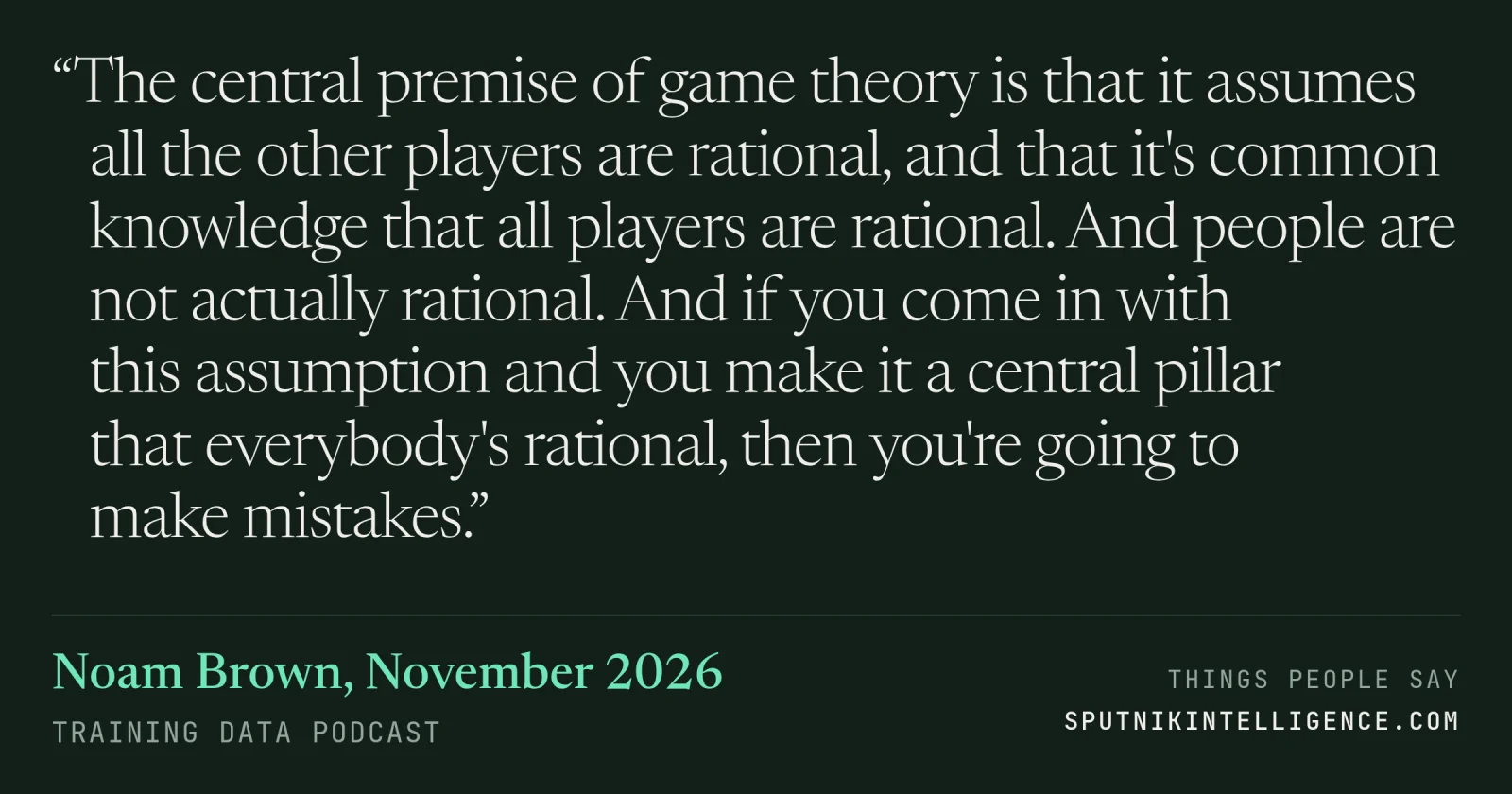
“The central premise of game theory is that it assumes all the other players are rational, and that it's common knowledge that all players are rational. And people are not actually rational. And if you come in with this assumption and you make it a central pillar that everybody's rational, then you're going to make mistakes.” — Noam Brown, Training Data

Asked why game theory, built for negotiation, didn't work well in Diplomacy, Noam Brown gives the core reason. It's the argument behind his move away from game theory toward modelling real people.

Training Data · 2026-11-24 Permalink → Listen →
Training Data Around 06:27 into the episode
Noam Brown

…If we have to spend like five years making an AI that could finally play diplomacy, that's great. So we took it on and we learned a lot along the way. And one of the things that I took away is that actually the game theory approach doesn't actually work that well in diplomacy. I originally came in.

Alfred Lin

Say more about that because I thought that game theory was developed to actually be a much better negotiator in a repeat game and especially in diplomacy.

Noam Brown

I think there is intuition that you can take away from game theory, but the problem with game theory is that it assumes, this is the central premise of game theory, that it assumes that all the other players are rational, and that it's common knowledge that all players are rational. And people are not actually rational. And if you come in with this assumption and you make it a central pillar that everybody's rational, then you're going to do, you're going to make mistakes. And so I think a good example is, are you familiar with the ultimatum game?

Alfred Lin

Well, you should explain it. So

Noam Brown

it's this idea that there's two players, Alice and Bob. Alice has $100 and can offer Bob anywhere between $0 and $100. And Bob can either accept or reject. And if Bob rejects, they both get zero. If Bob accepts, then they split the money that way. So if Alice were to offer Bob $10 and Bob accepts…

Alfred Lin

Yeah.

Speaker names come from our own diarization. The position is estimated from where the line sits in the episode.

Collections They Appear In