 Sam Altman
Entrepreneur and investor who has served as CEO of OpenAI since 2019, leading the company behind ChatGPT and its research on artificial general intelligence.
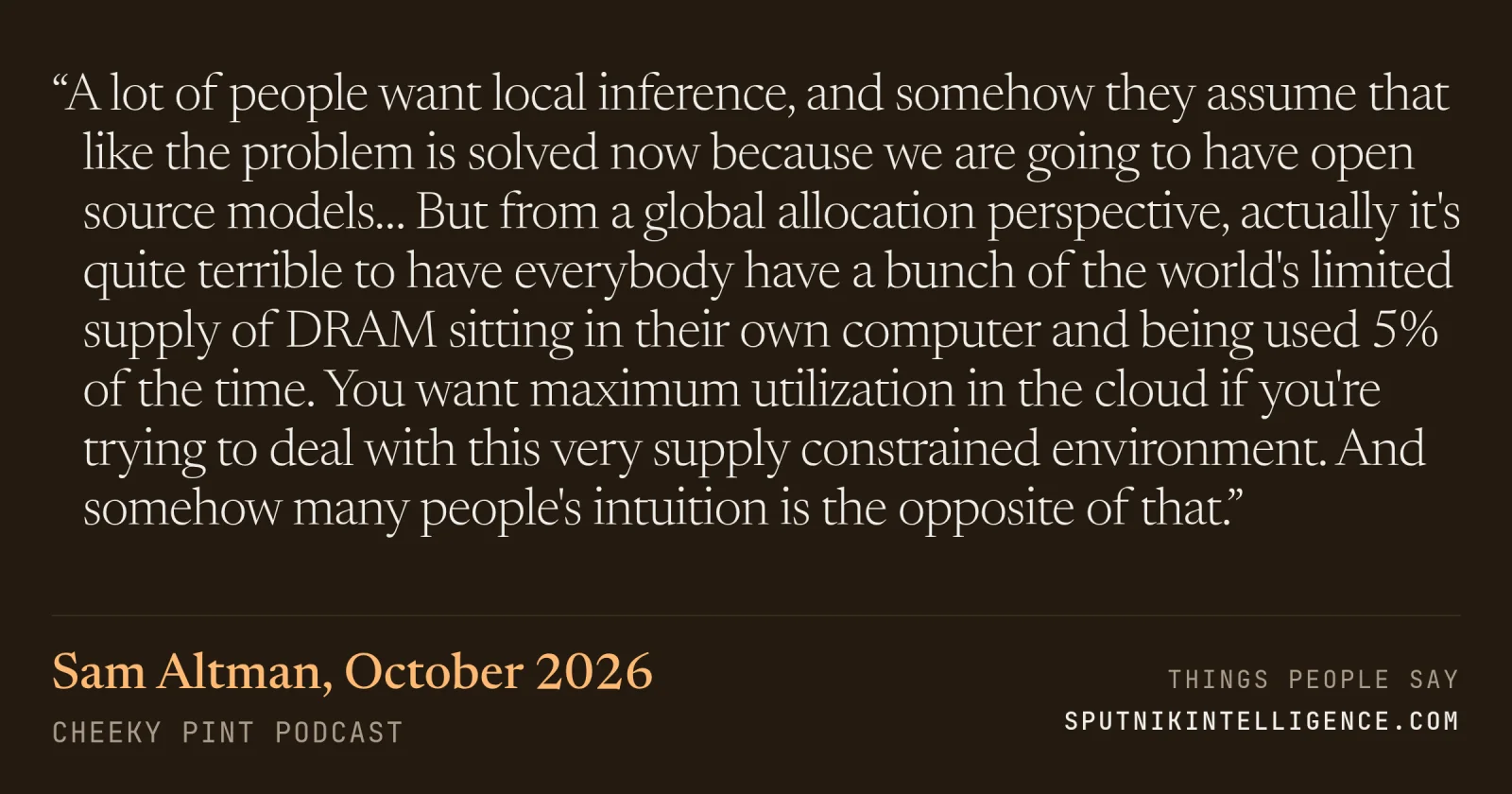
“A lot of people want local inference, and somehow they assume that like the problem is solved now because we are going to have open source models… But from a global allocation perspective, actually it's quite terrible to have everybody have a bunch of the world's limited supply of DRAM sitting in their own computer and being used 5% of the time. You want maximum utilization in the cloud if you're trying to deal with this very supply constrained environment. And somehow many people's intuition is the opposite of that.”
Cheeky Pint · Bootstrapped & Indie SaaS · October 2026
Context
Altman and John Collison discussing the shortage of memory chips and compute. Altman argues that running open models on personal machines, often pitched as a way around the crunch, makes the shortage worse.
Transcript
Clearly.
…to see is at every part of the supply chain, both new startups coming along and maybe more relevantly, people with relevant experience getting into. So, you know, Intel makes chips. They can probably make, they can get back into the memory game, as is tradition. As is traditionally switched back.
Oh, I think there are like all of these ways where the supply chain, it's just like super non-obvious. An example of this is people, a lot of people want local inference, and somehow they assume that like the problem is solved now because we are going to have open source models. We're going to be able to run them on our computers. And so we're not going to need all the stuff in the data center. But from a global allocation perspective, actually it's quite terrible to have everybody have a bunch of the world's limited supply of DRAM sitting in their own computer and being used 5% of the time. You want maximum utilization in the cloud if you're trying to deal with this very supply constrained environment. And somehow many people's intuition is the opposite of that.
Where else have we seen the market respond to high prices? Not just in memory, but across the supply chain?
Turbines? Batteries? Concrete.
Sorry, the market is responding there in high prices. I'm seeing where are you seeing any interest? Market responses in terms of high prices pulling in innovation.
More from Cheeky Pint