Where to Find Them
Sam Altman
writes
Sam Altman
,
hosts
Y Combinator Startup Podcast
,
hosts
TBPN
,
writes
The Logan Bartlett Show
,
writes
a16z Podcast
,
writes
Unsupervised Learning with Jacob Effron
,
writes
Internal Tech Emails
,
writes
OpenAI
,
writes
AI + a16z
,
writes
The AI Morning Minute
,
writes
AI Revolution Hub
and
writes
AiDrops
.
They have also been a guest on
Greymatter
(6 times) ,
The Twenty Minute VC (20VC): Venture Capital | Startup Funding | The Pitch
(4 times) ,
Hard Fork (NYT)
(3 times) ,
Lex Fridman Podcast
(2 times) ,
Mostly Human with Laurie Segall
(2 times) ,
Bloomberg Tech
(2 times) ,
Conversations with Tyler
(2 times) ,
Squawk Pod
(2 times) ,
OpenAI Podcast
(2 times) ,
The Ezra Klein Show
(2 times) ,
On with Kara Swisher
(2 times) ,
How I Built This (Guy Raz)
(2 times) ,
Sources
(2 times) ,
TED Tech
(2 times) ,
Decoder with Nilay Patel
(2 times) ,
Squawk on the Street
(2 times) ,
Masters of Scale
(2 times) ,
The Circuit with Emily Chang
(2 times) ,
The Social Radars
,
Training Data
,
All-In with Chamath, Jason, Sacks & Friedberg
,
Rowan's Notes
,
EconTalk
,
Economist Podcasts
,
Cheeky Pint
,
The Most Interesting Thing in AI
,
Pivot to AI
,
Halftime Report
,
Doom Debates!
,
Worklife with Molly Graham
,
Possible
,
Uncapped with Jack Altman
,
BG2Pod with Brad Gerstner and Bill Gurley
,
Babbage from The Economist
,
Big Technology
,
StrictlyVC Download
,
Core Memory
,
Search Engine
and
Invest Like the Best (Patrick O'Shaughnessy)
.
Recently:
“Why Sam Altman is against a single superintelligence”
on Cheeky Pint (October 2026);
“OpenAI Seeks $30B as Trump Backs AI Safety Audits”
on Bloomberg Tech (September 2026);
“OpenAI DevDay | Sam Altman, Alexander Embiricos, Andrew Ambrosino, Peter Steinberger, Tibo Sottiaux, Kath Korevec, Casey Neistat”
on TBPN (September 2026);
“Sam Altman Live at OpenAI Dev Day 9/29/26”
on Halftime Report (September 2026);
“Special Edition: OpeanAI CEO Sam Altman Talks GPT-6 Astra Debut, Going Public”
on Bloomberg Tech (September 2026);
“Sam Altman on OpenAI’s next model and the AI backlash”
on Sources (September 2026).
What They Said
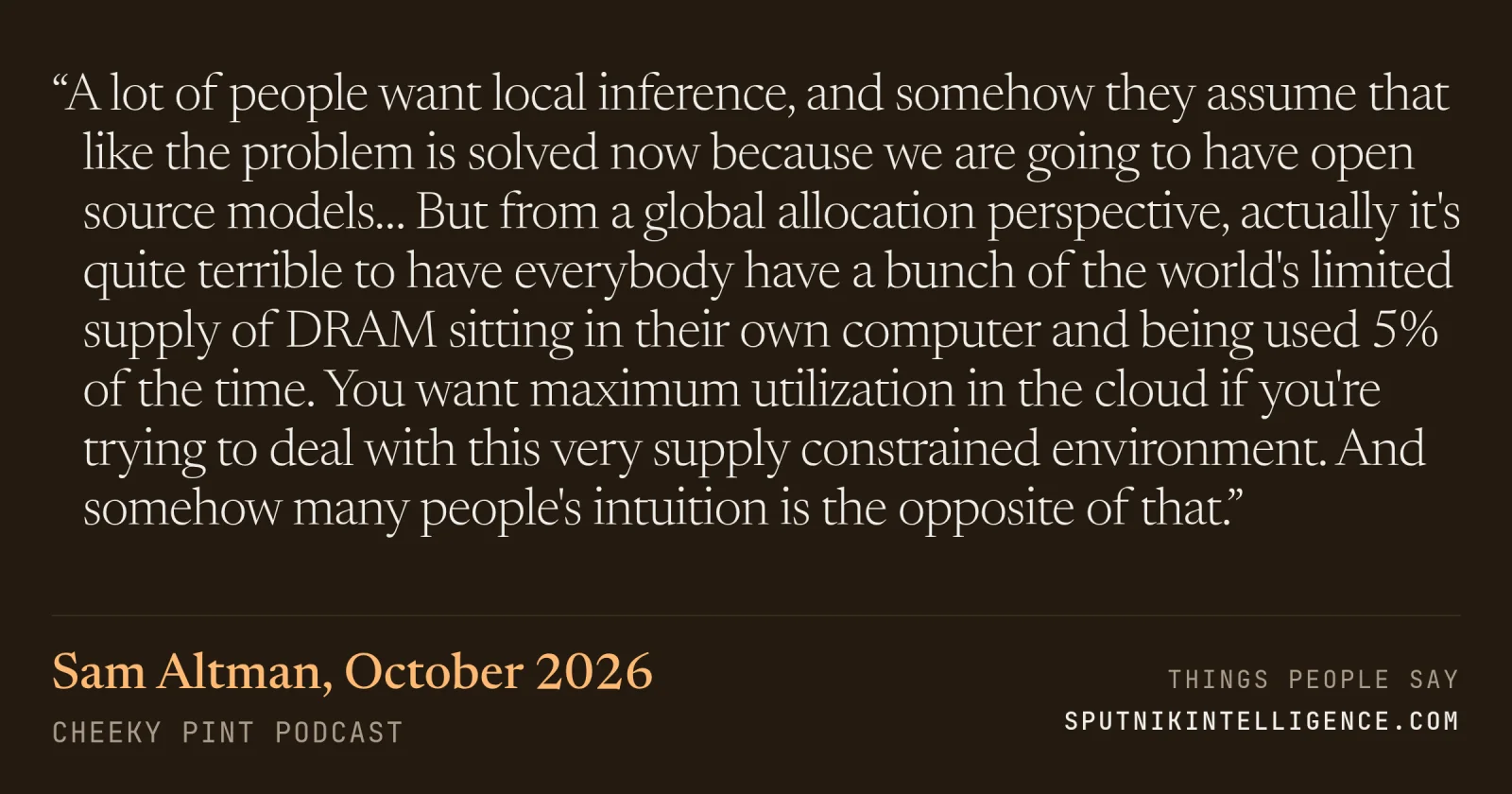
Altman and John Collison discussing the shortage of memory chips and compute. Altman argues that running open models on personal machines, often pitched as a way around the crunch, makes the shortage worse.
Cheeky Pint · 2026-10-29
Permalink →
Listen →
Cheeky Pint
Around 25:17 into the episode
John Collison
…to see is at every part of the supply chain, both new startups coming along and maybe more relevantly, people with relevant experience getting into. So, you know, Intel makes chips. They can probably make, they can get back into the memory game, as is tradition. As is traditionally switched back.
Sam Altman
Oh, I think there are like all of these ways where the supply chain, it's just like super non-obvious. An example of this is people, a lot of people want local inference, and somehow they assume that like the problem is solved now because we are going to have open source models. We're going to be able to run them on our computers. And so we're not going to need all the stuff in the data center. But from a global allocation perspective, actually it's quite terrible to have everybody have a bunch of the world's limited supply of DRAM sitting in their own computer and being used 5% of the time. You want maximum utilization in the cloud if you're trying to deal with this very supply constrained environment. And somehow many people's intuition is the opposite of that.
John Collison
Where else have we seen the market respond to high prices? Not just in memory, but across the supply chain?
Sam Altman
Turbines? Batteries? Concrete.
John Collison
Sorry, the market is responding there in high prices. I'm seeing where are you seeing any interest? Market responses in terms of high prices pulling in innovation.
Speaker names come from our own diarization. The position is estimated from where the line sits in the episode.
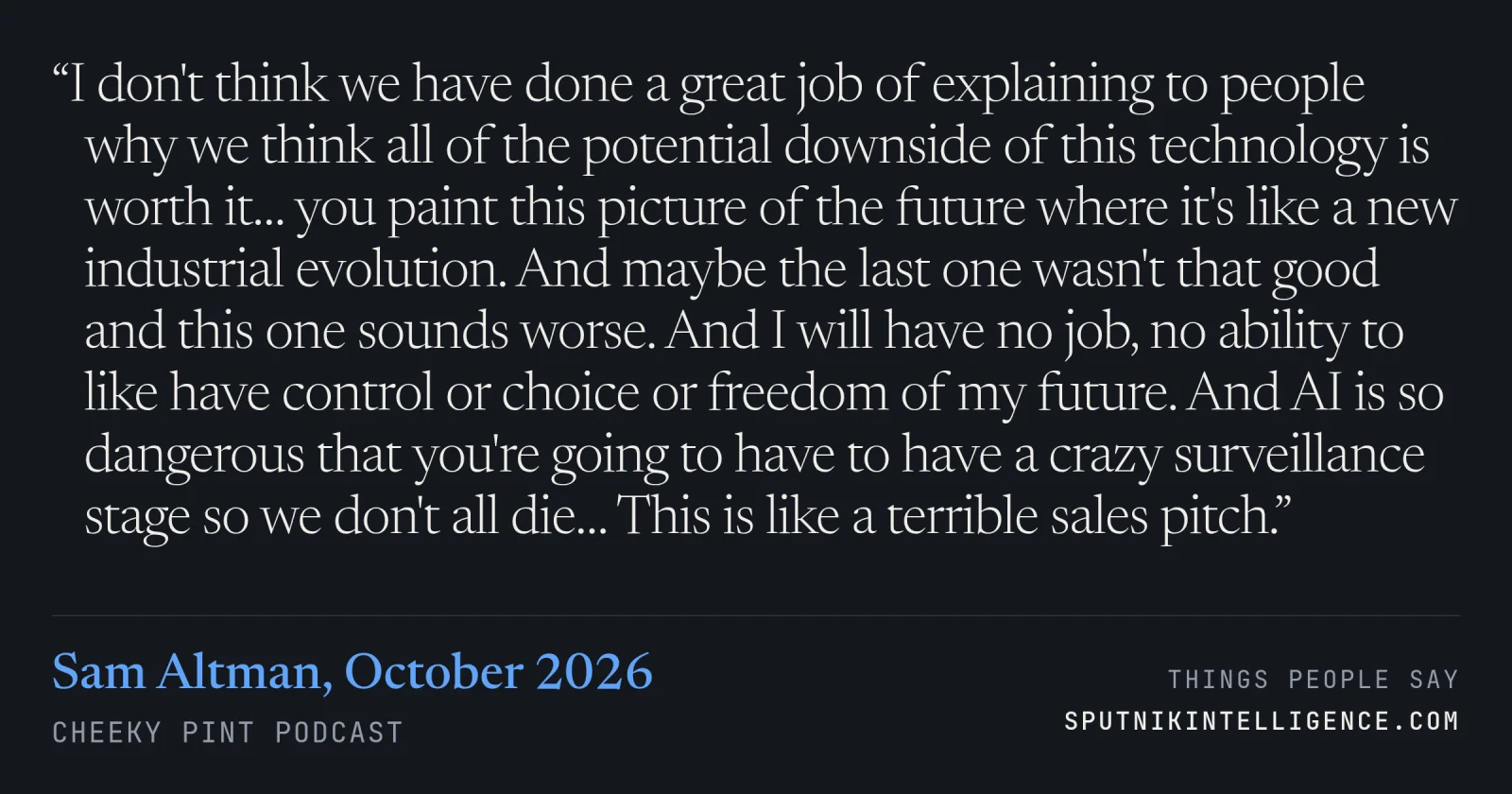
John Collison asked whether training models to be good at cyberattacks was a mistake, comparing the industry to an SNL sketch: "we urge you to urge us to stop." Altman agrees the joke landed because it was true, and criticizes how the AI field has pitched its own future to the public.
Cheeky Pint · 2026-10-29
Permalink →
Listen →
Cheeky Pint
Around 04:07 into the episode
Sam Altman
…a while, you know, pull out their gigantic Xerox Alto disk or they would like pull out their like, you know, with like line by line written of assembly or they would pull out their punch cards. And I felt like it is incredible to me that you all bootstrapped us to this point doing it this way. Yes,
John Collison
…was the cyber RL a mistake? Or did we just have to go there? Because it's a little like the SNL thing of, you know, we urge you to urge us to stop. It's like the models are getting very good at cyber capabilities. Like, yeah, I mean, They are getting very good, but not just totally emergently.
Sam Altman
…potential downside of this technology is worth it. Like the kind of caricature of this is people feel like we're like, all right, you know, fine. You say the model is going to cure cancer someday. Maybe it will. And if so, I guess that's good. And you say it's going to like make stuff cheaper. And okay, maybe I already see that's good and I get access to medical advice or legal advice. But then you paint this picture of the future where it's like a new industrial evolution. And maybe the last one wasn't that good and this one sounds worse. And I will have no job, no ability to like have control or choice or freedom of my future. And AI is so dangerous that you're going to have to have a crazy surveillance stage so we don't all die. This is like a trend. This is like a terrible sales pitch. And one of the things that I am most proud of about OpenAI is even when it has been hugely unpopular in the AI safety community for us to push for iterative deployment and putting these tools in the hands of people, we have really stuck to that principle. And I think this is the only kind of good path. I think people, it's not enough to…
John Collison
Iterative deployment is this idea that you just have to get the advances out there and you can't kind of stopper them up inside.
Sam Altman
I mean, not all. You still have to make them safe before you put them out there. You can't cause havoc in the world. But that building up a capability overhang is a thing to fight against. That directionally speaking, yes, you want to get this into the world. You want to get this into people's…
John Collison
The exploits get a lot of headlines. The prevented exploits do not. How quickly are people making progress with cyber blue?
Speaker names come from our own diarization. The position is estimated from where the line sits in the episode.

Altman explains why he has become excited about swarms of AI agents. His argument is that society's robustness comes from many actors keeping each other in check, and a single all-powerful model would lose that.
Cheeky Pint · 2026-10-29
Permalink →
Listen →
Cheeky Pint
Around 21:09 into the episode
Sam Altman
…society, it is unbelievably robust. And this would not happen without a lot of people keeping each other in check and collaborating and kind of these values of pluralism and democracy. And I had been sort of sad that that was going to trend away in AI. And now I'm excited about this as a direction.
John Collison
You're saying basically it shouldn't lead in a centralized direction because you will have many agents and agents pushing against each other in a dynamic equilibrium. And offense, defense is a good example of this.
Sam Altman
I would much rather intuitively have a trillion AIs of slightly superhuman intelligence join society than one AI of one trillion IQ join society.
John Collison
Yeah. And you think we're headed in that direction of the multiple.
Sam Altman
All of these things are things we have to push for. Like all of these things are like we have this incredible technology. It can be pointed and deployed in many ways. I think there are a lot of people who may have a different opinion about how it should be used and what is the best version of the…
John Collison
Let's talk about starting a business. Thanks to coding models, your weekend side hustle can quickly become a serious undertaking. And we've been busy here at Stripe making that product. As simple as possible. Stripe Atlas helps you with everything you need to start a business, like company…
Speaker names come from our own diarization. The position is estimated from where the line sits in the episode.
Collections They Appear In