Where to Find Them
Morgan Housel
hosts and writes
The Psychology of Money with Morgan Housel
,
hosts
Motley Fool Hidden Gems Investing
,
writes
Collaborative Fund
,
writes
The Boldin Your Money Podcast
,
writes
Capital Founders OS
,
writes
Morgan Housel
,
writes
The Burnouts with Phoebe & Sophia
and
writes
Icons and Ideas with Peter Mallouk
.
They have also been a guest on
Capital Allocators – Inside the Institutional Investment Industry
(7 times) ,
Plain English with Derek Thompson
(7 times) ,
Masters in Business
(7 times) ,
The Prof G Pod with Scott Galloway
(5 times) ,
Young and Profiting with Hala Taha (Entrepreneurship, Sales, Marketing)
(4 times) ,
The Compound and Friends
(4 times) ,
TBPN
(4 times) ,
Rule Breaker Investing
(3 times) ,
Prof G Media
(3 times) ,
The Learning Leader Show With Ryan Hawk
(3 times) ,
Animal Spirits Podcast
(3 times) ,
The Knowledge Project (Shane Parrish)
(3 times) ,
The Tim Ferriss Show
(3 times) ,
The Investor's Podcast (We Study Billionaires) - The Investor’s Podcast Network
(3 times) ,
The Rational Reminder Podcast
(3 times) ,
The Game Changing Attorney Podcast with Michael Mogill
(2 times) ,
Prof G Markets
(2 times) ,
The Julia La Roche Show
(2 times) ,
Open Book with Anthony Scaramucci
(2 times) ,
The Long View
(2 times) ,
So Money with Farnoosh Torabi
(2 times) ,
FranklinCovey On Leadership
(2 times) ,
My First Million
(2 times) ,
Invest Like the Best (Patrick O'Shaughnessy)
(2 times) ,
Ask The Compound
,
Stansberry Investor Hour
,
The Memo by Howard Marks
,
Bogleheads On Investing Podcast
,
The Rundown
,
Real Estate Rockstars Podcast
,
BigDeal
,
Sourcery
,
Odd Lots
,
The Stacking Benjamins Show
,
Enterprising Investor
,
Value Hive Podcast
,
ACQ2 by Acquired
,
Huberman Lab
,
The Pomp Podcast
,
The Startup Ideas Podcast
,
The Meb Faber Show - Better Investing
,
The Hustle Daily Show
,
Freakonomics Radio
,
Bankless
and
BiggerPockets Real Estate Podcast
.
Recently:
“How America Became Addicted to Debt — with Morgan Housel”
on Prof G Media (October 2026);
“How America Became Addicted to Debt — with Morgan Housel”
on The Prof G Pod with Scott Galloway (October 2026);
“Mark Twain on Relative Wealth”
on The Psychology of Money with Morgan Housel (October 2026);
“Pessimism always sounds smarter than optimism.”
on Collaborative Fund (October 2026);
“A False Sense of How People View You”
on The Psychology of Money with Morgan Housel (October 2026);
“Morgan Housel: Take Smarter Risks and Build Lasting Wealth as an Entrepreneur | Finance | YAPClassic”
on Young and Profiting with Hala Taha (Entrepreneurship, Sales, Marketing) (October 2026).
What They Said
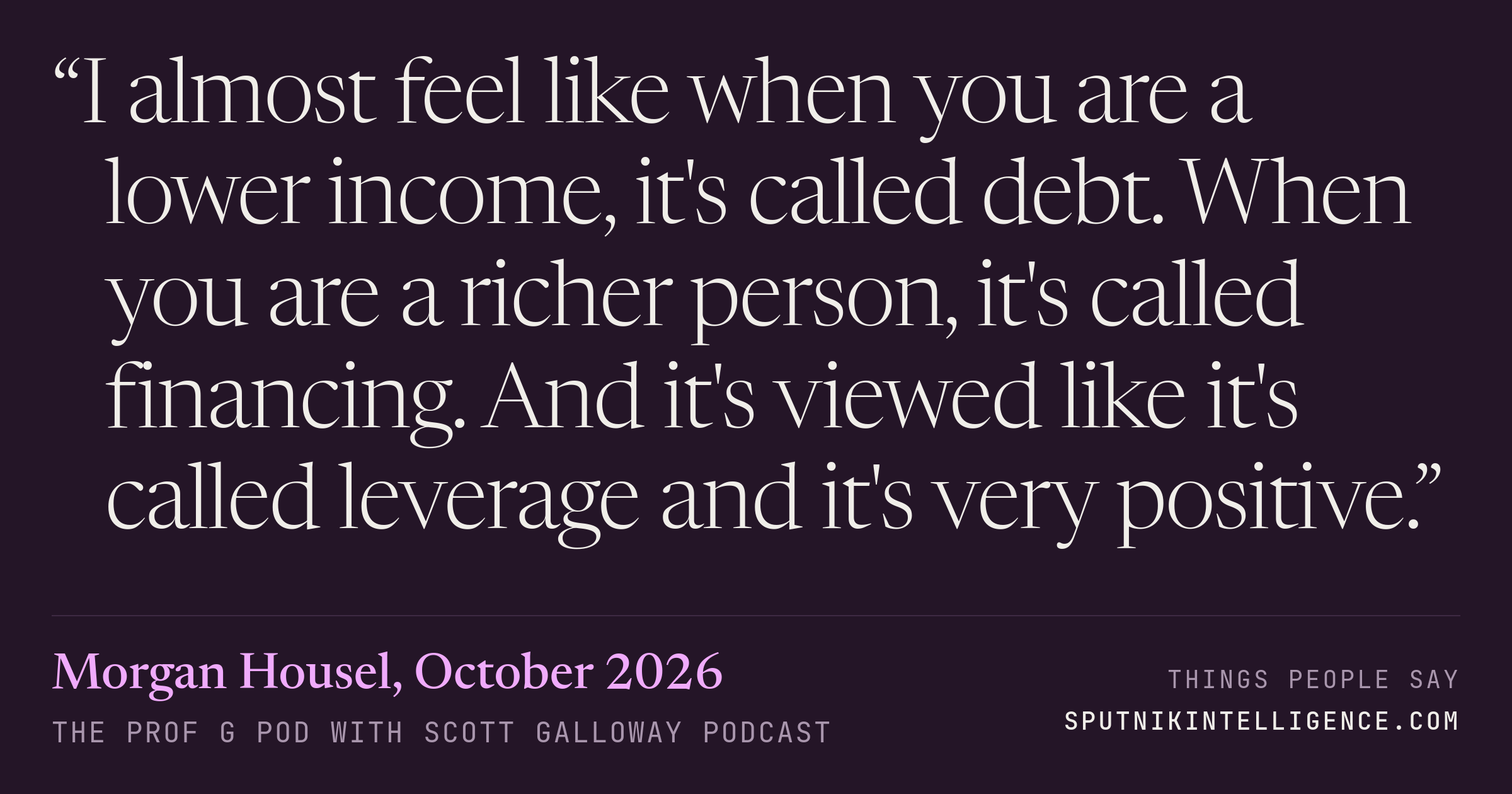
Asked where the line falls between debt that builds something and debt that destroys, Housel pointed to billionaires with multi-billion-dollar credit lines against their stock, who can survive an 80% crash. A lower-income borrower who loses a job, he said, lives in a much narrower channel of outcomes.
The Prof G Pod with Scott Galloway · 2026-10-21
Permalink →
Listen →
The Prof G Pod with Scott Galloway
Around 12:49 into the episode
Speaker 2
Meet Klavio, your brand's new best friend. With all your data in one place, Klavio knows you and your customers. It's AI agents build campaigns from one prompt and answer questions 24-7. Always on brand, always with your okay. Go to klaviyo.com slash best friends.
Speaker 1
…extent, the term debt, you know, you're in debt or you can't get out, it has a very negative connotation. But at the same time, if leveraged well, it's a very powerful tool. What is the line between debt that builds something and the debt that just fills a gap or even destroys parts of your life?
Speaker 3
You're right. I mean, I almost feel like when you are a lower income, it's called debt. When you are a richer person, it's called financing. And it's viewed like it's called leverage and it's very positive. Now, you know, it's true. This has been well documented that if you look at like the deck of billionaires, the centa billionaires, most of them are in a tremendous. Amount of debt. Mark Zuckerberg, Larry Ellison, all those people have multi-billion dollar credit lines against the stock that they own, but that's against $100 billion in stock that they own. If Facebook stock fell 80%, Mark…
Speaker 1
written that people's relationship with money is shaped more by when they were born than by what they were taught. Say more?
Speaker 3
If you and I grew up during the Great Depression, you and I would not think the same thing about the stock market that we do today. Both of us, I think, are pretty positive on long-term equity ownership and long-term compounding in a diversified portfolio. If you were 25 years old in 1932, you did…
Speaker 1
Do you think there's any psychology around money when you're living in what feels to be especially tumultuous, volatile times? I mean, this does feel, you always think you're in an exceptional time, but this feels exceptionally insecure right now. How does that relate to your approach to money? I
Speaker names from our own diarization · position estimated from where the line sits in the episode
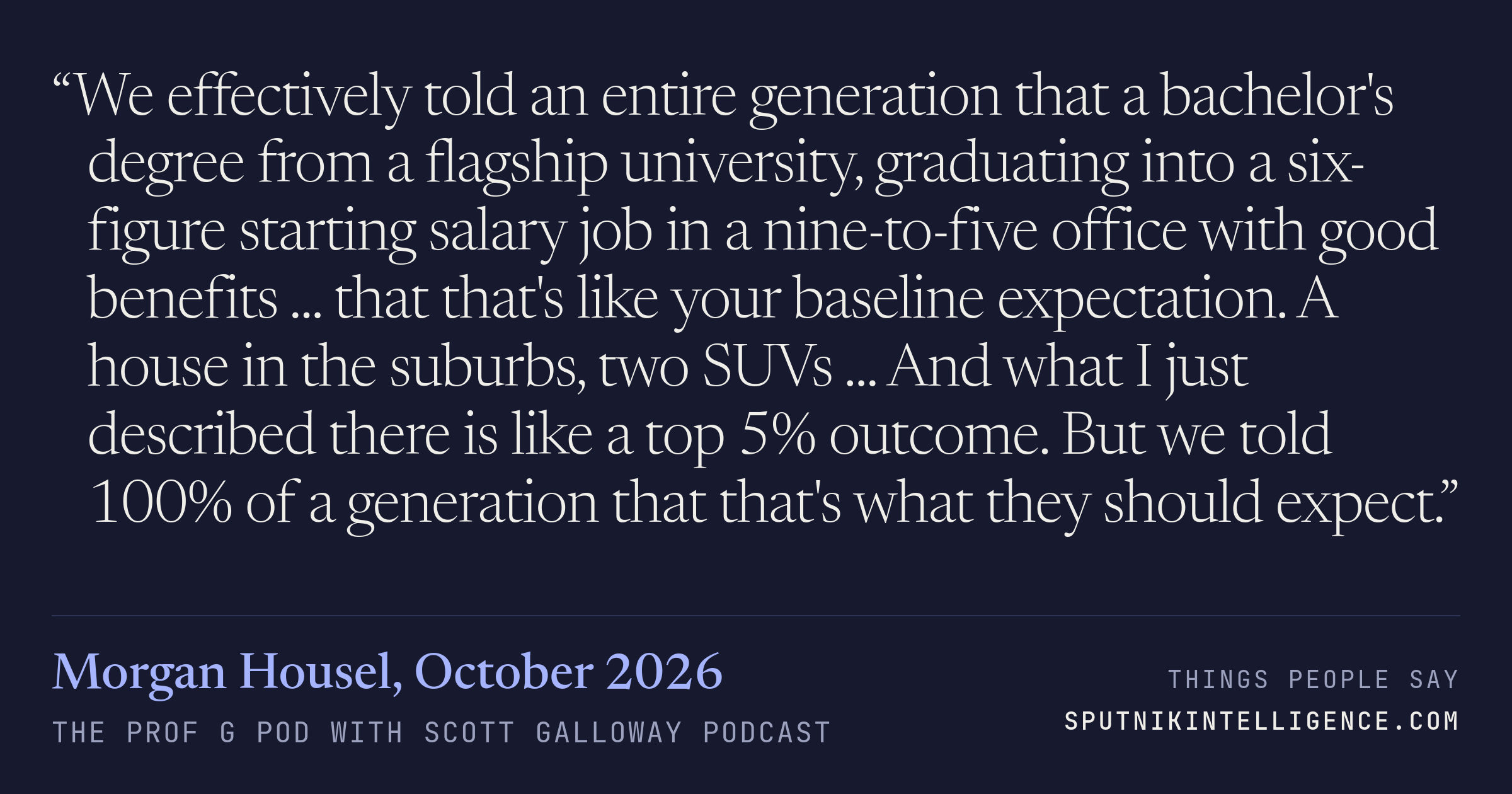
Scott Galloway asked how the culture around borrowing has shifted. Housel said debt is the tool people use to close the gap between expectations and reality. He added that household debt as a share of income has actually fallen every year since 2008, partly because young people can't afford homes.
The Prof G Pod with Scott Galloway · 2026-10-21
Permalink →
Listen →
The Prof G Pod with Scott Galloway
Around 03:12 into the episode
Speaker 3
When you are a lower income, it's called debt. When you are a richer person, it's called financing.
Speaker 1
…designed is designed the way it is. With us is the kind of our Yoda around financial management and approach to money or the relationship you have with or we have with money. Morgan, thanks for being with us today. I'll kick it off. How has the culture shifted in terms of people view borrowing?
Speaker 3
…that society and culture has exposed that gap and widened that gap between where you are and where society tells you that you think that you should be, you're going to fill that hole with debt. That's always been the case. One of the things that I think we've done over the past, two generations really, and really in the last generation, and we did it with good intentions and inadvertently, but we effectively told an entire generation that a bachelor's degree from a flagship university, graduating into a six-figure starting salary job in a nine-to-five office with good benefits and a salary and like home by 5 p.m., that that's like your baseline expectation. A house in the suburbs, two SUVs, that's what you should expect. And what I just described there is like a top 5% outcome. But we told 100% of a generation that that's what they should expect. And so filling that with debt has often been the case. Now, one thing I would say, Scott, that's very important here to…
Speaker 1
credit card debt at a much higher interest rate, which doesn't build wealth, right?
Speaker 3
Right. And so maybe if that, yes, like they don't have mortgages at 3% fixed, but now they have credit card debt at a different level. But I think that is a very underreported story that it's declined every year, every year as a share of income. So not the total amount, but relative to what people…
Speaker 1
I think there's some nuance there, and that is so drunk driving deaths and teen pregnancies are at all-time lows. On the whole, that's a good thing, but it also reflects that young people aren't getting out and socializing as much, which is a bad thing. And what I would argue, while an appreciation…
Speaker names from our own diarization · position estimated from where the line sits in the episode
Collections They Appear In