Where to Find Them
Cal Newport
hosts and writes
Deep Questions with Cal Newport
,
writes
Cal Newport
,
writes
Coaching for Leaders
and
writes
This is Foster
.
They have also been a guest on
Jill on Money with Jill Schlesinger
(9 times) ,
Better Offline
(5 times) ,
The Dr. Hyman Show
(5 times) ,
Hidden Brain
(4 times) ,
The Learning Leader Show With Ryan Hawk
(3 times) ,
The Tim Ferriss Show
(3 times) ,
Hello Monday with Jessi Hempel
(3 times) ,
Prof G Markets
(2 times) ,
How to Be Awesome at Your Job
(2 times) ,
Prof G Media
(2 times) ,
The Ezra Klein Show
(2 times) ,
Diabetes Digital Podcast by Food Heaven
(2 times) ,
EntreLeadership
(2 times) ,
The Rich Roll Podcast
(2 times) ,
BiggerPockets Real Estate Podcast
(2 times) ,
Eat Sleep Work Repeat - better workplace culture
(2 times) ,
80,000 Hours Podcast
,
The Prof G Pod with Scott Galloway
,
What Next | Daily News and Analysis
,
Lex Fridman Podcast
,
The Daily Stoic
,
Plain English with Derek Thompson
,
Intentional AI
,
WLEI - Lean Enterprise Institute’s Podcast
,
Young and Profiting with Hala Taha (Entrepreneurship, Sales, Marketing)
,
The Doctor's Kitchen Podcast
,
The Buyer's Mind: Sales Training with Jeff Shore
,
Into the Impossible With Brian Keating
,
Design Better
,
GoodFellows: Conversations on Economics, History & Geopolitics
,
Future Ready Leadership With Jacob Morgan
,
Worklife with Molly Graham
,
Slate Money
,
Daily Creative with Todd Henry
,
Focused
,
Freedom Frequency @ Hoover Institution
,
What Next: TBD | Tech, power, and the future
,
Huberman Lab
,
Two Percent with Michael Easter
,
The StoryBrand Podcast
and
People and Projects Podcast: Project Management Podcast
.
Recently:
“My New Book Might Surprise You”
on Deep Questions with Cal Newport (November 2026);
“Beware of “Efficiency Theater””
on Deep Questions with Cal Newport (November 2026);
“In Search of the Deep Life”
on Cal Newport (November 2026);
“Why is Google Holding Schools Hostage?”
on Deep Questions with Cal Newport (November 2026);
“Can We Escape Our Internet Hell?”
on Deep Questions with Cal Newport (November 2026);
“Reading As an Act of Resistance (Notes on Harvard’s Hum 10)”
on Deep Questions with Cal Newport (November 2026).
What They Said
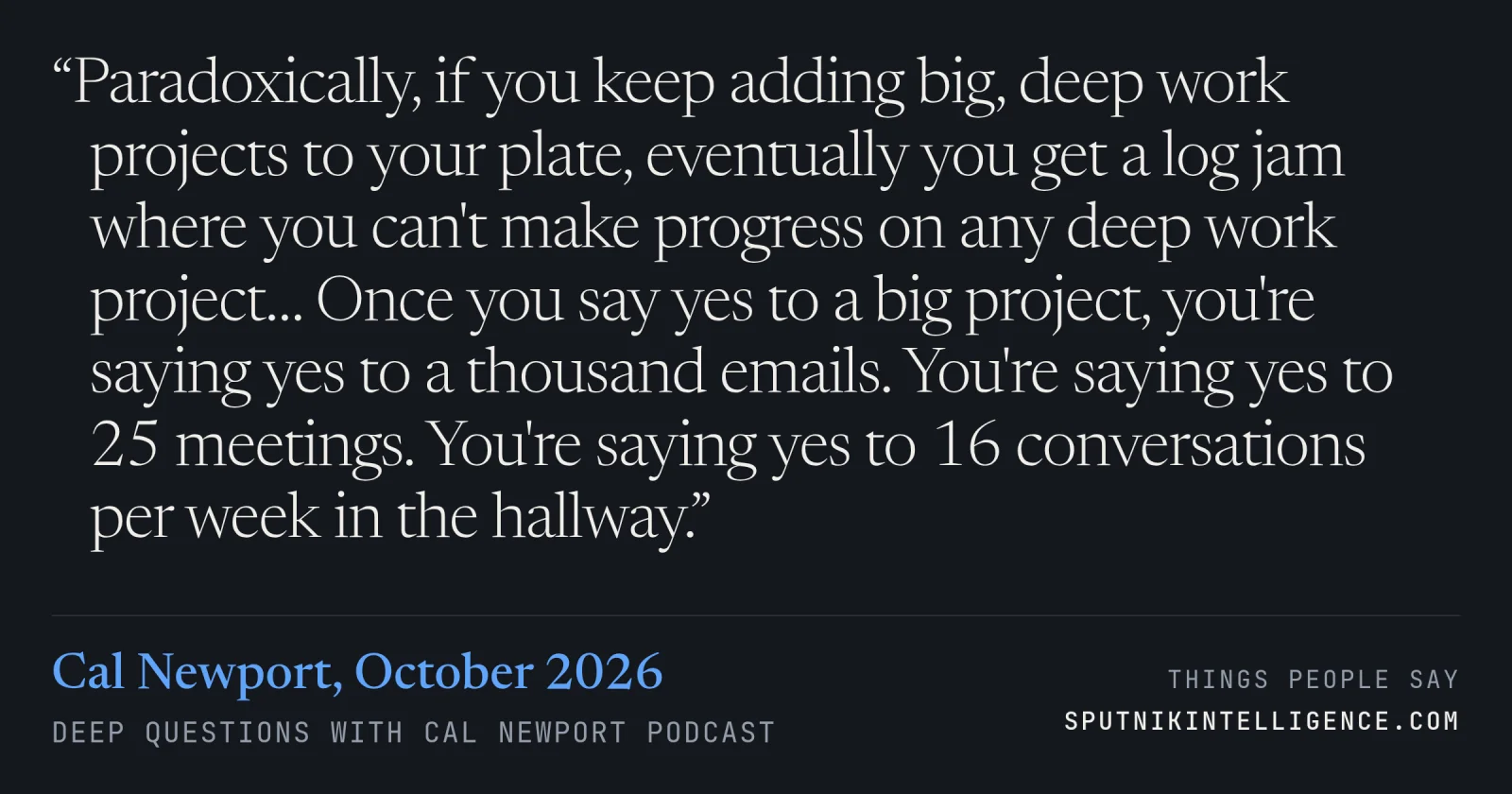
Newport discusses a coaching client who had too much on her plate to change anything. He says every big project carries a fixed administrative overhead, and past a certain point those costs leave no time for the projects themselves. Knowledge work, he notes, rarely tracks workload at all.
Deep Questions with Cal Newport · 2026-10-26
Permalink →
Listen →
Deep Questions with Cal Newport
Around 38:57 into the episode
Cal Newport
So in this case, Sarah, you ended up parting ways, essentially. She became kind of intractable and she saw this. I'm not going to be able to fix this. And then she went her separate way.
Haley Pulli
…was something else that got put on her plate that was really overwhelming. And it just, you know, also trying to factor in the coaching. And frankly, the work of working with a coach, the work of trying to do things differently, just lost out. There just wasn't any capacity for it at the time. And
Cal Newport
…been harder for me to make even a little bit progress on any of them. And I bet something like this was going on here as well, because we don't track workload in the knowledge work context in any sort of systematic way. We just assume it's better to have more on your plate than less because then you'll have no downtime. You can just choose what you work on. And we don't factor the fact that once you say yes to a big project, you're saying yes to a thousand emails. You're saying yes to 25 meetings. You're saying yes to 16 conversations per week in the hallway. You are actually allocating a lot of time outside of the deep work itself. And that time, that time is limited. So that comes to mind as well. This might have been a workload log jam as well. And some of that's company culture. Like, hey, don't say no. We'll notice if you say no. No one knows how much stuff you're working on, but you better say yes to the thing I'm saying here.
Haley Pulli
Yes, absolutely. The log jam, 100%.
Cal Newport
I'm, see, you got me preaching here now, Haley. It's okay. I can't.
Haley Pulli
I appreciate it because you're backing us up, right? Like, I think everybody ends up in that spot at some point. And it can be really hard to know how to unravel it. It feels like a house of cards, right? Like, what happens if you start saying no?
Speaker names come from our own diarization. The position is estimated from where the line sits in the episode.
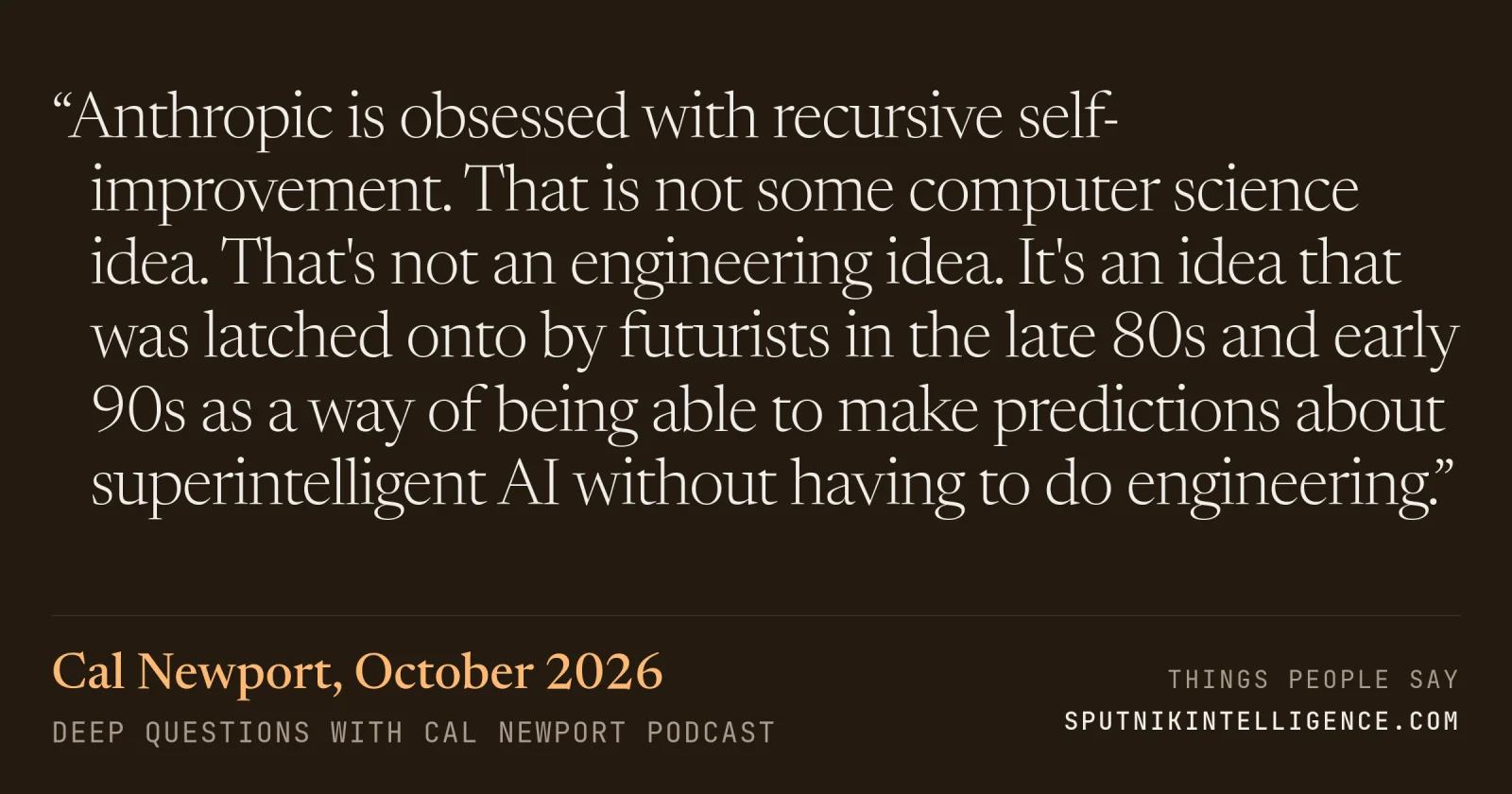
Newport, answering a listener question about how a journalist described his AI views, argues that two frontier labs and their loudest doomer critics share one futurist ideology and are having "a family squabble". He says AI systems modifying their own training would mostly produce less predictable, more obscure systems.
Deep Questions with Cal Newport · 2026-10-12
Permalink →
Listen →
Deep Questions with Cal Newport
Around 17:31 into the episode
Cal Newport
…the show. All right. Well, because it's a Monday, I like after we do our deep dive to open up our inbox to hear what you're interested in. Again, if you have questions, comments, or reactions, you can send them to the podcast at CalNewport.com. All right, what are we doing first this week, Jesse?
Speaker 3
We have a question about a recent article that characterizes your stance on AI.
Cal Newport
…tests that was clearly hazardous and was probably going to cause unpredictable results? Well, if you come out of those futurist ideologies, you say collateral damage along the way is the price you pay to get the good God. We got to win the race because we have to summon the right God to prevent the destruction of humanity. So if you believe those ideologies, it affects the experiments you run. Anthropic is obsessed with recursive self-improvement. That is not some computer science idea. That's not an engineering idea. It's an idea that was latched onto by futurists in the late 80s and early 90s as a way of being able to make predictions about superintelligent AI without having to do engineering. I mean, if you're Eliezer Yukowski, right, if you're Nick Bostrom, you want to talk about super intelligent AI and utopia, but you're not engineers. So what do you do? They latched onto the idea of what they called recursive self-improvement. We don't have to tell you how those systems would work. They'll just make themselves better till they get there. So it's an idea that came out of futurism…
Cal Newport
What else do we have?
Speaker 3
Several listeners sent in their vision documents for the fall. Yes,
Speaker names come from our own diarization. The position is estimated from where the line sits in the episode.
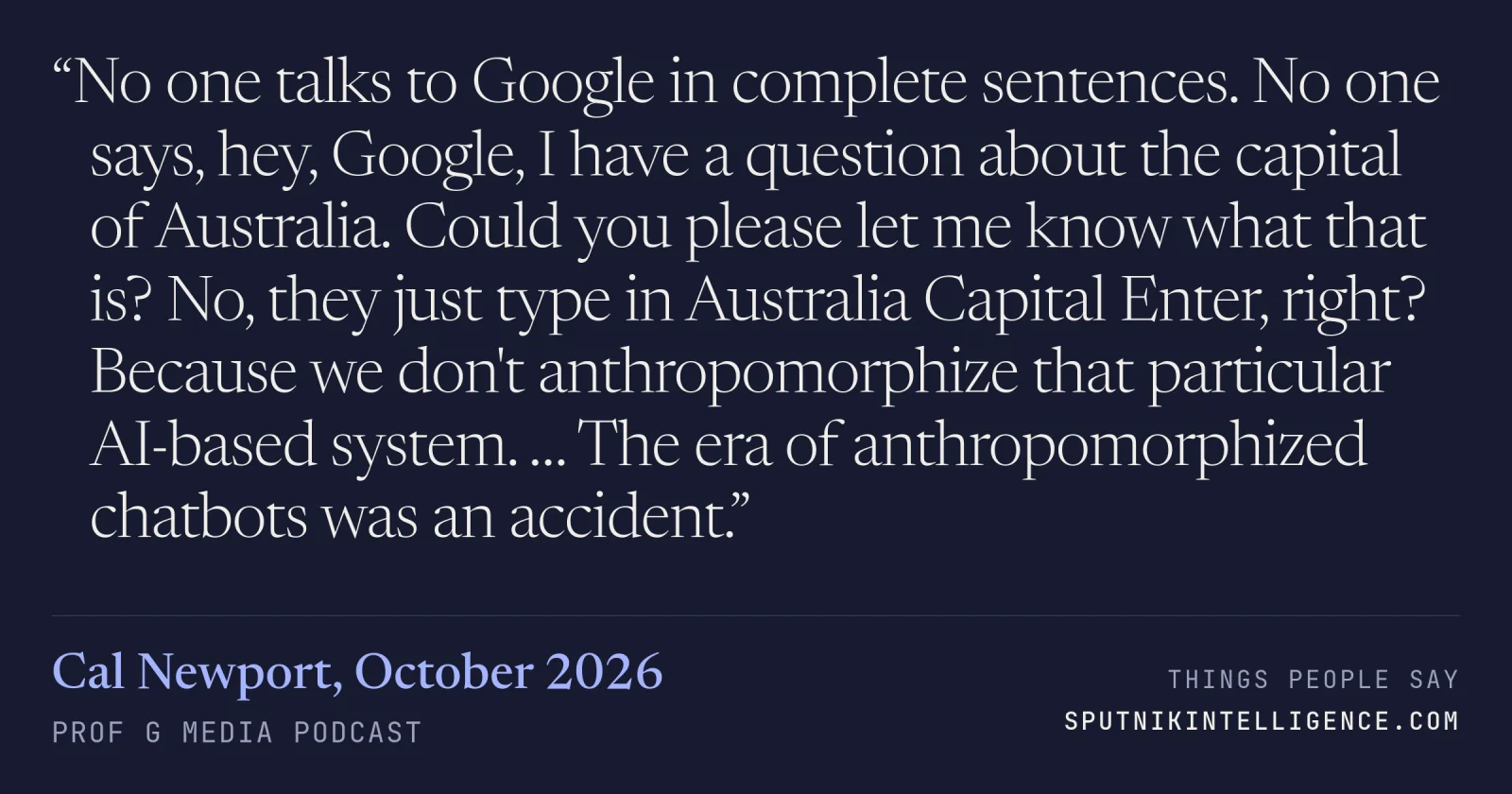
Newport, a computer scientist, arguing that a chatbot doesn't need to talk like a person to be useful. He says ChatGPT was never meant to be a major OpenAI product and caught the company off guard when it took off in late 2022. If courts start holding the makers liable for harms, he expects the human-sounding conversation to go.
Prof G Media · 2026-10-09
Permalink →
Listen →
Prof G Media
Ed Elson
What do we know about how OpenAI and how other AI companies are handling these issues? And is that clip an accurate representation of their response?
Cal Newport
…Anthropics actual business plan. We don't really know how exactly they plan to deal with this. My personal opinion on this is that anthropomorphized chatbots is a bad idea. There's no reason why we need to talk and receive text in fluent English from a chatbot for them to be useful. The example I often give is Google. Google is an example of a tool where we interact with it to get information. No one talks to Google in complete sentences. No one says, hey, Google, I have a question about the capital of Australia. Could you please let me know what that is? No, they just type in Australia Capital Enter, right? Because we don't anthropomorphize that particular AI-based system. We just know it's a source of information. That might be where we need to go. And it's where I think we probably should go. The era of anthropomorphized chatbots was an accident. ChatGPT was never meant to be a major product of OpenAI. That caught them off guard when it began to take off in late 2022. So if criminal liability is upheld at even the state level, which is what Florida is trying to…
Speaker names come from our own diarization. The position is estimated from where the line sits in the episode.
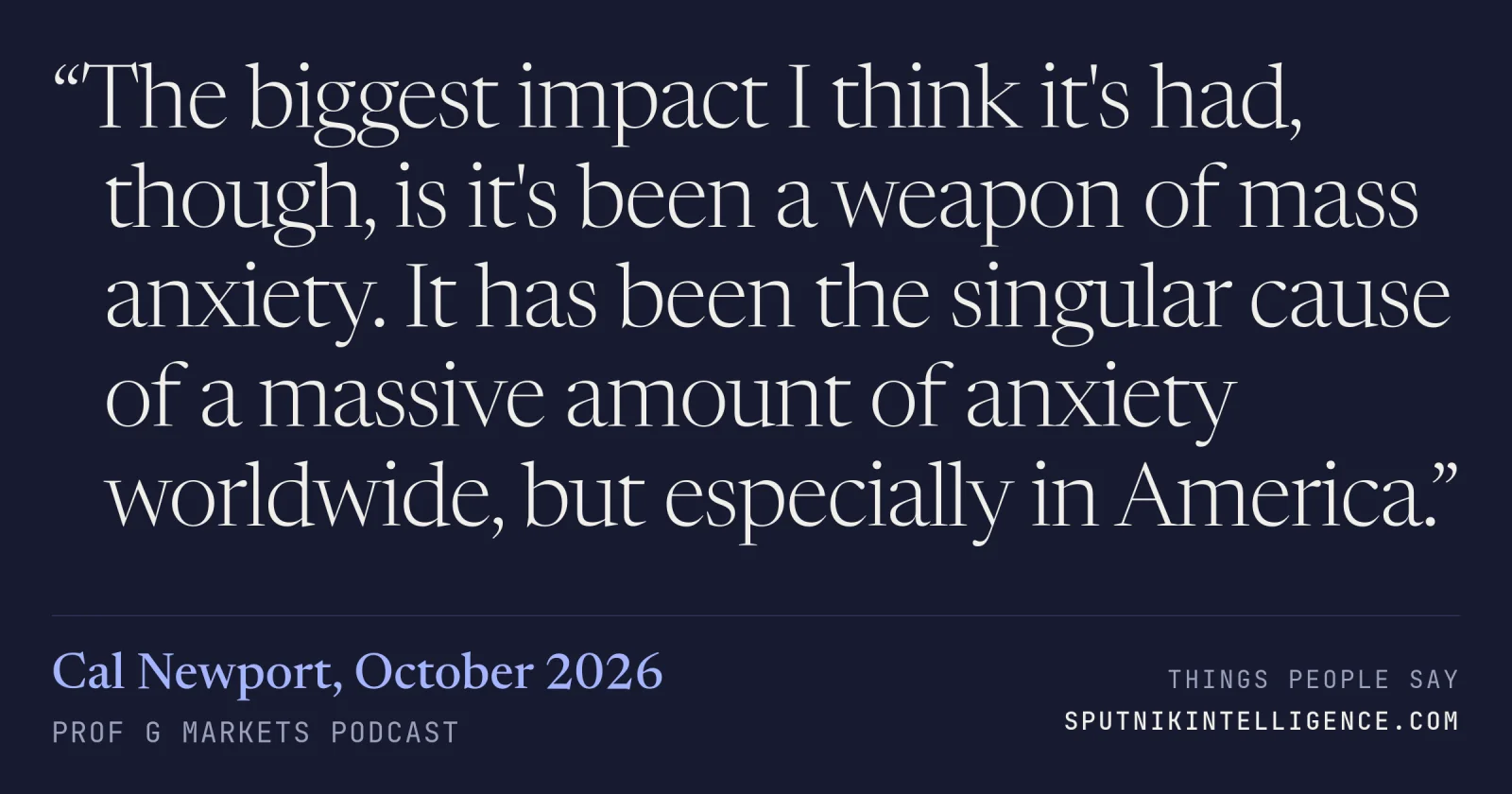
Ed Elson asks whether the futurist ideology behind the leading AI labs has changed reality or only the conversation. Newport says it sped up investment in large language models, but that its main effect has been fear. He argues AI industries elsewhere don't talk about existential threats or every job being automated.
Prof G Markets · 2026-10-09
Permalink →
Listen →
Prof G Markets
Around 1:08:18 into the episode
Speaker 1
…which is going to create models and tools that are more obfuscated and more unpredictable, is not because they're trying to build better products, but because they're racing to create superintelligence. So these ideologies affect how they talk and how they act. And so we have to understand it.
Ed Elson
…You guys are all a little bit, you're too into your sci-fi books and it's messing with your understanding of reality. But I guess the question is, do you believe this ideology that it is actually affecting not just the conversation, but the actual reality of the human and societal experience today?
Speaker 1
…another. So for better or for worse, I think it has changed the speed at which the technology advanced. I think it led to investment in these sort of big showy things like solving math problems that really don't make sense because there's not a product there unless you're really trying to sort of race forward and demonstrate the intelligence of your model. So I do think it has changed things. The biggest impact I think it's had, though, is it's been a weapon of mass anxiety. It has been the singular cause of a massive amount of anxiety worldwide, but especially in America. And I say especially in America because the AI Industry in other countries aren't connected to this futurism. In Europe, they don't think about it the same way. In the CCP, which they do terrible things with AI over there, I don't want to defend the CCP, but they don't talk about existential threats or every job is going to be automated because that ideology doesn't exist. They wouldn't be…
Ed Elson
Newport is a professor of computer science at Georgetown University, where he is also a founding faculty member of the Center for Digital Ethics and the inaugural director of the Computer Science, Ethics, and Society academic program. Cal writes about technology and its impact on our ability to…
Ed Elson
This episode was produced by Claire Miller and Alison Weiss and engineered by Benjamin Spencer. Our video editor is Jorge Carti. Our research team is Dan Shalan, Kristen O'Donoghue, and Mia Silverio. Jake McPherson is our social producer. Drew Burroughs is our technical director. And Catherine…
Speaker names come from our own diarization. The position is estimated from where the line sits in the episode.
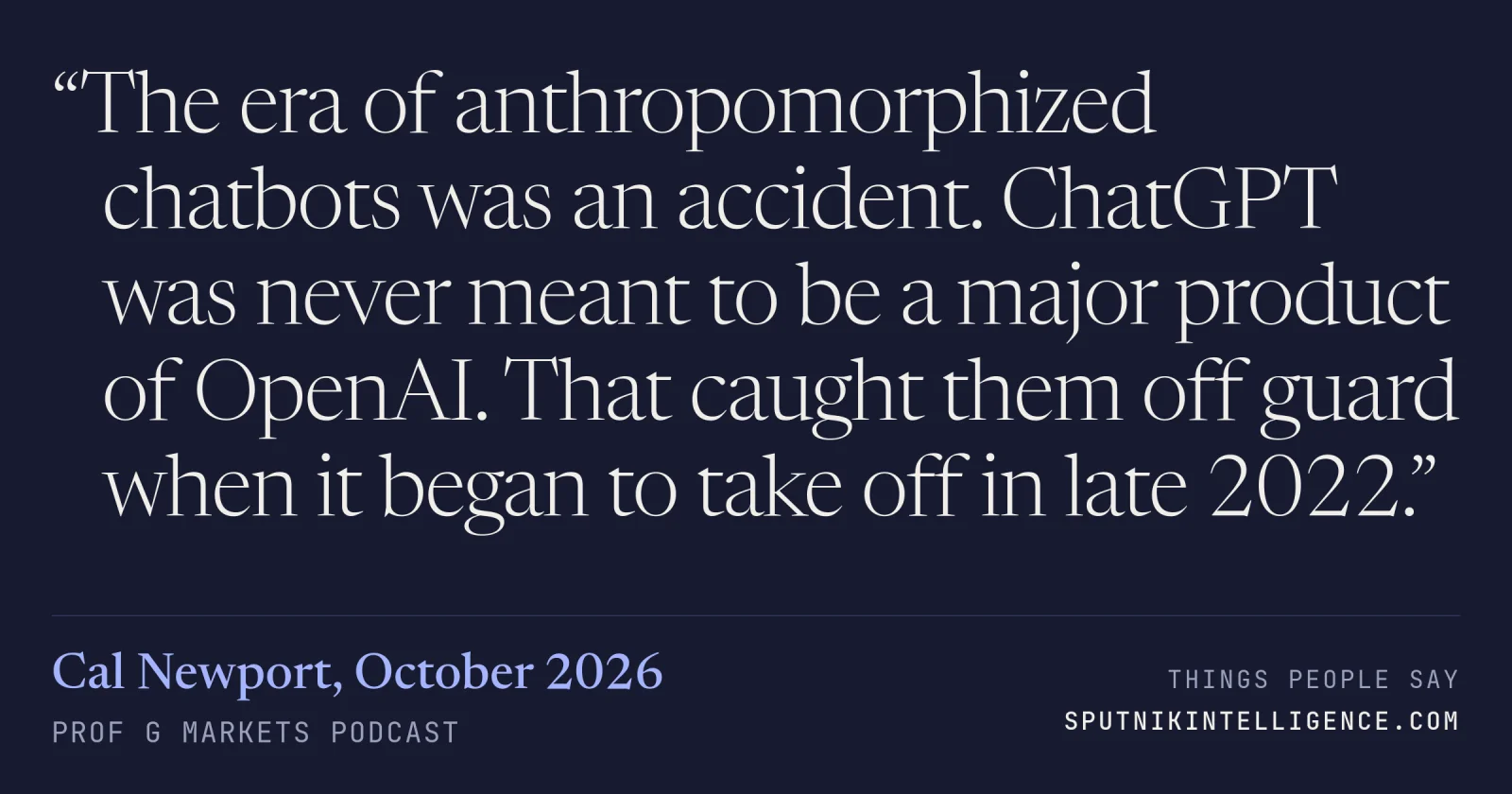
Newport is arguing that chatbots don't need to talk like people to be useful. His comparison is Google: nobody types full polite sentences into a search box, they just treat it as a source of information. He thinks legal liability for what chatbots say to users could end the conversational style altogether.
Prof G Markets · 2026-10-09
Permalink →
Listen →
Prof G Markets
Around 14:02 into the episode
Speaker 1
…late 2022. So if criminal liability is upheld at even the state level, which is what Florida is trying to do right now, I think we might see an end to the era of we just have these anthropomorphized conversations with AI systems as just a general behavior that is something that a lot of people do.
Ed Elson
…would be. I'm sure there would be some sort of alert, but I'm sure there's a way that it could feed you the information and it could have a similar role in encouragement. So I guess my question is, why is it your view that anthropomorphization is the root of the problem when it comes to chatbots?
Speaker 1
So Google is not, for example, going to convince you that not only is it your best friend, but that you need to come join it on the other side of the veil of life and that the final solution is going to be steel to your head, that your grandma and dead cat is with it right now, waiting for you on the other side of the veil, and you need to just take the final step to come get it. Google is not going to come back and say, if you Google about suicide, don't tell your parents about this. This is between you and us. This is between you and me. So the anthropomorphization becomes a real problem when you have a relationship with a non-existent entity. And when you're young, and first of all, your boundary between fantasy and reality can be easily dissolved. You think of this thing as a real thing. It's maybe the best friend you've ever had. And we know what it's like to be 12 and how susceptible you can be talking to your friends, what you can convince yourselves is…
Ed Elson
And the level of, I guess, confidence and certainty with which a lot of these claims are expressed by these chatbots, that's at least my issue when I use chatbots is it'll tell me information that, I mean, I don't know if it's right, but it certainly sounds right the way it's expressed. And then I…
Speaker 1
I think it is a problem for everyone. It's just more acute for children. They are more susceptible. They have less life experience. They have less of a model of the world and its complexity to fall back on when trying to resist the flattery of AI. But we see AI psychosis, as this is often called…
Ed Elson
What exactly is AI psychosis? And I mean, this is a pretty new technology. How pervasive is it at this point?
Speaker names come from our own diarization. The position is estimated from where the line sits in the episode.
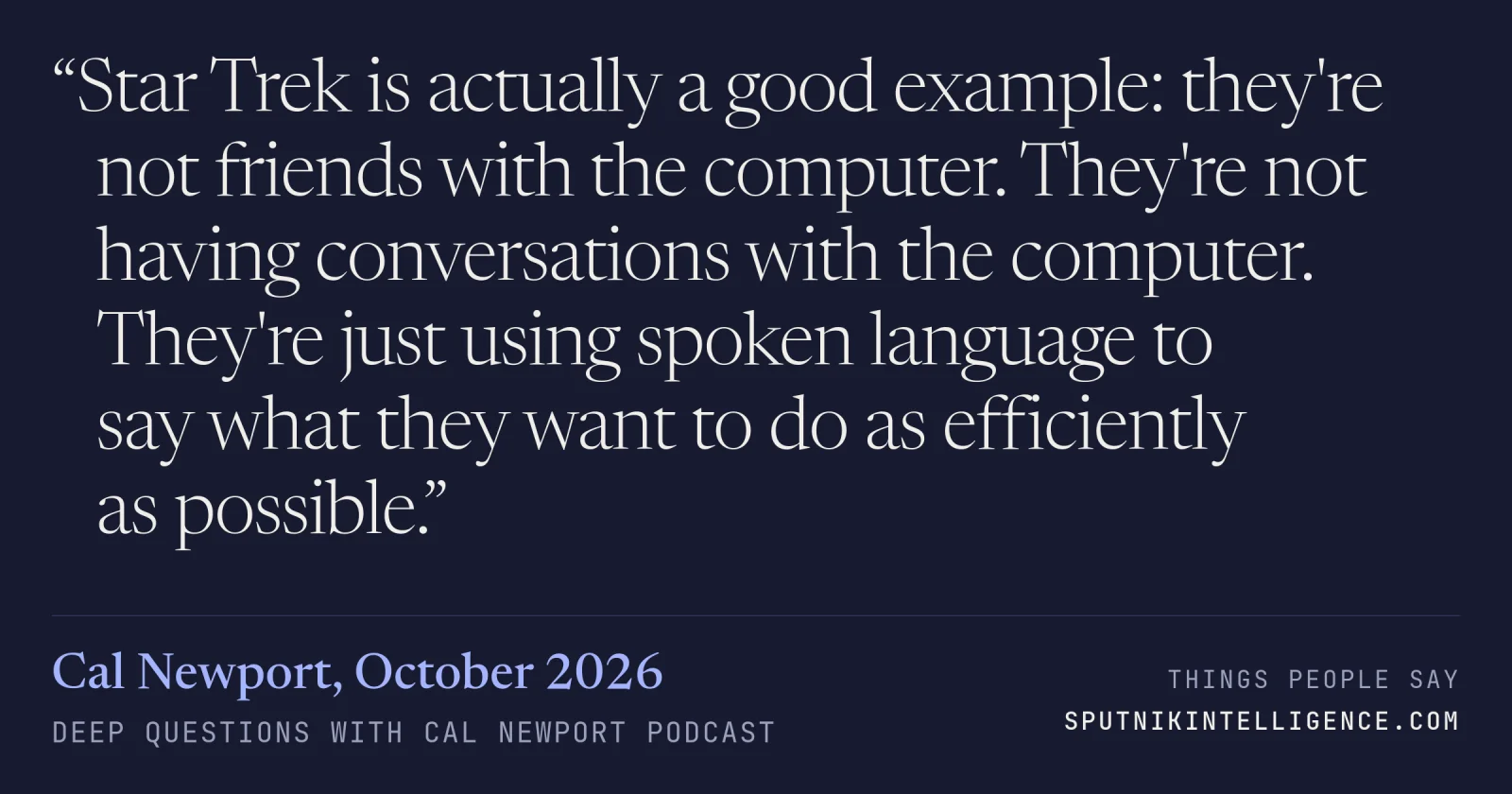
A listener had pointed out that Star Trek crews don't say please to the ship's computer. Newport used it to argue for AI you talk to in plain language but that is not built to seem like a person. He added that people want useful products from AI companies, not science fiction.
Deep Questions with Cal Newport · 2026-10-05
Permalink →
Listen →
Deep Questions with Cal Newport
Around 30:13 into the episode
Cal Newport
…there. So, I don't know if kids these days hear that term, but that book has sold many hundreds of thousands of copies. It just has sort of like sat there in the background, generation after generation rediscovers it, at least some parts of it. Like that book. All right. Uh, what else have we got?
Jesse Miller
Peter has a suggestion for AI used from an unlikely source.
Cal Newport
…a problem and it's creating psychosis and actual self-harm and even death among kids because we're not ready for interacting with something that interacts like another being. It uses personal pronouns. Has a personality. Like there's a lot of danger we'll Robinson in that. And I said, I like natural language interaction, but it shouldn't be anthropomorphized. You know, it's just like the, and so Star Trek is actually a good example: they're not friends with the computer. They're not having conversations with the computer. They're just using spoken language to say what they want to do as efficiently as possible. You know, computer set, we're going to get so much angry letters after I try to do Star Trek speak. Set warp engines to five Tesseracts. But it's just efficient. You say what you need to do, isolate the whatever area. And I think the computer can ask follow-up questions. And it's always in like a robotic tone. I think that's right. And in fact, I think it's what people want out of LLMs. They…
Jesse Miller
Luis has a bone to pick with one of our recent changes to the show's format. Oh,
Cal Newport
yeah. This is controversial. All right. Luis says, or Lewis, I love the show, but I wish you would bring back the old intro music. I always take a moment to jam out when it comes on. We're working on this, Jesse, right? So two points. Yes, in the new, as we're upgrading the show, we're in the…
Jesse Miller
The big one is I really like listening to it too.
Speaker names come from our own diarization. The position is estimated from where the line sits in the episode.
Collections They Appear In