 Koray Kavukcuoglu
SVP of Google DeepMind and Chief AI Architect at Google, running the organization day to day and overseeing Gemini model development, frontier AI research, and...
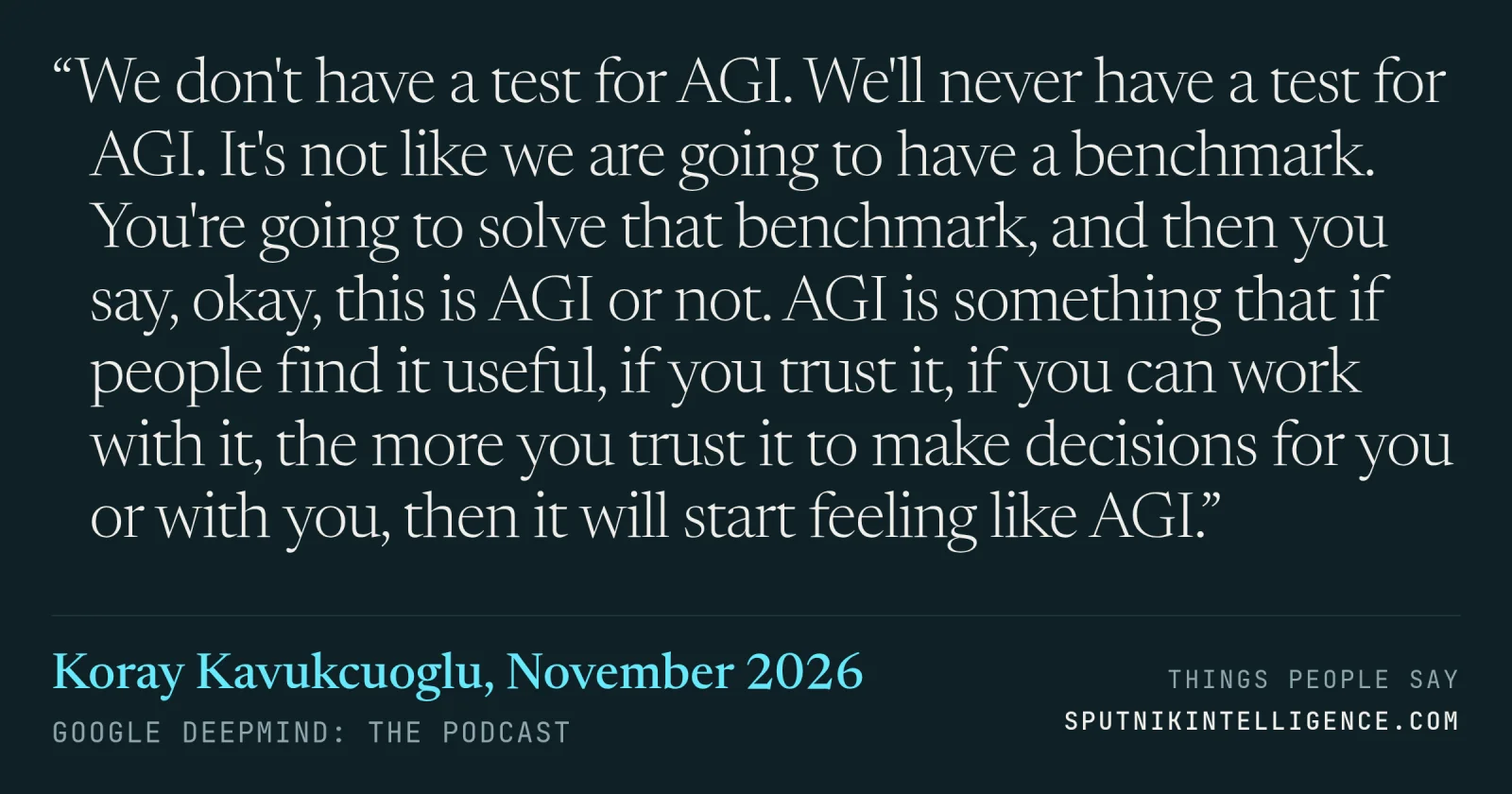
“We don't have a test for AGI. We'll never have a test for AGI. It's not like we are going to have a benchmark. You're going to solve that benchmark, and then you say, okay, this is AGI or not. AGI is something that if people find it useful, if you trust it, if you can work with it, the more you trust it to make decisions for you or with you, then it will start feeling like AGI.”
Google DeepMind: The Podcast · AI Research & Frontier Labs · November 2026
Context
Hannah Fry asked for the strongest version of his argument that products are the route to AGI. He says the AGI goal works as a North Star but doesn't tell you the next step; products do, because they show what people actually trust the model to do.
Transcript
…Obviously, we know that, like, I mean, we all believe that science is the biggest driver of progress and making the models better and better at different scientific domains and then being able to take on and help with research in those different scientific domains. These three all combine together.
You mentioned products there. I really want to ask you about this because I know that you've argued before that products are the route to AGI. Just give me the sort of strongest version of that argument for me.
The strongest version of the argument is we don't have a test for AGI. We'll never have a test for AGI. It's not like we are going to have a benchmark. You're going to solve that benchmark, and then, like, I mean, you say, okay, like, this is AGI or not. Right? Like, AGI is something that if people find it useful, if you trust it, if you can work with it, the more you trust it to make decisions for you or to make decisions with you, then it will start feeling like AGI. Because with that trust, you will afflict a lot of, like, just like you are collaborating with a person, you will affloat a lot of decision-making there. And that implies generality in order to be able to solve problems in the real world, right? And that's where you get with the products. Like, AGI, to me, therefore, is like this sort of thing, I explain it as like the North Star, the goal, yes. But it doesn't give you, as you ask, like, what is the next step you should do? Products give you that. Like, they are sort of like the stones that you go through. And each one of them helps you solve another thing, right? And through those, we really figure out, like, I mean, like, the idea that we can…
Almost like the usefulness of it is part of the definition of what makes it AGI.
Exactly. Like, otherwise, why would you call it intelligence if you know that it's not useful to you at all? Like, how is it intelligent then?
Right, yeah. Start with the application, essentially.
More from Google DeepMind: The Podcast