 Kevin Xu
Founder of Interconnected Capital, Writer of Interconnected newsletter, ex GitHub, Obama White House
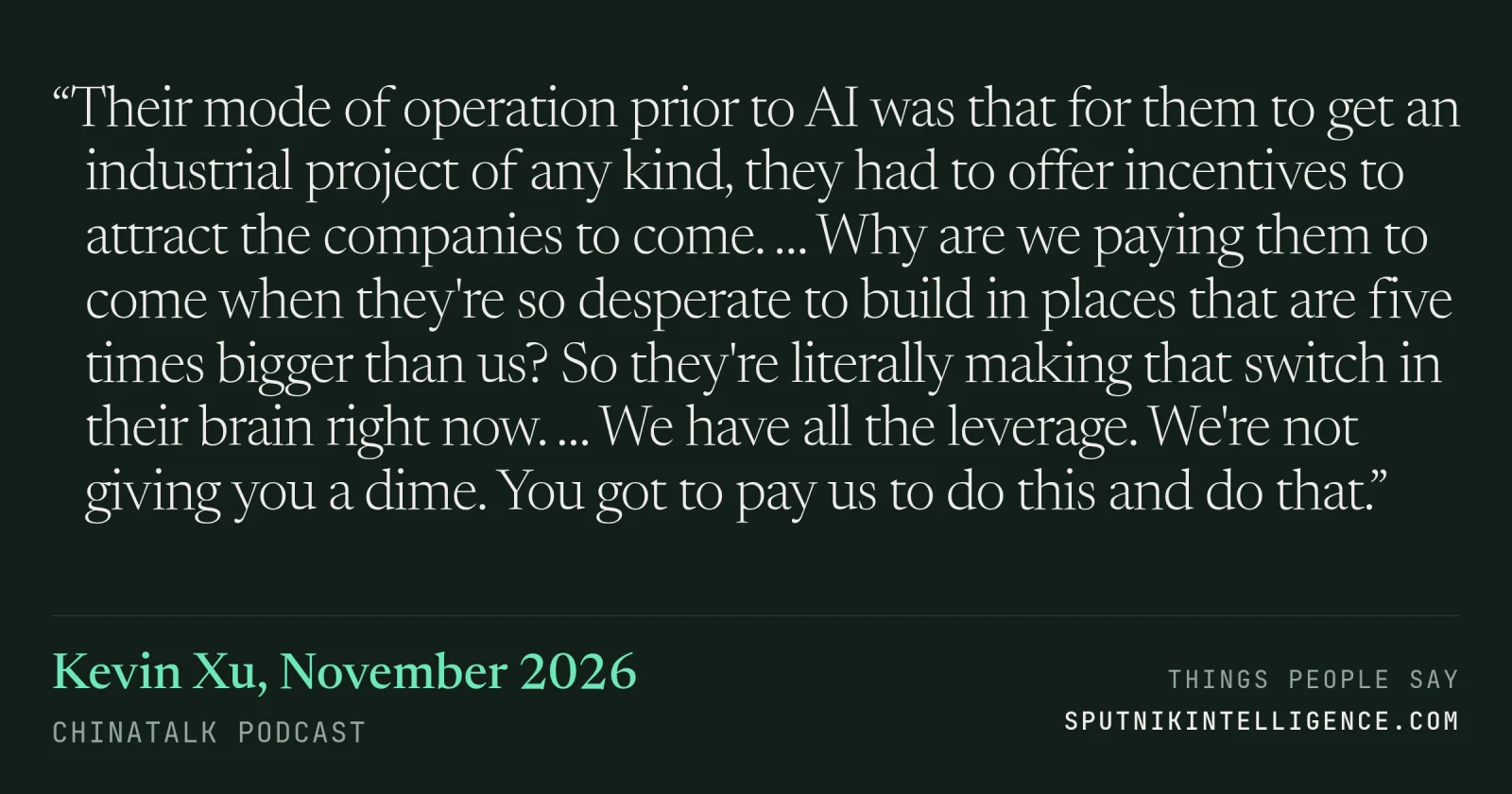
“Their mode of operation prior to AI was that for them to get an industrial project of any kind, they had to offer incentives to attract the companies to come. … Why are we paying them to come when they're so desperate to build in places that are five times bigger than us? So they're literally making that switch in their brain right now. … We have all the leverage. We're not giving you a dime. You got to pay us to do this and do that.”
ChinaTalk · Geopolitics & World Affairs · November 2026
Context
Xu, who tracks local data center moratoriums, describes what small-town officials tell him. The leverage has flipped from towns courting industry to companies needing towns, and big tech has been slow to adapt.
Transcript
…then. I mean, those are sort of data centers that have been built in the past already, but I think it's still sort of instructive of, you know, there is a positive sum outcome here of sharing kind of the surplus gains from building these things. You know, need to make a deal. I mean, I think you,
…it's like going above and beyond just the tax revenue that may not sort of flow in a, in a, um, in a way which is like immediately legible as, oh, AI is doing this to make my life better. You know, the data center is the thing which is driving this improvement in my kids' school or what have you.
Yeah, I think there are actually two interesting mismatches in that dynamic. One is, of course, the big tech just needs to fork up, right? These numbers are literally the rounding error of the rounding error of the entire size of the project they're trying to build here. When it's sweet, how little, yeah, it's like having like two racks of GPU worth of money that could be improving local communities in a very tangible way. Now, I would also say a lot of the local communities, a lot of the cities that are city councils who hold the power, they've been blindsided by this dynamic too. So I got the chance to actually interact with a lot of local city council people because of my dashboard. People like start emailing me, be like, hey, did you get this moratorium? Make sure you include this one in your next dashboard. And I get to like talk to them a little and activists too, which is that, you know, their mode of operation prior to AI was that for them to get an industrial project of any kind, they had to offer incentives to attract the companies to come, right? That is their mode of operation for eternity. So their first reaction is always, okay, please come to us. We're this little town, Wisconsin. We'll give you tax…
So shifting topics a bit, staying on AI and New Democratic Congress, one area where I am quite optimistic on the new Democratic Congress next year is tougher export controls on China. I think we have seen because of the Trump administration's ambivalence around export controls on China and the…
I know that's a favorite
topic of yours, George. So we
More from ChinaTalk