 Dwarkesh Patel
Hosts the Dwarkesh Podcast, a long-form interview show on AI progress, timelines, and the people building frontier models, along with economists and historians.
Dwarkesh Patel
Hosts the Dwarkesh Podcast, a long-form interview show on AI progress, timelines, and the people building frontier models, along with economists and historians.
“We are spending as a society billions, maybe tens of billions of dollars, on building these huge physics experiments. And if you look at maybe the most beautiful, the most important theory of physics ever conjured, it seems like a guy just thinking in a cave — the empirical basis for that theory is maybe just knowing that light has a speed. I mean, maybe you need to measure G experimentally.”
Dwarkesh Podcast · AI Research & Frontier Labs · July 2026
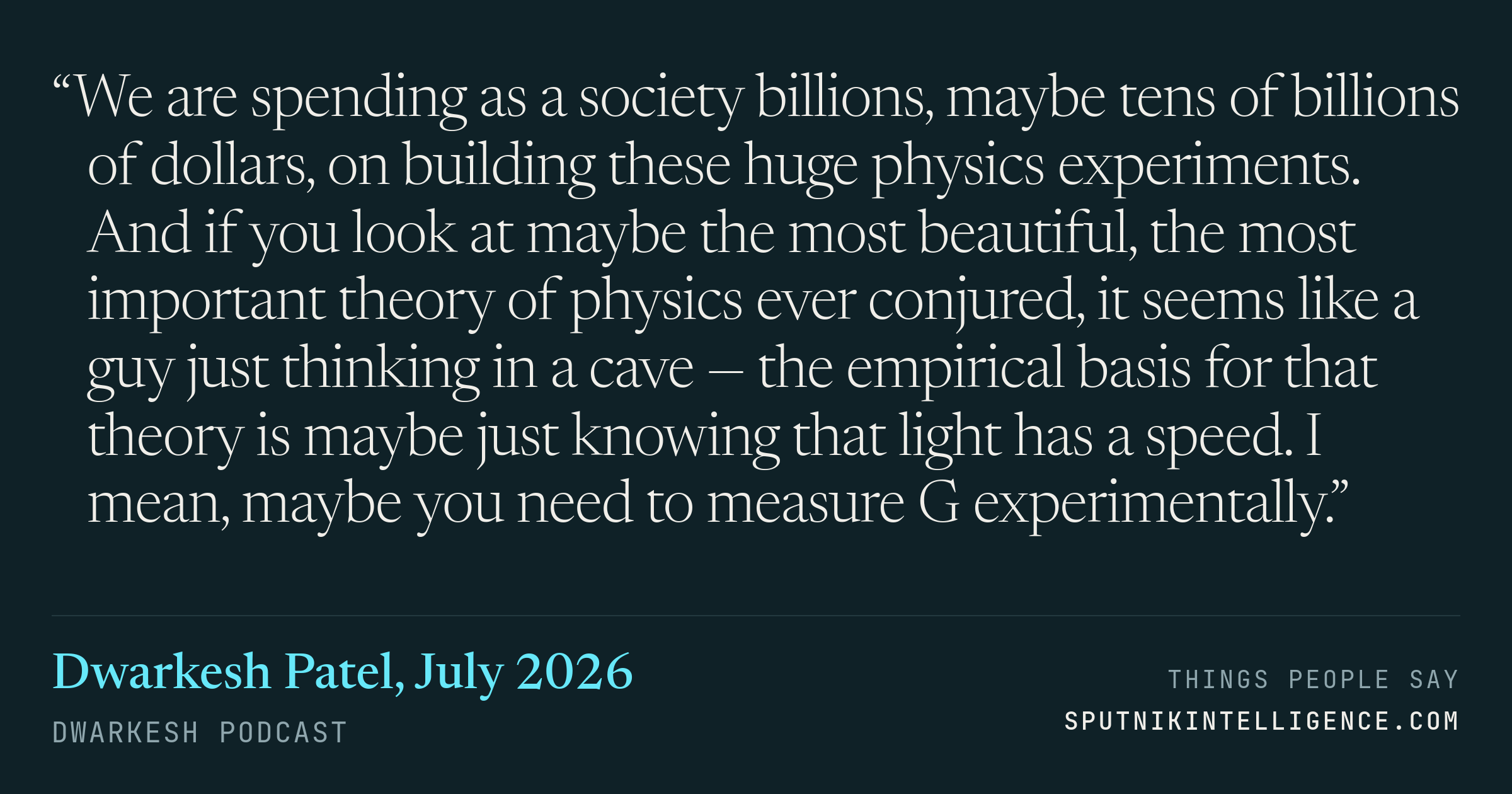
Put to Adam Brown after he walked through how Einstein reached general relativity: the observation that the most celebrated theory in physics required almost no experimental input, at a time when physics is enormously capital-intensive. Brown's correction is that you don't even need to measure G — it's a free parameter in the theory.
Transcript
Can you tell the story of how GR went from a theory that Einstein had to something that the world came to believe is true?
Oh, yeah, that would be the bending of light. So there were known anomalies with Newton's physics beforehand, like we couldn't get the orbit of Mercury exactly right. And one of the very nice early tests of general relativity is that it did get the orbit of Mercury exactly right. So that was a pretty good confirmation. But at the same time, that's not quite so satisfying because it was a number that's already known that you invent a theory and then it correctly predicts. It's considered more impressive if you get the right answer without knowing what the right answer is in advance. And so that would be. bending of light. Certainly historically that was the most influential. So according to general relativity, all energy gravitates and all energy is affected by gravity. And so light as it's passing a massive object like the sun will get bent in the direction of the sun. Actually the same will happen in Newtonian physics. If you just say, suppose you have a particle going along and you know how much it gets bent as it passes the sun, depending on its impact parameter, but also its velocity. And the faster it's going, the less it gets bent. So you just take that Newtonian formula and you plug in velocity equal to speed of light and see what the answer you get at. You get a certain amount of bending through Newtonian physics. And general relativity, you can do the same calculation and you actually get double the Newtonian answer. So this was a big, I mean, the slightly strange history of it. Before he had finished writing down general relativity, Einstein had a prediction based on what he thought was the equivalence principle, you know, based on his understanding of the equivalence principle for what this answer should be. And so he wrote down the answer. And then in response to him and a number of other people being interested in this, there were people sending out expeditions to go and try and measure it. Actually, I think the very first thing that Newton did is he phoned up the observatory and said, you know, can you measure, look at distant stars behind the sun and measure how light bends as it passes the sun? And this was the true theorist move because I think the director of the Mount Wilson Observatory said, like, absolutely, we cannot do that. If you point a telescope at the sun, you'll go blind. If you point it just next to the sun, you'll just get washed out by the corona of the sun. You won't see anything. Except there's one time when you won't get washed out by the sun, and that's during a total solar eclipse when the moon blocks the sun and you're able to see stars very close to the sun and measure the bending of the light behind them. So during the 1910s, there was a whole bunch of expeditions sent to measure the deflection of light. They'd go, you know, park out in the path of totality and look through telescopes at the stars right next to the sun and see if they moved in the sky and if they moved how much they moved. And I think the first one that they did was in 1911. They went to Argentina for an eclipse and then everything set up. I mean, this is the problem with this thing. And then you get there all the way to Argentina, a very long way in those days. And then it's just washed out by the clouds and you don't see anything. And it's very frustrating. And then the next one that went along was there was a German expedition sponsored by the arms manufacturer Krupp, who went to the Crimea and tried to measure it there. And just before the solar eclipse happens, World War I breaks out. And now Germany and Russia are at war and they're all arrested and turned for the rest of the war. And so that also fails. And it actually turns out to be a good thing for Einstein that they all failed, because it turned out that Einstein's original, before he had full general relativity, his original equivalence principle argument was wrong and led him to predict that the bending of light in general relativity would be the same as it was in Newtonian physics. And so during the war, while everything shut down and no one is thinking about eclipse expeditions, he corrects this mistake and comes up with a new prediction that actually will be double the Newtonian prediction. And then in 1919, Sir Arthur Eddington launches a British expedition to go and observe the eclipses all over the world and successfully comes back and declares that indeed it was the Einstein prediction, that it was double the Newtonian prediction. And that's really what launches Einstein as a global celebrity, is that this British experiment confirming a sort of German origin theory was part of the post-war reconciliation and that Einstein had figured out anything. And that is, I'd say, the point at which general relativity became the consensus view and people were super convinced of this very impressive test. Nowadays, we've done huge and more tests than that, very precise orbital dynamics. You can see it in the orbit of Mercury and indeed even in the other planets. You can just measure the redshifting as light as it goes, the gravitational effect on the propagation of light, the energy of light, all over the place. But historically, that was the most impressive confirmation of general relativity.
One question you could ask is we are spending as a society billions, maybe tens of billions of dollars on building these huge physics experiments, basically. And if you look at maybe the most beautiful, the most important theory of physics ever conjured, it seems like a guy who's just thinking in a cave, it seems like the empirical basis for that theory is maybe knowing that light has a speed. I mean, maybe you need to measure G experimentally.
Not really. G is a free parameter in general relativity. It does not... Not required. It's not required. Yeah, so you're right. The empirical basis is pretty thin. You don't need much. And theoretical physicists are pretty cheap. There's a great temptation. Why don't we just spend it all on theoretical physicists and not build these vastly expensive experiments?
Yeah, increasing the demand curve on the theoretical physicist, but yeah.
That's right. Yeah, not so cheap anymore. But how far can that get you? I would say that general relativity is perhaps one extreme of that. That is not how it usually works in the history of physics. This really is closer to some Ayn Rand hero just sitting alone, you know, the product of a single mind. He got lots of help in various ways, but it really was just like a singular vision that he pursued for years. And it was pretty, you know, he wrote it down and a lot of people were very impressed almost immediately. It did require launching a somewhat expensive eclipse expedition to go confirm it before he really achieved global celebrity. And most people were sold on it. But it was, it's perhaps one of the most extreme examples of this, where just somebody just sits down and thinks very hard and writes down a true theory. And in some sense, physics has been chasing that high ever since. People love that romantic vision of themselves just sitting down and thinking with very few empirical insights and just thinking very, very hard and doing thought experiments. And it's typically not worked out quite as well for everybody else as it worked out for Einstein. In fact, it didn't even work out that well for Einstein in the later part of his career. Yeah, how far you could get just by thinking, what do you need to do general relativity? You need the financier of the speed of light. You need to convince yourself not just that the speed of light is finite, but that there's the symmetry that protects that that Einstein came up with in special relativity. Then you probably want the equivalence principle, that the inertial, it's an empirical fact that the inertial masses and the gravitational mass are the same for everything. But that's pretty sparse. And from just those two things, there's still a few options. But if you have lots and lots of large language models, you can just, if there's only a limited number of options, you can just explore the entire tree and say, okay, focus on this, you know, the equivalence principle is something that's super significant. And this other thing, now, okay, now abandon simultaneity and see how far that takes you. So still, there's only a finite number of things to explore there. I don't know how that, how well, I think we got very, very lucky with general relativity that that's quite so powerful under those circumstances. But if you just had lots and lots of Einsteins and you just give each of them various options, you could presumably see them in parallel.
More from Dwarkesh Podcast