 Jesse Cramer
Fee-only fiduciary financial planner who left aerospace engineering, where he worked on space telescopes, to advise clients on retirement planning.
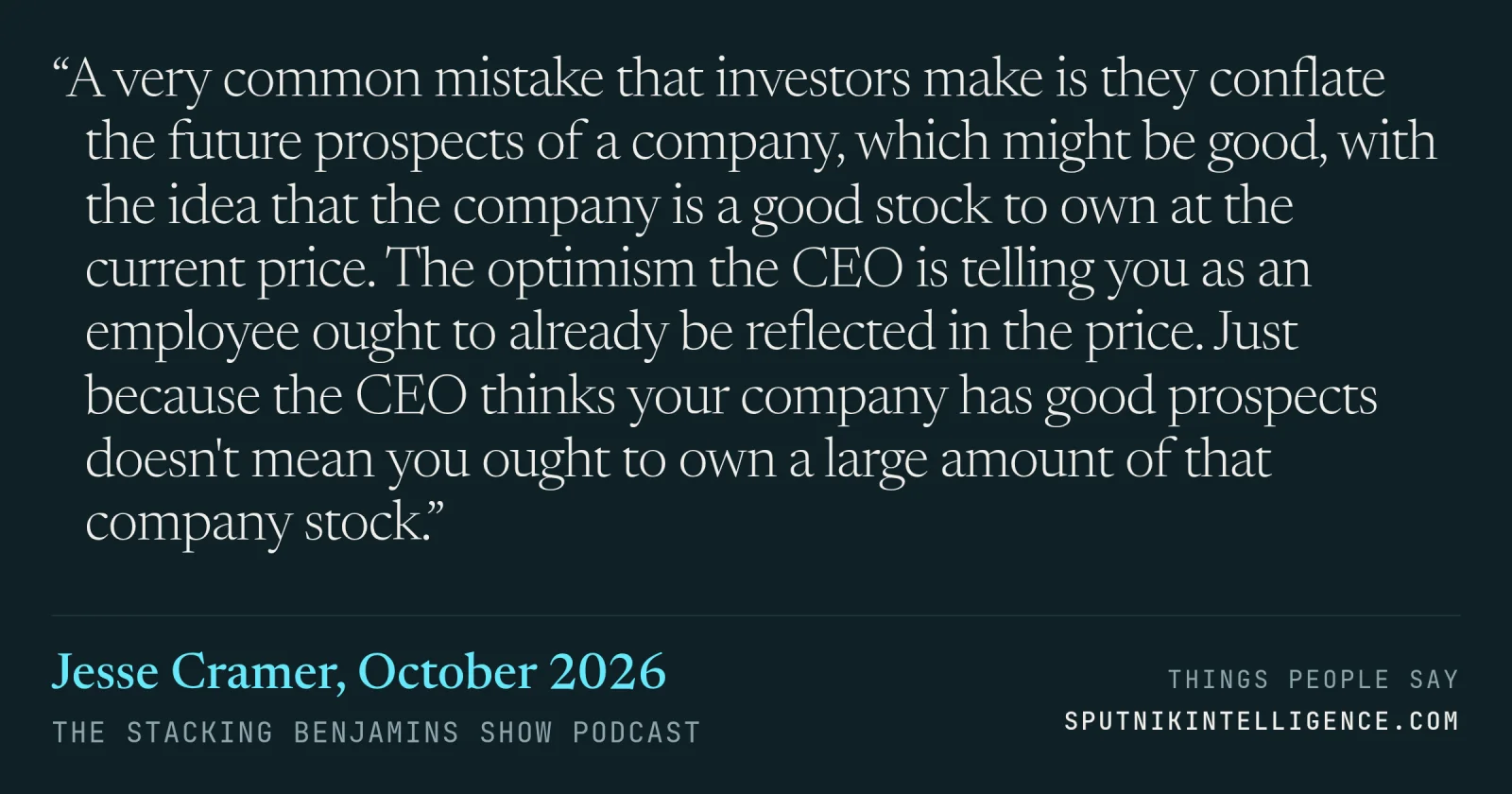
“A very common mistake that investors make is they conflate the future prospects of a company, which might be good, with the idea that the company is a good stock to own at the current price. The optimism the CEO is telling you as an employee ought to already be reflected in the price. Just because the CEO thinks your company has good prospects doesn't mean you ought to own a large amount of that company stock.”
The Stacking Benjamins Show · Money & Markets · October 2026
Context
The panel was debating what to do when employer stock, here an AI company, has grown to a large share of a portfolio. Cramer argues against holding a big position just because the outlook sounds bright.
Transcript
…about the overall industry higher than I would rank optimism about the company specifically. So industry optimism might change my answer or might make me a little bit more prone to holding. But overall, I think the biggest factor is what role does this amount of money play in your own life.
Jesse, let's say it's an AI company right now. Paula talking about the industry. Does that make you more nervous or less nervous?
Probably makes me more nervous if it's an AI company. But on the whole, again, it's this is a publicly traded company. There's an argument to be made that the optimism within the company, the optimism that the CEO is telling to you as an employee, that that optimism ought to be already reflected in the price of the company itself. And I think a very common mistake that investors make is they conflate the future prospects of a company, which might be good, with the idea that the company is a good stock to own at the current price. And those two things aren't always the same. Because really the argument ought to be if the CEO says, hey, things are really, really good. And if you as the employee think, oh, things are really, really good. And also the stock price happens to be vastly undervalued. That's harder to justify the undervalued part. But make a long story short, just because the CEO thinks that your company has good prospects doesn't mean that you ought to own a large amount of that company stock.
Oh, G, I want to finish this discussion with you on scenario number one, this very scary scenario. We have to. Probably not funny when you laugh at your own sound effect, is it? You mentioned selling options. Do you sell options to protect your downside? Do you sell options to maybe squeeze more…
or to bring out some more cash?
Based on the question that you asked earlier about just kind of starting from that thesis of it's 38% and what do we want to do with it? The only risk that you have isn't that it goes up because that would be a good outcome. It's, I guess, by definition volatility, but it's a good volatility. It's…
More from The Stacking Benjamins Show