 Andy Yen
Runs Proton, an encrypted-email and privacy company, and argues on Uncanny Valley | WIRED that privacy-minded users object to companies misusing data, not to AI...
Andy Yen
Runs Proton, an encrypted-email and privacy company, and argues on Uncanny Valley | WIRED that privacy-minded users object to companies misusing data, not to AI...
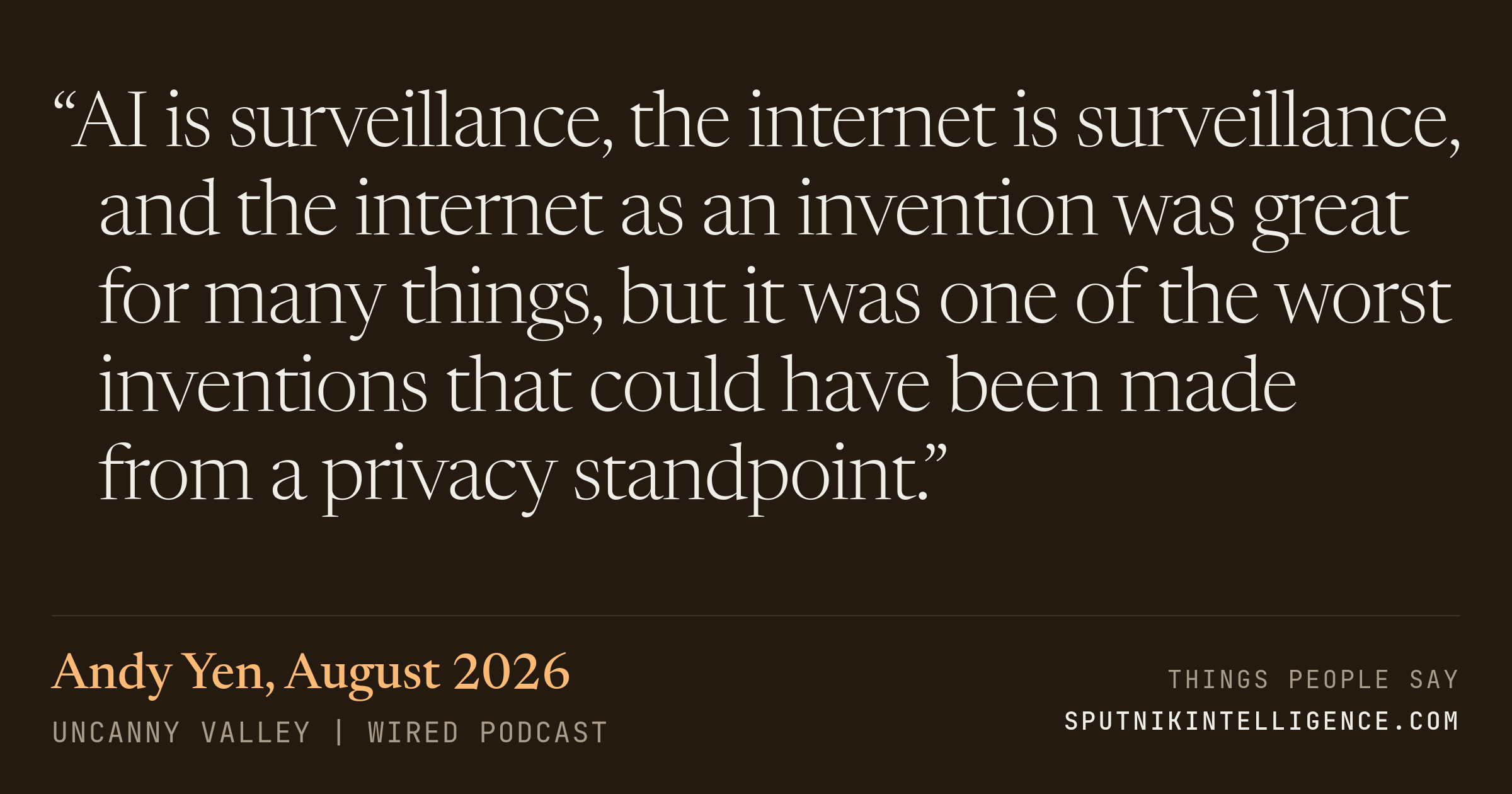
“AI is surveillance, the internet is surveillance, and the internet as an invention was great for many things, but it was one of the worst inventions that could have been made from a privacy standpoint.”
Uncanny Valley | WIRED · August 2026
Andy Yen runs Proton, an encrypted-email and privacy company that has also started shipping its own AI features. Explaining why he thinks privacy companies can't just sit AI out, he puts AI in the same bucket as the internet itself: transformative, and terrible for privacy.
Transcript
Well, it's a Freeman business model. So, actually, most of them use it for free, but the typical conversion rates that you see for Freeman business models are usually between 1% and 3%. And Proton sits in that bucket as well.
Okay, okay. Well, you mentioned a couple of these kind of landmarks and the history of surveillance capitalism, starting with Snowden. The one that I'm honestly hearing about the most myself today, like the reason that more people are asking me about Proton anecdotally than any other is AI. Like, people keep asking me, my own family, among my friends, if they should switch to Proton, and they're asking because they're sick of having AI pushed on them in Gmail in particular. Are you capitalizing on this kind of perhaps AI backlash, this resistance to AI that is making people think about their privacy?
We are capitalizing on it, and we're making it easier than ever now to switch. So, for example, now there's an easy switch tool on Proton where you can basically bring all your emails from Google automatically and get everything put into Proton in just a couple of clicks. But my take on this trend is actually a little bit more nuanced. AI is surveillance, the internet is surveillance, and the internet as an invention was great for many things, but it was one of the worst inventions that could have been made from a privacy standpoint. We have lost our privacy to a large extent because of the creation of the internet and all that enables. And that's something that we have to come to terms with. And if I look at AI, I think it's kind of the same thing. The genie is out of the bottle. We're not going to put it back in. And we are not going to be returning to a pre-AI world. If we accept that as a fact, the key question becomes: who do we want to have as the future stewards and controllers of this new future that we're all stepping into today? And the options are: number one, it can be the gigantic tech companies of the world who have done everything possible in the last two decades to prove that they cannot be trusted for their data. Or maybe it can be some other independent tech companies with different business models. So, the reason Proton actually is also building AI features and building AI tools is because I think if the privacy companies do not find a way to step in to build privacy-first AI, we are essentially ceding the future to tech companies that don't have the best interests of users at heart. And this is what happened in the late 90s, early 2000s, when we let Google, Meta, Yahoo, these other companies take over the entire space. So, our push in the AI is really to try to avoid a repeat of that mistake that was made several decades back. We think it's important to actually be present there.
Well, it's a yeah, I guess the question is: well, are you in fact excited about AI?
Yeah, if I were to describe Proton's stance, I would say we were reluctantly pulled in, but we saw the writing on the wall. And once we came to the conclusion that AI was here to stay, it was unavoidable if we are to fulfill our mission that we also enter the space to provide an alternative. I would probably prefer a world where AI didn't exist, but it's here.
Interesting. Well, do your users agree?
More from Uncanny Valley | WIRED