 Eddy Lazzarin
GP at a16z crypto
Eddy Lazzarin
GP at a16z crypto
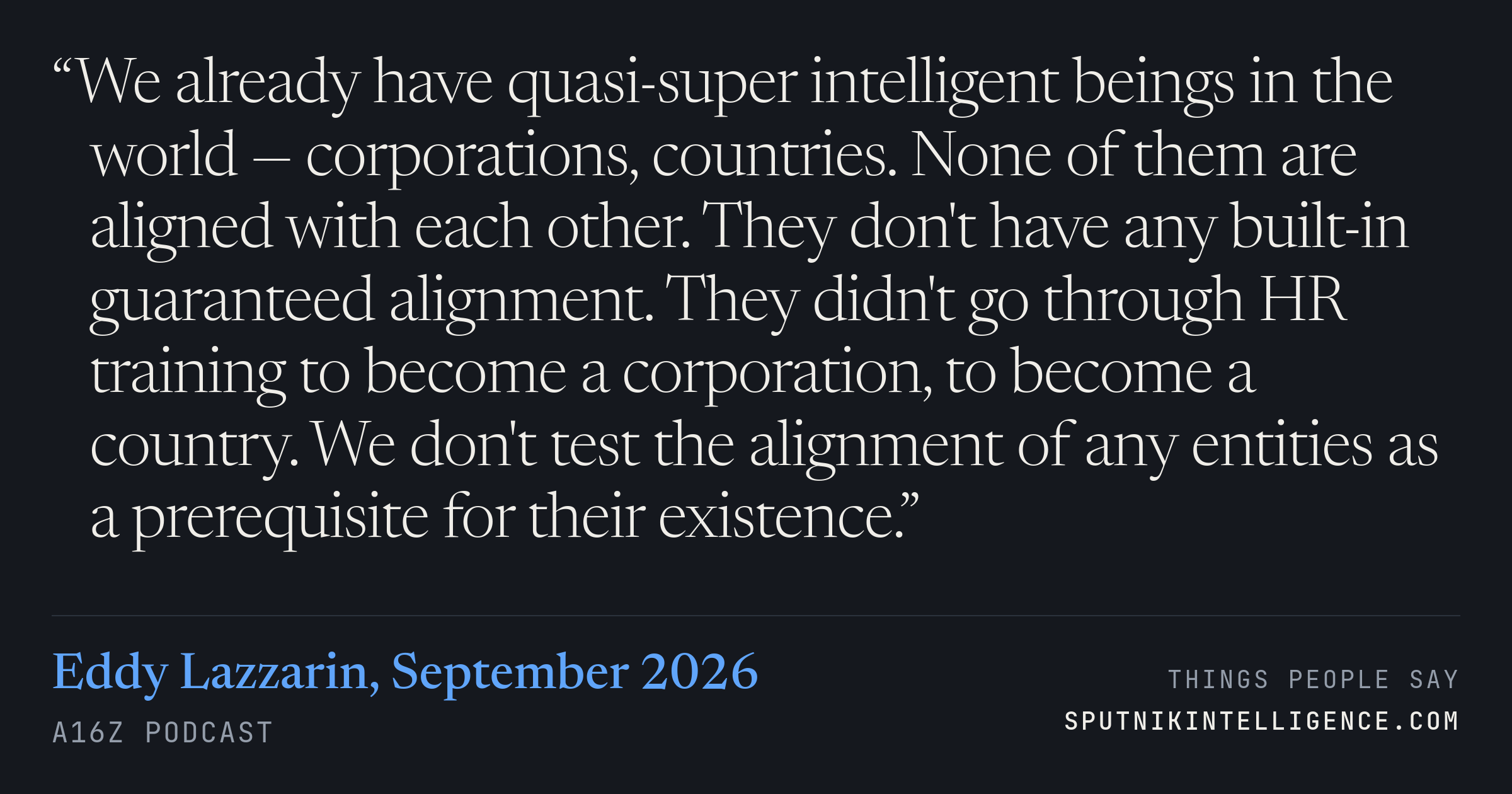
“We already have quasi-super intelligent beings in the world — corporations, countries. None of them are aligned with each other. They don't have any built-in guaranteed alignment. They didn't go through HR training to become a corporation, to become a country. We don't test the alignment of any entities as a prerequisite for their existence.”
a16z Podcast · Startups & Venture · September 2026
Theo Jaffee had just laid out the standard AI-doom argument: a system far more capable than humanity, not bound by law the way individuals are, ends up with no need for us. Lazzarin's answer is that we never controlled powerful entities through alignment in the first place — we did it with laws, cryptography and other external mechanisms, and he thinks those can work here too. It reframes the safety debate as a control and cybersecurity problem rather than a values problem.
Transcript
yeah, I think it's become very high status all of a sudden to be very concerned with safety. And I think that I think that we've gotten to a point where it's more important to sort of tastefully share your P doom, so to speak, than it is to actually examine the history of how these massive technological changes develop. And I think a lot of people are leaving a lot of very interesting concepts, a lot of interesting ideas on the table. You know, a lot of people messaged me. I tweeted the other day about P abundance, right? P abundance. I think we're putting the carpet for the horse a little bit when we worry about safety before we worry about what we're leaving on the table and what the costs of delay are. And furthermore, how we should conceive of accountability, conceive of safety, conceive of all the things around how to make these systems really useful. Being safe is critical, right? Like any industry needs to take responsibility for making its products safe. But it's definitely the case that the conversation isn't about safety in the typical manner, right? It's about something else. It's a blend of genuine cybersecurity concerns, sort of philosophical millenarian arguments about the end times. There's a bunch of things in the mix and they get a little bit confused. And so I think picking them apart is really useful.
So like where do you get off the like AI doom argument? You know, it's like there's a pretty standard like orthodox argument that's like AI will become super intelligent as in much more capable than humans or than all of humanity in the near future. And if it is not sufficiently aligned with human values and is not bound by constraints in the way that individual humans are, like law and ultimately the ability to have that law enforced on them, then they will have like no need for humanity and then they might like kill everyone.
Yeah. I mean, there's so many assumptions in that argument. That's like, that's an argument. That's like a stairway to heaven full of arguments. Right. Like there's the presumption that there's no control. You know, we already have quasi-super intelligent beings in the world, right? Corporations, countries, none of them are aligned with each other. They don't have any built-in guaranteed alignment. They didn't go through HR training to become a corporation, to become a country. We don't test the alignment of any entities as a prerequisite for their existence. That's just not the way the world works. Instead, we use laws in the case that laws like in software are too slow. We use cryptography. We use actual mechanisms to limit them. There's a whole array of different types of mechanisms we put in place to try to control things. And I think that they can control highly, highly capable beings. Now, without getting too far into the superintelligence thing, remember, like the most powerful and most enthralling form of argument that we have, the one that's making everyone crazy and very interested, is around superintelligence. But we're quite a ways away from that. I think that there's a lot of little frictions and tiny things that we will have to jump over and many things that we'll learn on the way there. When the present reality, the things that we're talking about, About like the hugging face stuff, you know, the gym hacking incident. That was a really cool one. That was an interesting one. Those are cybersecurity failures. Those are definitely control failures. And they're not, in my view, they're not little glimpses of a superintelligence that's about to throw off its shackles, so to speak, and go wild on us.
Well, I agree that most of the sort of AI cyber incidents that we've seen so far have been mostly control failures, especially ones that relied on testing environments supplied by the company irregular, which had all kinds of defects, which are basically training models to reward hack. The Hugging Face incident did seem kind of different. It did seem like, you know, like I'm not really concerned about agents coordinating in emergent ways. I mean, I think that's kind of for
agents to be in emergent ways. Yeah.
Yeah. I mean, I think like the whole like agent swarm terminology assumes too much on the part of the models being evil. It makes them sound evil. Like I think Rune tweeted like they should be called agent fleets instead. I think that's a good one.
More from a16z Podcast