 Misha Laskin
On Masters of Scale
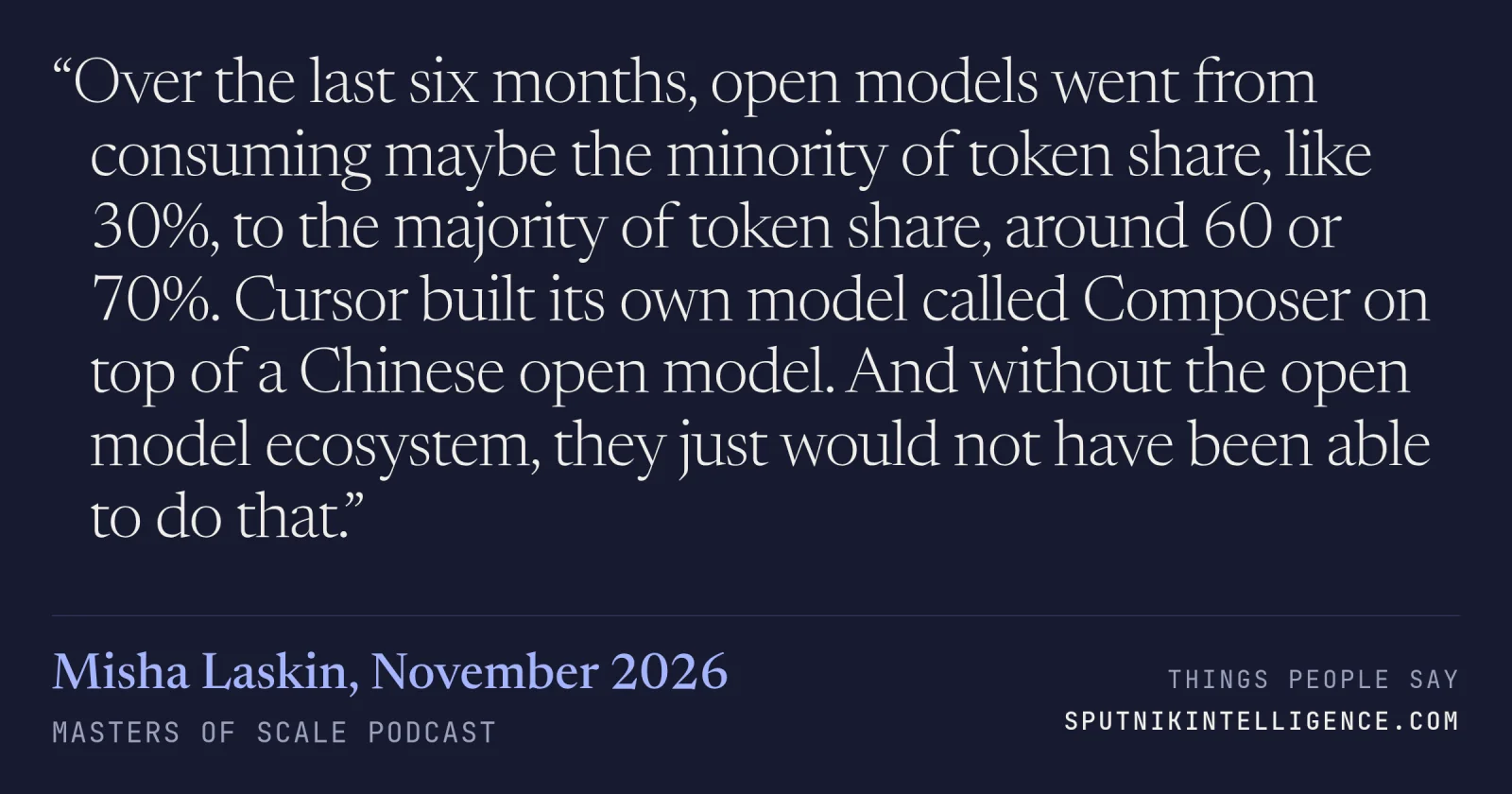
“Over the last six months, open models went from consuming maybe the minority of token share, like 30%, to the majority of token share, around 60 or 70%. Cursor built its own model called Composer on top of a Chinese open model. And without the open model ecosystem, they just would not have been able to do that.”
Masters of Scale · Startups & Venture · November 2026
Context
The host asked about the national security case for American open models when global customers may pick cheaper Chinese ones. Laskin answers with his own token-share figures and uses Cursor as an example of a company built on an open model.
Transcript
go to the less expensive open models, which is what's been happening for a lot of the Chinese businesses,
right?
That's right. So, right, over the last six months, open models went from consuming maybe the minority of token share, like 30%, to the majority of token share, around 60 or 70%. If you're a startup and you want to take models and drive down the cost and increase performance for the proprietary data that you're collecting, let's say you're a coding startup, right? There is a cursor built its own model called Composer on top of a Chinese open model. And without the open model ecosystem, they just would not have been able to do that. So the fact that they were able to do that is a great thing. And you ultimately want to offer customers choice, right? It's not just one open model. It should be a garden of models that they can use.
And Cursor is built on a Chinese open model. That doesn't necessarily mean that their business is susceptible to influence from China or that China has access to their data just because they built it on a Chinese model.
If you're using DeepSeq's API, let's say, then you're definitely sending data to China, right? But if you are downloading the model and running it on your infrastructure, then you're not sending data to China. I think that there is a worry about the models in the future, in the near future, having…
And how do you get paid as an open model?
More from Masters of Scale