 Koray Kavukcuoglu
SVP of Google DeepMind and Chief AI Architect at Google, running the organization day to day and overseeing Gemini model development, frontier AI research, and...
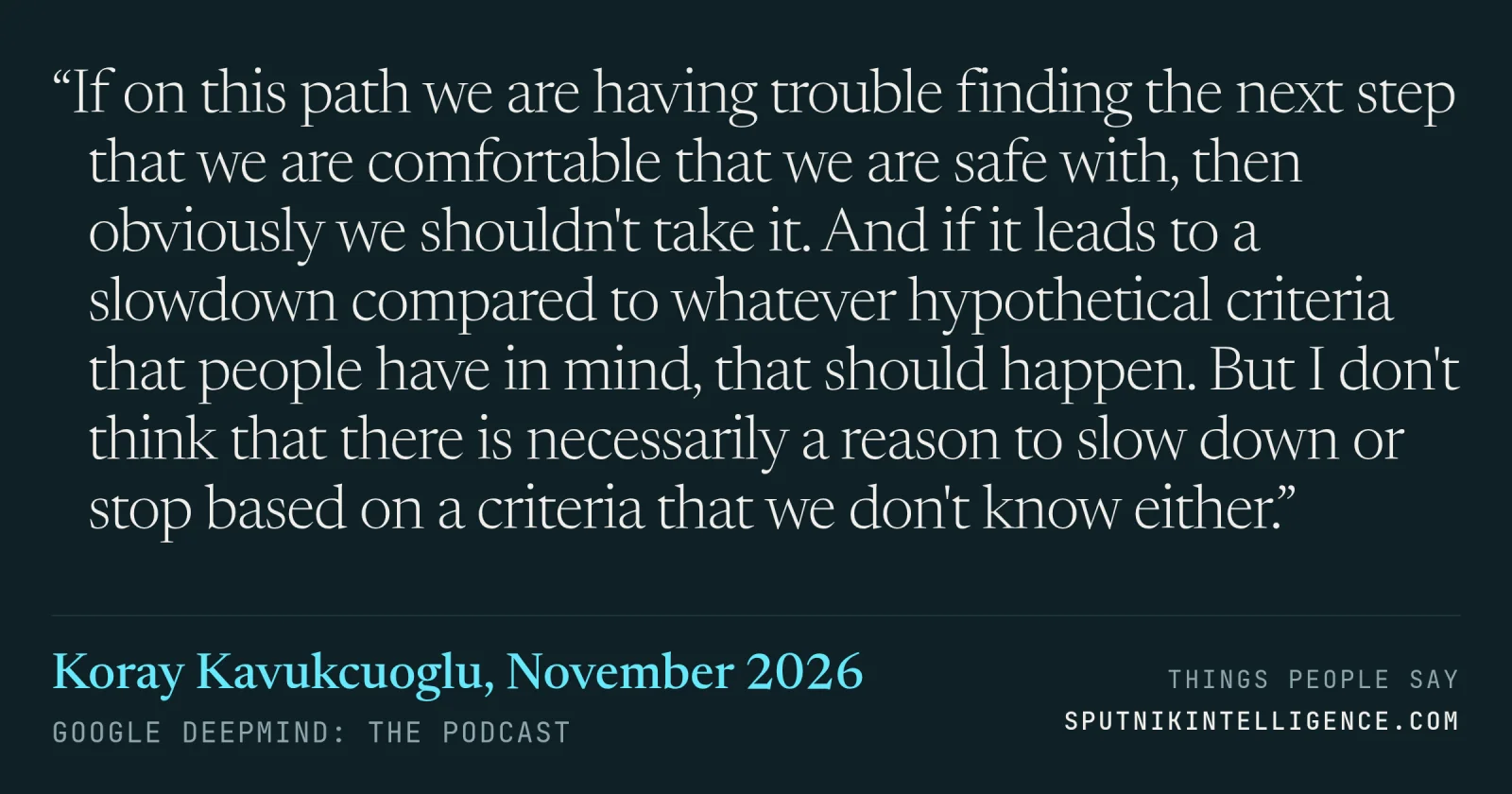
“If on this path we are having trouble finding the next step that we are comfortable that we are safe with, then obviously we shouldn't take it. And if it leads to a slowdown compared to whatever hypothetical criteria that people have in mind, that should happen. But I don't think that there is necessarily a reason to slow down or stop based on a criteria that we don't know either.”
Google DeepMind: The Podcast · AI Research & Frontier Labs · November 2026
Context
Fry asked about recent calls for labs to slow down. His answer is conditional: slow down when safety demands it, not on vague criteria.
Transcript
…make sure that the model follows what the user wants. So, like, yes, it is harder, but the fact that I'm doing this across a large population means that I can actually understand the true way that I can get the model to tune for whatever user wants. Like, and everyone wants something else. There's
been a lot of talk recently about this idea that the labs should slow down their research. What's your take on all of it?
I think my take on it is: if on this path we are having trouble finding the next step, that is the step that we are comfortable that we are safe with, then obviously we shouldn't take. And if it leads to a slowdown compared to whatever hypothetical criteria that people have in mind, that should happen. But I don't think that there is necessarily a reason to slow down or stop based on a criteria that we don't know either. Every lab, I can speak for our lab, that we should be building technologies that we know that we can release to the world and that it's a safe technology to use. We have to be clear about the side effects of those. We have to be clear about the risks of using these. That is why we are very careful about researching the mitigations for the model, that making sure that the alignment is there, making sure that the model doesn't do things that we think are clearly unsafe. We work with experts outside of the company to give them the models so that they understand the capabilities and they can help research both the safety aspect, but also use it in their domains to understand the impacts of the models. So, all this machinery is there in a way. Like if…
Because the thing is, I mean, I think that you've proven over and over again that safety is really genuinely something that you care about very deeply.
Yes.
I think that there's this fear, I suppose, in the general public that more generally, across the board, it might get to a point where it's difficult to make a sort of independent safety decision when ultimately the labs are in a race with one another. Are you getting that sense from people?
More from Google DeepMind: The Podcast