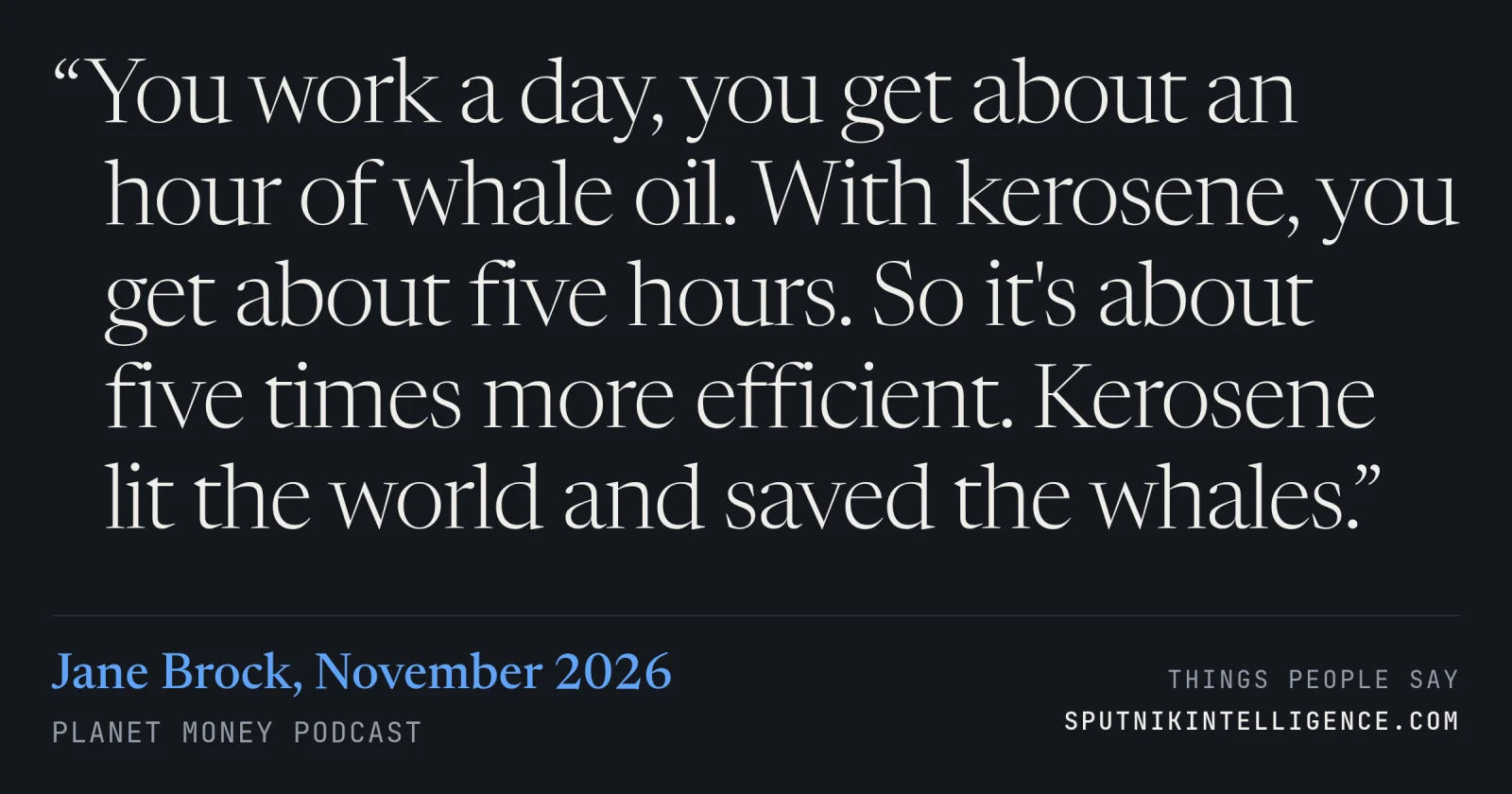
“You work a day, you get about an hour of whale oil. With kerosene, you get about five hours. So it's about five times more efficient. Kerosene lit the world and saved the whales.”
Planet Money · Money & Markets · November 2026
Context
The hosts were explaining that kerosene, discovered around 1850, was the first real leap in cheap light. A historian of artificial light gives the comparison with whale oil in hours of light per day's wages.
Transcript
This big breakthrough, kerosene. Not cutting edge now, but back
then, Jane Brock says kerosene was a huge deal. When the first kerosene lamps came out, it was, as one historian said, it was the kind of oil people had dreamed about for centuries. It was brighter, it was cleaner, and importantly, it was much cheaper.
You work a day, you get about an hour of whale oil. Kerosene, you get about five hours. Whoa. So it's about five times more efficient. Kerosene lit the world and save the whales.
So if kerosene was so great, why did it take the world so long to find it? Science. This idea of professional scientists, this idea that there are lots of people who go to work every day at universities and do experiments. In the 1800s, this is still a new thing. If
you happen to be president of Yale University, this is around the time when you're thinking, you know, maybe we should get one of those science departments.
Why weren't they doing those experiments a century earlier? Well, Yale didn't have scientists a century earlier. They were teaching Greek and they were teaching logic.
More from Planet Money