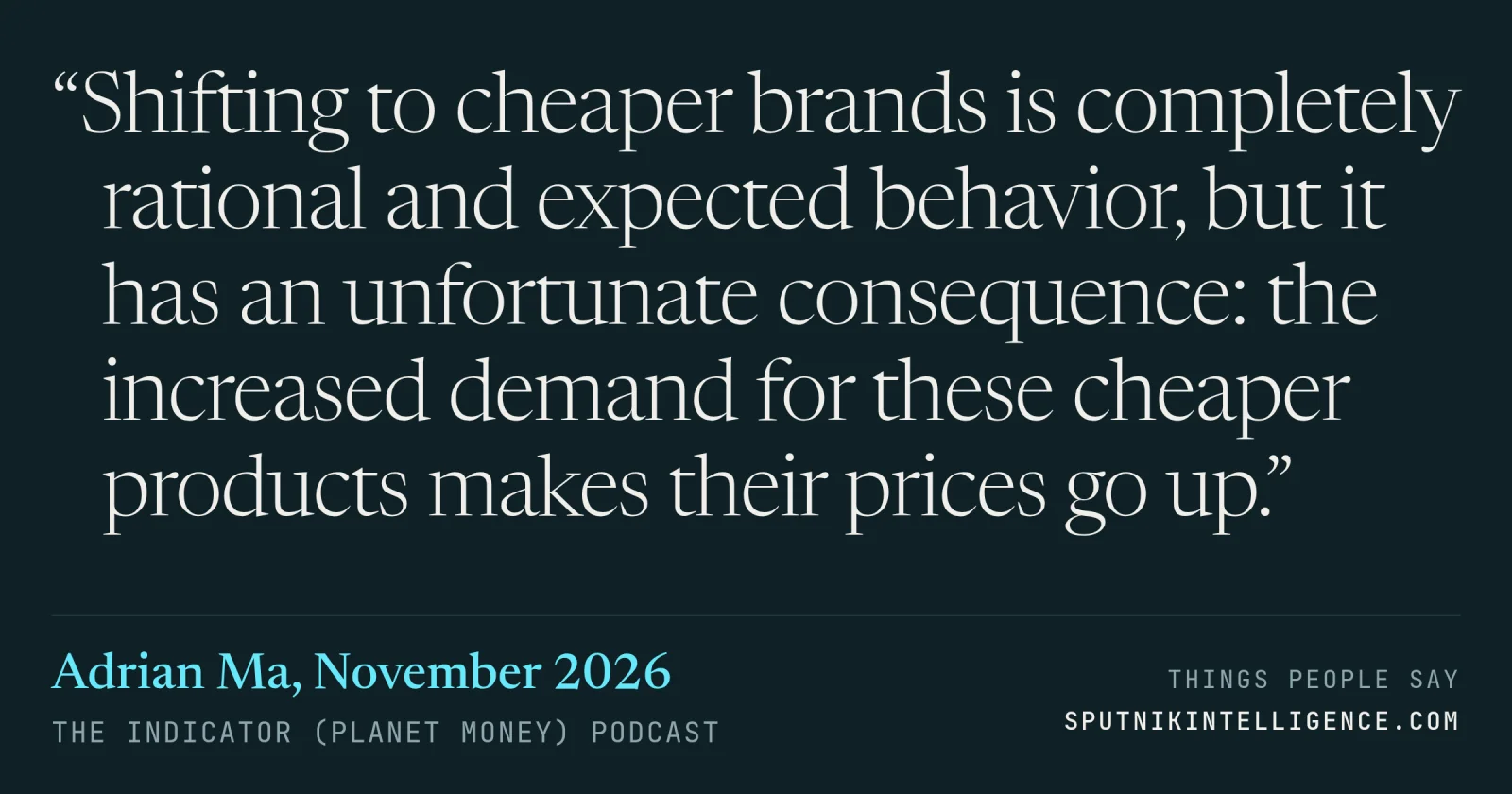
“Shifting to cheaper brands is completely rational and expected behavior, but it has an unfortunate consequence: the increased demand for these cheaper products makes their prices go up.”
The Indicator (Planet Money) · Money & Markets · November 2026
Context
Explaining "cheapflation": during the inflation surge, shoppers traded down to store brands, and that extra demand pushed up the prices of the cheapest goods, hitting low-income households hardest.
Transcript
Alberto and his colleague named this phenomenon cheapflation, and they introduced it to the world in a 2024 paper. Alberto says you can think about both shoppers and companies playing a role in cheapflation.
…During an inflation surge, like what we saw during COVID, many people will shift their spending to cheaper brands. Like instead of the Haage-Daws pint of ice cream, they're getting the Tub of Breyers frozen dairy dessert. Instead of the cage-free, free-range eggs, they'll get the store-brand eggs.
This is completely rational and expected behavior, but it has an unfortunate consequence, which is that the increased demand for these cheaper products makes their prices go up.
And Alberto says this dynamic is especially hard for low-income shoppers. They are likely already buying the cheapest variety of bread or jarred marinara sauce.
So they end up facing all these new people that buy the same goods and make that inflation or the cheaper varieties rise faster.
That is the shift in consumer behavior that contributes to cheapflation. Now let's look at what happens with the companies that make these products. Alberto says profit margins are often slim for less expensive stuff. And that's because companies are pricing their products low to be more…
More from The Indicator (Planet Money)